  What's New! Detailed Sitemap All images © by Roberto Piperno, owner of the domain. Write to romapip@quipo.it. Text edited by Rosamie Moore. Page revised in November 2009. |
  Santa Maura (Lefkada)
Key dates: 1362 - 1477 Duchy of Santa Maura (Leucade); it was ruled by the Del Tocco family. 1477 - 1684 Part of the Ottoman Empire (1500-01 temporary Venetian occupation). 1684 - 1797 Venetian possession (1715-16 temporary occupation by the Ottomans). 1797 - 1810 Occupied by the French, then by the Russians, then by the French again and finally by the British.
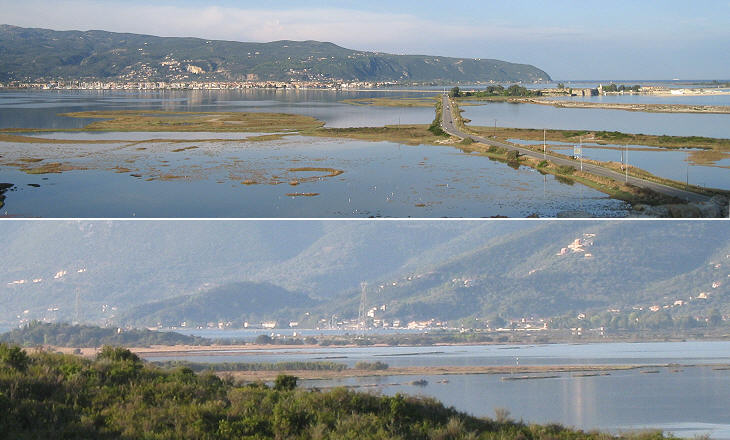
The northern tip of the island of Santa Maura (today Lefkada) is situated very close to the mainland to which it is linked by a long strip of sand which forms a large lagoon.
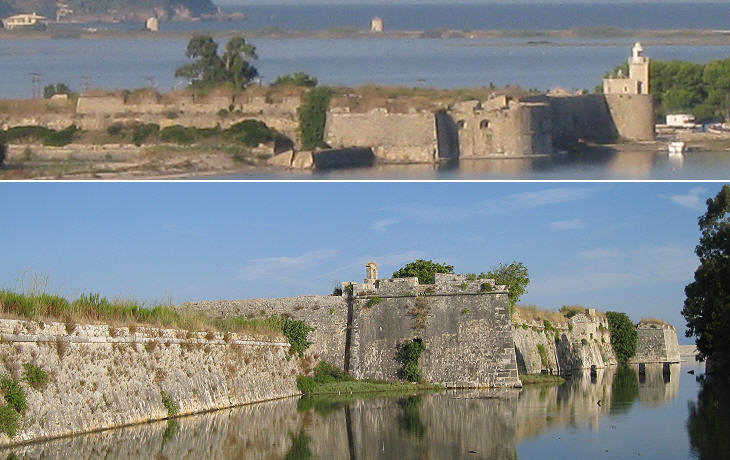
A medieval fortress was built on the strip of sand to protect a canal which allowed ships to enter the lagoon.
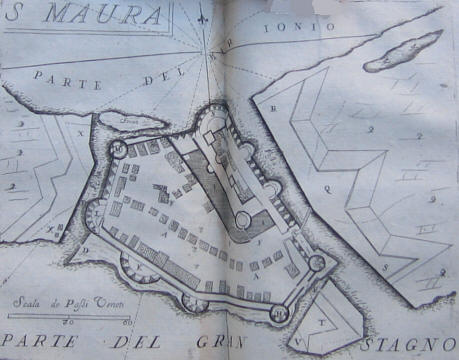
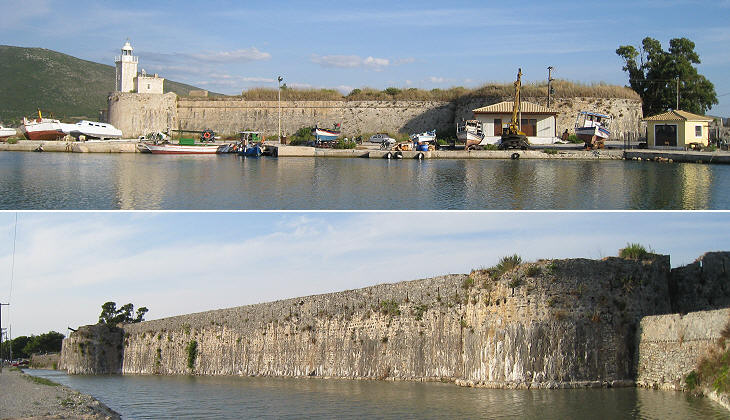
The fortress was modified by the Ottomans and later on by the Venetians; the latter in particular provided it with a large number of cannon which were capable of greatly damaging a hostile fleet.
The walls of the fortress are low, because the Venetians did not want them to be an easy target for the enemy's cannon. They strengthened in a traditional way only the eastern side of the fortress which faced the mainland.
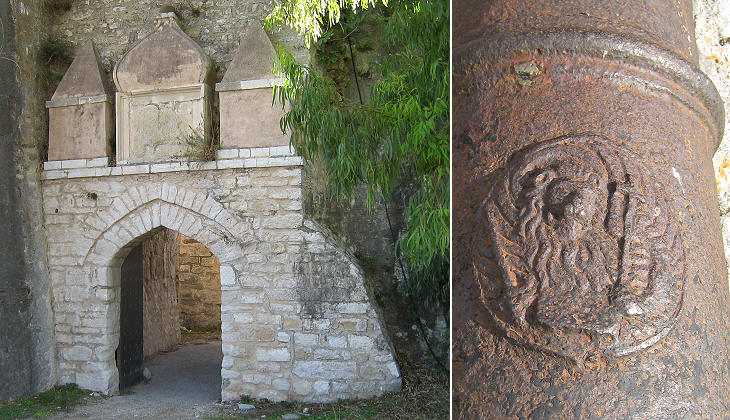
The main entrance to the fortress shows elements of an Ottoman design; the Venetians placed a winged lion above the gate, but now it is barely visible (the image used as background for this page shows a modern winged lion placed by Greek authorities on the external walls of the fortress). A winged lion can still be seen on a cannon.
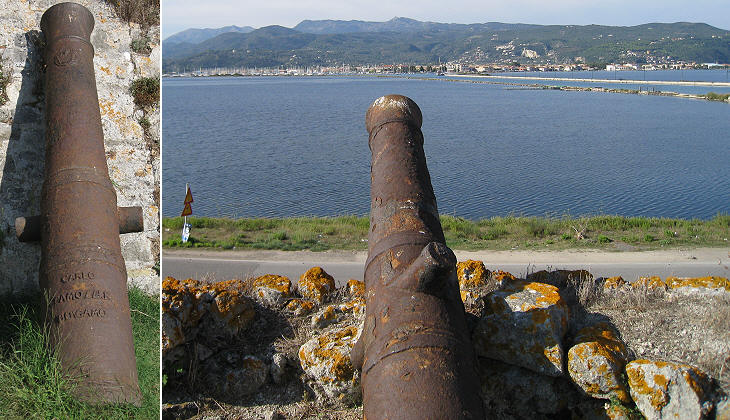
Inside the fortress there is a cannon upon which the name of the manufacturer can still be read (Carlo Camozzi from Bergamo, a town near Milan which was a Venetian possession). The foundry was located in the village of Clanezzo (you may wish to see it in an external link).
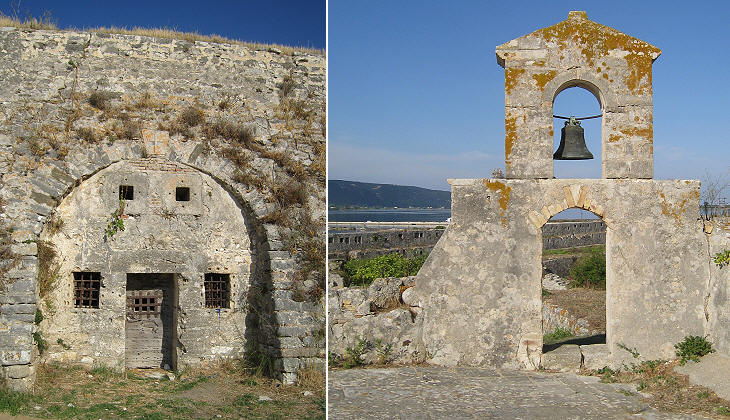
The Venetians acquired Santa Maura in 1684 and they decided to build a new town on the other side of the lagoon; the population of the island increased after the 1718 Peace of Passarowitz because Venice relocated people from its former possessions in Candia and Morea to Santa Maura. The fortress continued to house a small civilian population as the Diary of Charles Bush Hearn testifies: "Today (June 25, 1849) we came to the famous 500 year-old fortress, Santa Maura. Its bulky and mighty walls dominate the entrance to Lefkada Island. A lagoon surrounds the fortress. These waters are rich in plant life as well as native and migratory birds. Behind the fortress, beyond the lagoon, lays the major town of the island, Levkas. The strong walls of the fortress are earthquake proof. They have withstood the tremors over the past five centuries resulting from fortification techniques of ancient times. There are three sides to the fort with seven gun positions which are placed at seven points where the walls jut out. There are special rooms called "ammunition magazines" where ammunition is stored. The fortress is livable too. There is a model city within: houses, schools, offices and a hospital. Underground there are tanks, called "cisterns," for storing rainwater. During the past 39 years of the British Protectorate, all facilities have been modernized." In 1888 most of the buildings inside the fortress were destroyed by a fire caused by the explosion of a munitions depot.
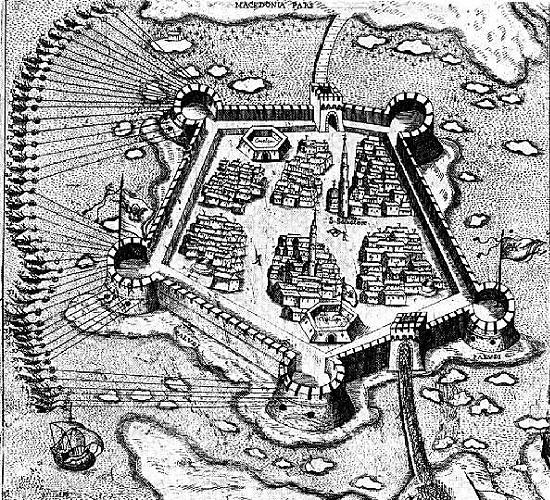
The engraving shows the Venetians defending Santa Maura; in 1715 however they preferred to abandon the island to concentrate their forces on the defence of Corfu. In 1716, after the Ottomans had failed to conquer that island, the Venetians managed to return to Santa Maura.
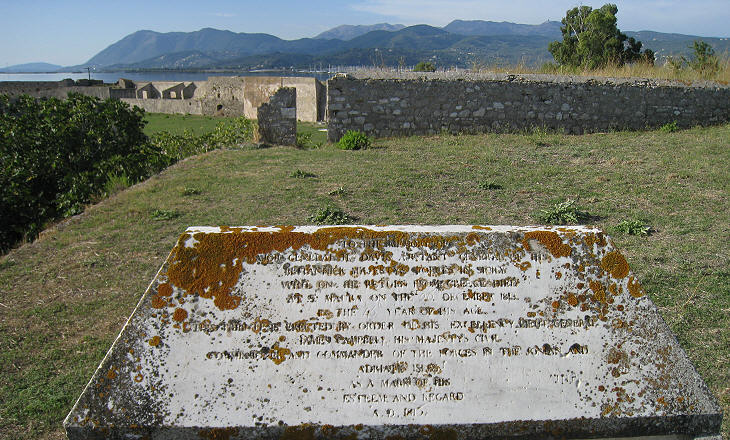
TO THE MEMORY OF MAJOR GENERAL H(ENRY) DAVIS, A(D)JUTANT GENERAL OF HIS BRITANNIC MAJESTY’S FORCES IN SICILY WHO ON HIS RETURN FROM GREECE DIED AT S(AN)TA MAURA ON THE 26TH DECEMBER 1813 IN THE 45TH YEAR OF HIS AGE. THIS TRIBUTE IS ERECTED BY ORDER OF HIS EXCELLENCY LIEUT. GENERAL JAMES CAMPBELL HIS MAJESTY’S CIVIL COMMISSIONER AND COMMANDER OF THE FORCES IN THE JONIAN AND ADRIATIC ISLES AS A MARK OF HIS ESTEEM AND REGARD A(NNO) D(OMINI) 1815. Move to page two: other defences of the lagoon, Ottoman fortifications and XVIIIth century churches Excerpts from Memorie Istoriografiche del Regno della Morea Riacquistato dall'armi della Sereniss. Repubblica di Venezia printed in Venice in 1692 and related to this page:
Introductory page on the Venetian Fortresses Pages of this section: On the Ionian Islands: Corfù (Kerkyra) Paxo (Paxi) Santa Maura (Lefkadas) Cefalonia (Kephallonia) Asso (Assos) Itaca (Ithaki) Zante (Zachintos) Cerigo (Kythera) On the mainland: Butrinto (Butrint) Parga Preveza and Azio (Aktion) Vonizza (Vonitsa) Lepanto (Nafpaktos) Atene (Athens) On Morea: Castel di Morea (Rio), Castel di Rumelia (Antirio) and Patrasso (Patra) Castel Tornese (Hlemoutsi) and Glarenza Navarino (Pilo) and Calamata Modon (Methoni) Corone (Koroni) Braccio di Maina, Zarnata, Passavà and Chielefà Mistrà Corinto (Korinthos) Argo (Argos) Napoli di Romania (Nafplio) Malvasia (Monemvassia) On the Aegean Sea: Negroponte (Chalki) Castelrosso (Karistos) Oreo Lemno (Limnos) Schiatto (Skiathos) Scopello (Skopelos) Alonisso Schiro (Skyros) Andro (Andros) Tino (Tinos) Micono (Mykonos) Siro (Syros) Egina (Aegina) Spezzia (Spetse) Paris (Paros) Antiparis (Andiparos) Nasso (Naxos) Serifo (Serifos) Sifno (Syphnos) Milo (Milos) Argentiera (Kimolos) Santorino (Thira) Folegandro (Folegandros) Stampalia (Astipalea) Candia (Kriti) You may refresh your knowledge of the history of Venice in the Levant by reading an abstract from the History of Venice by Thomas Salmon, published in 1754. The Italian text is accompanied by an English summary. Clickable Map of the Ionian and Aegean Seas with links to the Venetian fortresses and to other locations (opens in a separate window) |