  What's New! Detailed Sitemap All images © by Roberto Piperno, owner of the domain. Write to romapip@quipo.it. Text edited by Rosamie Moore. Page added in June 2005. |
 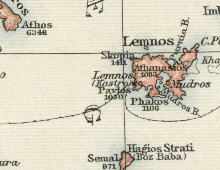 Lemno (Limnos) Lemno (Limnos)
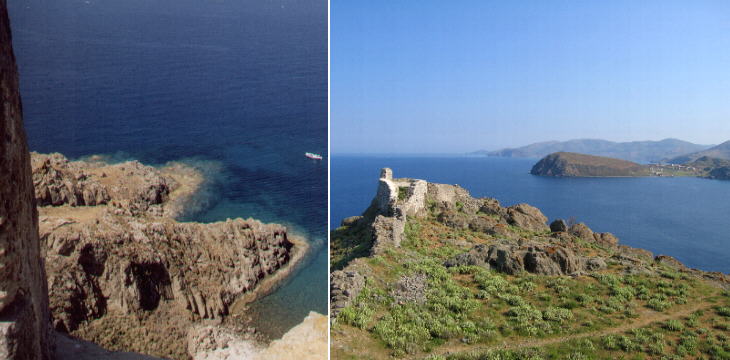
Key dates: 1208 The Venetians occupy Lemno: they keep the island in the following centuries although both Byzantines and Genoese seize it for short periods. 1476 The Ottomans make an attempt to seize the island; they fail but three years later they are successful. 1652; 1656-57; 1698 The Venetians briefly occupy the island to use it as a base to threaten Constantinople. Lemno is a volcanic island located in the northern part of the Aegean Sea. Its many bays and coves provided safe harbours to the Venetian convoys en route from Negroponte to Constantinople.
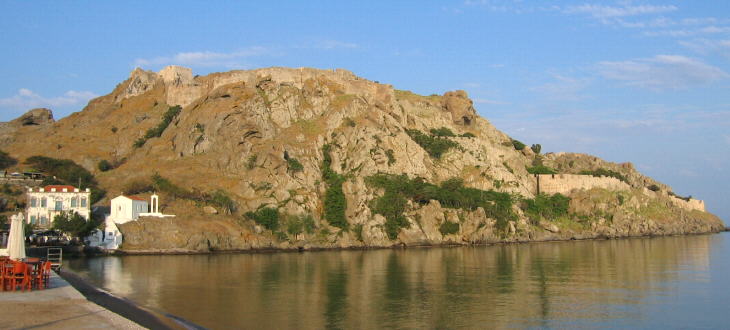
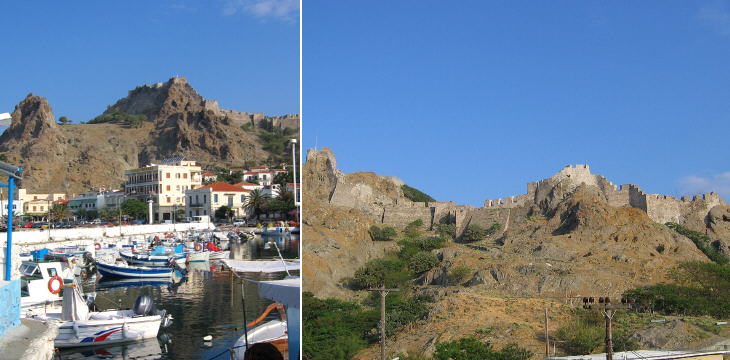
Myrina, on the western coast of the island, is the main town of Lemno. It was named after the sea-goddess Myrine, who was worshipped in the gynocratic island: according to Robert Graves' The Greek Myths: "The Lemnian men had quarreled with their wives, complaining that they stank, and made concubines of Thracian girls captured on raids. In revenge the Lemnian women murdered them all without pity, old and young alike, except King Thoas, whose life his daughter Hypsipyle secretly spared, setting him adrift in an oarless boat. One year later Argo, the ship of Jason and his Argonauts, hove in sight of the island: the Lemnian women mistook her for an enemy ship from Thrace; they donned their dead husbands' armour and ran boldly shore ward, to repel the threatened attack. The eloquent Echion, Jason's herald, soon set their minds at rest; and Hypsipyle called a council at which she proposed to send a gift of food and wine to the Argonauts, but not to admit them into her city of Myrine, for fear of being charged with the massacre. Polyxo, Hypsipyle's aged nurse, then rose to plead that, without men, the Lemnian race must presently become extinct. 'The wisest course', she said, 'would be to offer yourselves in love to those well-born adventurers, and thus not only place our island under strong protection, but breed a new and stalwart stock.' This disinterested advice was loudly acclaimed, and the Argonauts were welcomed to Myrine. Each adventurer was surrounded by numerous young women, all itching to bed with him. Hypsipyle claimed Jason for herself, and royally entertained him; it was then that he begot Euneus, who eventually became King of Lemnos. Many children were begotten on this occasion by the other Argonauts too and, had it not been for Heracles, who was guarding the Argo and at last strode angrily into Myrine, beating upon the house doors with his club and summoning his comrades back to duty, it is unlikely that the golden fleece would ever have left Colchis." A rock projecting into the sea protects two natural harbours: Romeikos Gialos and the smaller Tourkikos Gialos; most likely the names refer to the fact that the large Venetian convoys used to cast anchor in the large northern bay, while the more protected southern cove was preferred during the Ottoman rule. The town is on the isthmus between the two harbours.
The outer walls of the old fortress have been recently restored (and in part rebuilt) to provide a very evocative background to the view of the small, otherwise uninteresting town.
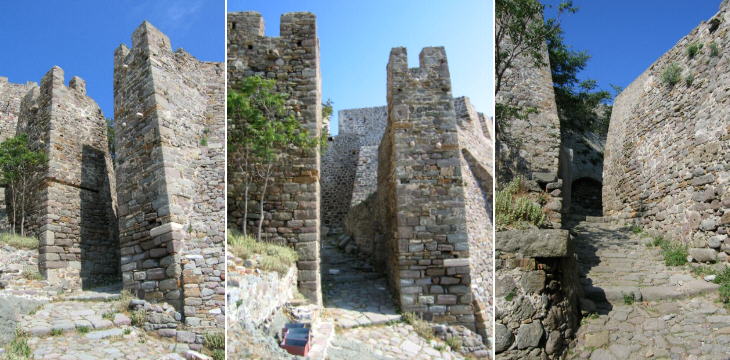
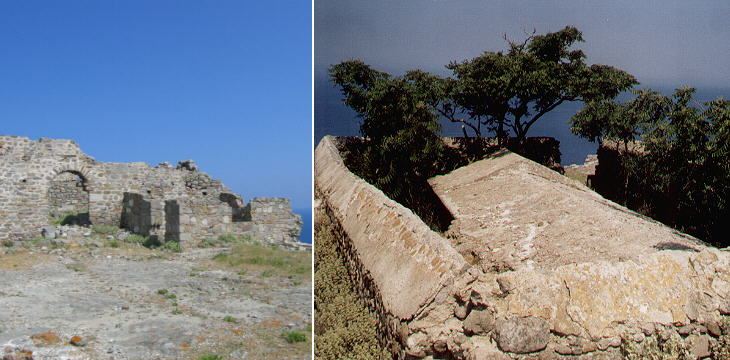
The walls of the fortress were never "upgraded" to the requirements of artillery warfare so they provide a good example of medieval defence techniques. The entrance is hidden between two towers and beyond the gate a double turn of the street made life difficult for the assailants.
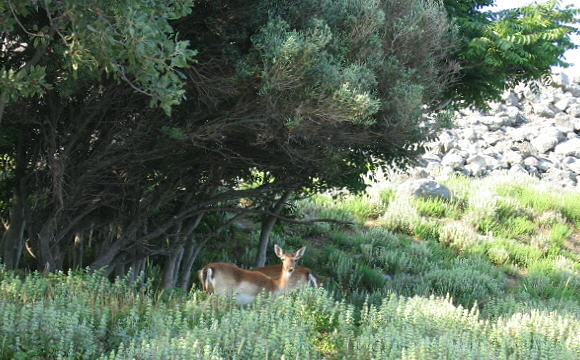
The access to the fortress is not controlled by a custodian; usually one finds in these abandoned sites stray dogs or goats, so it is a pleasant surprise to discover that a few shy deer are the only inhabitants of the fortress.
The fortress was built on the site of a very ancient acropolis: archaeologists have found here and in other sites of the island traces of very peculiar rites: the large number of oil lamps found during the excavations have led the archaeologists to believe religious ceremonies took place at night. Maybe it was at sunset when, in the period close to the summer solstice, the gigantic dark shape of Mount Athos, invisible during the day, suddenly makes its appearance when the sun goes down behind it. Thus the ancient inhabitants of Myrina knew that they were not alone in the world.
A few walls scattered in the vast area within the outer walls and openings in the ground leading to a net of tunnels give only a vague idea of how the interior of the fortress was structured. The only building which has retained its structure is a powder-house: to minimize the impact of explosions it was built below ground level and it was surrounded by thick walls.
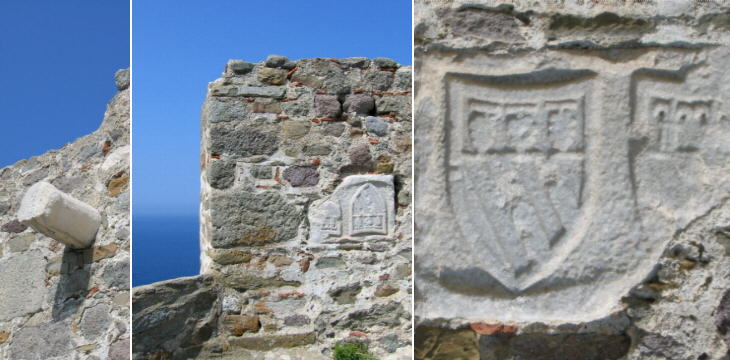
Here and there a broken marble column shows up on the walls of the fortress: nothing else seems to be left of the temples, the churches, the mosques built on the site nor of the residence of the governors of the island. The only reward following a careful search is a relief in a newly rebuilt wall. It has been carelessly walled upside down and only by flipping vertically the image one understands that it shows two XVIIth century Venetian coats of arms: the broken one belonged to the Querini, once the lords of Stampalia. Introductory page on the Venetian Fortresses Pages of this section: On the Ionian Islands: Corfù (Kerkyra) Paxo (Paxi) Santa Maura (Lefkadas) Cefalonia (Kephallonia) Asso (Assos) Itaca (Ithaki) Zante (Zachintos) Cerigo (Kythera) On the mainland: Butrinto (Butrint) Parga Preveza and Azio (Aktion) Vonizza (Vonitsa) Lepanto (Nafpaktos) Atene (Athens) On Morea: Castel di Morea (Rio), Castel di Rumelia (Antirio) and Patrasso (Patra) Castel Tornese (Hlemoutsi) and Glarenza Navarino (Pilo) and Calamata Modon (Methoni) Corone (Koroni) Braccio di Maina, Zarnata, Passavà and Chielefà Mistrà Corinto (Korinthos) Argo (Argos) Napoli di Romania (Nafplio) Malvasia (Monemvassia) On the Aegean Sea: Negroponte (Chalki) Castelrosso (Karistos) Oreo Lemno (Limnos) Schiatto (Skiathos) Scopello (Skopelos) Alonisso Schiro (Skyros) Andro (Andros) Tino (Tinos) Micono (Mykonos) Siro (Syros) Egina (Aegina) Spezzia (Spetse) Paris (Paros) Antiparis (Andiparos) Nasso (Naxos) Serifo (Serifos) Sifno (Syphnos) Milo (Milos) Argentiera (Kimolos) Santorino (Thira) Folegandro (Folegandros) Stampalia (Astipalea) Candia (Kriti) You may refresh your knowledge of the history of Venice in the Levant by reading an abstract from the History of Venice by Thomas Salmon, published in 1754. The Italian text is accompanied by an English summary. Clickable Map of the Ionian and Aegean Seas with links to the Venetian fortresses and to other locations (opens in a separate window) |