  What's New! Detailed Sitemap All images © by Roberto Piperno, owner of the domain. Write to romapip@quipo.it. Text edited by Rosamie Moore. Page added in July 2007. |
  Butrinto (Butrint) Butrinto (Butrint)
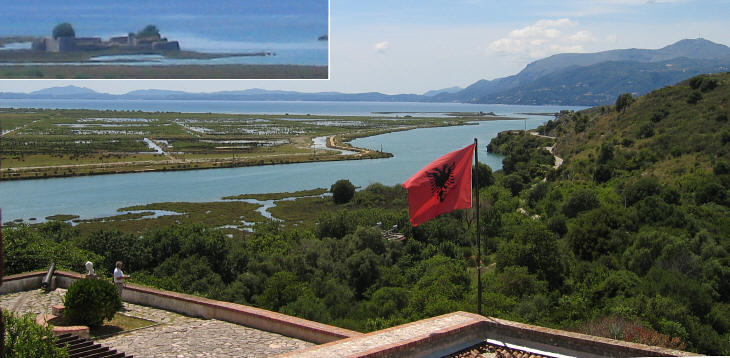
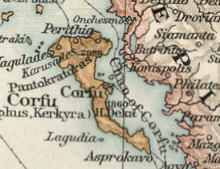
Butintrò or Butrinto owes its name to the ancient town of Bouthroton (Greek)/Buthrotum (Latin), but the site was inhabited from prehistoric times. This because it was located on a very narrow canal linking a lake with the Ionian Sea: the lake (which has limited depth) was an easy source of fish: the access to the open sea favoured trade towards nearby Corfù.
Between the Xth and the early XVth centuries Byzantines, Normans, Angevins, Bulgarians and Venetians took turns in occupying Butintrò which was regarded as a strategic location from which it was possible to attack Corfu. In 1959, during a visit to the archaeological site, Nikita Khrushchev, First Secretary of the Soviet Union Communist Party, considered using the Lake of Butrint as a base for nuclear submarines, but shortly after the visit Albania broke ties with the Soviet Union and the project was abandoned.
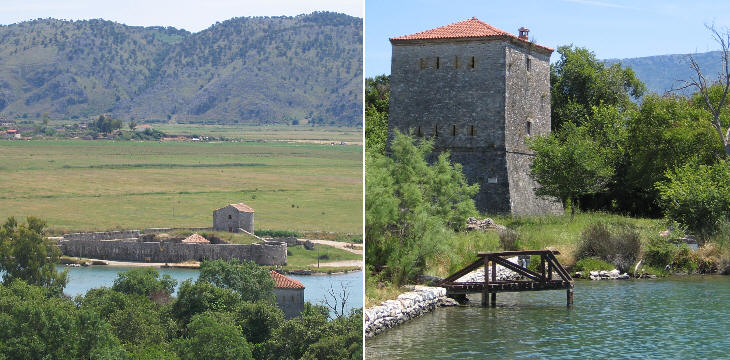
The Venetians built a small fortress on the site of the ancient acropolis, but later on moved their fortifications to the entrance of the canal (on the lake side). This presumably because the garrison was in charge of levying a duty on the fish shipped to Corfu and the new location was more practical.
The Venetian possession of Butintrò was not without interruptions, but in 1718 the Peace of Passarowitz formally certified that the site including the lake belonged to the Republic. Venice fell in 1797 and Ali Pacha of Tepeleni, who ruled over most of southern Albania and Epirus (north-western Greece), took the opportunity to occupy Butintrò. He built a small fortress at the other entrance of the canal.
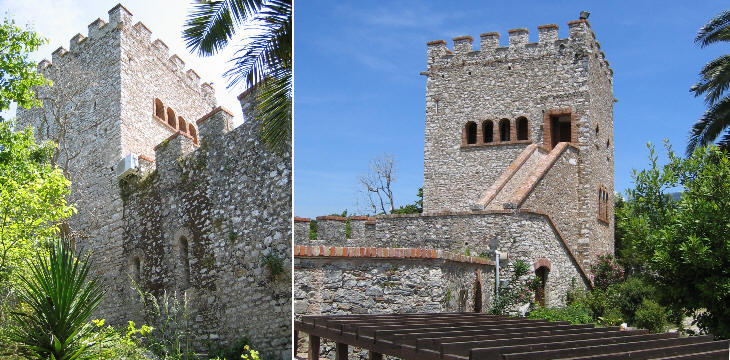
In the 1920s an Italian archaeological mission excavated the site at the foot of the hill and brought to light significant remains of the ancient town. On this occasion the crumbling Venetian castle at the top of the hill was almost entirely rebuilt to serve as lodging and shelter for statues and reliefs. It now houses a small museum.
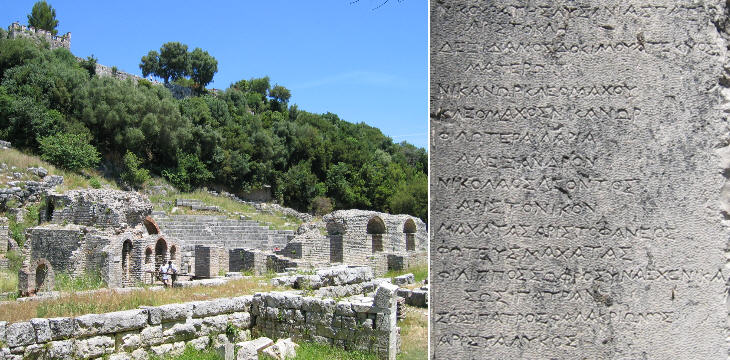
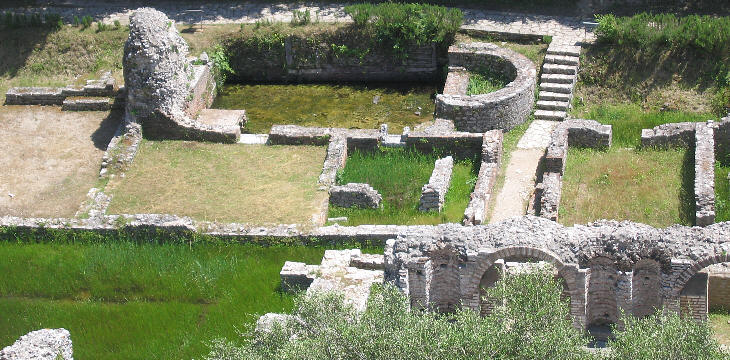
In 1992 Butrint was added to the UNESCO World Heritage List, the first Albanian site to be named to the list. The Roman town had baths, an aqueduct and a theatre: this is a well preserved monument and next to it there is a very interesting "Inscription Wall". Experts have concluded that the many names quoted in the inscriptions refer to manumitted slaves and their owners. Manumissions (releases from slavery) usually had the objective to celebrate some events or to encourage the colonization of an area by liberti (freemen).
The image in the background of this page shows a detail of a mosaic in a church of ancient Buthrotum. Introductory page on the Venetian Fortresses Pages of this section: On the Ionian Islands: Corfù (Kerkyra) Paxo (Paxi) Santa Maura (Lefkadas) Cefalonia (Kephallonia) Asso (Assos) Itaca (Ithaki) Zante (Zachintos) Cerigo (Kythera) On the mainland: Butrinto (Butrint) Parga Preveza and Azio (Aktion) Vonizza (Vonitsa) Lepanto (Nafpaktos) Atene (Athens) On Morea: Castel di Morea (Rio), Castel di Rumelia (Antirio) and Patrasso (Patra) Castel Tornese (Hlemoutsi) and Glarenza Navarino (Pilo) and Calamata Modon (Methoni) Corone (Koroni) Braccio di Maina, Zarnata, Passavà and Chielefà Mistrà Corinto (Korinthos) Argo (Argos) Napoli di Romania (Nafplio) Malvasia (Monemvassia) On the Aegean Sea: Negroponte (Chalki) Castelrosso (Karistos) Oreo Lemno (Limnos) Schiatto (Skiathos) Scopello (Skopelos) Alonisso Schiro (Skyros) Andro (Andros) Tino (Tinos) Micono (Mykonos) Siro (Syros) Egina (Aegina) Spezzia (Spetse) Paris (Paros) Antiparis (Andiparos) Nasso (Naxos) Serifo (Serifos) Sifno (Syphnos) Milo (Milos) Argentiera (Kimolos) Santorino (Thira) Folegandro (Folegandros) Stampalia (Astipalea) Candia (Kriti) You may refresh your knowledge of the history of Venice in the Levant by reading an abstract from the History of Venice by Thomas Salmon, published in 1754. The Italian text is accompanied by an English summary. Clickable Map of the Ionian and Aegean Seas with links to the Venetian fortresses and to other locations (opens in a separate window) |