  What's New! Detailed Sitemap All images © by Roberto Piperno, owner of the domain. Write to romapip@quipo.it. Text edited by Rosamie Moore. Page added in December 2005. |
 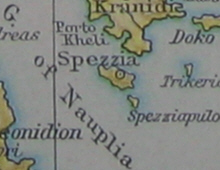 Spezzia (Spetse) Spezzia (Spetse)
Key dates: (due to the lack of historical records some dates are based on evidence related to nearby Egina and Napoli di Romania) : XIVth century: Venice acquires the island which in ancient times was called Pitiousa: the island is renamed Spezzie or Spezzia, maybe a reference to spezie (spices) 1540: the island is ceded to the Ottomans 1687: the Venetians reoccupy Spezzia 1715: Spetse returns into Ottoman hands. The island of Spetse is located just a few miles off the coast of Morea (Peloponnesus) at the entrance to the gulf of Napoli di Romania (Nauplia).
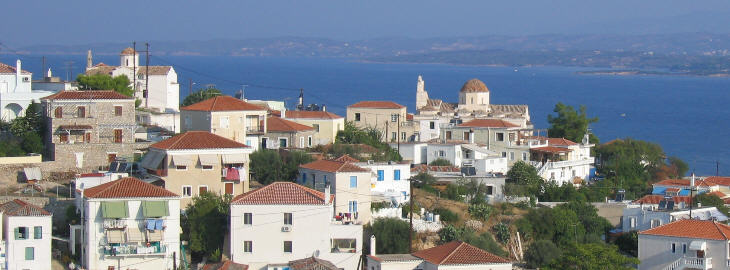
Today the town of Spetse stretches for a couple of miles along the eastern coast of the island: in the past the inhabitants lived on the eastern coast but on a low hill protected by walls and by the ravines caused by two small streams. The site was (and still is) called Kastelli after the It. castello (castle).
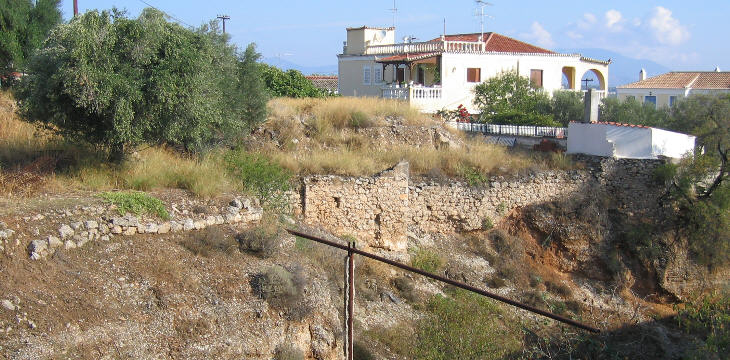
In 1770 (in the context of the Russian - Ottoman war) the inhabitants of Spetse made an attempt to drive out their rulers, but the revolt failed and the Turks set fire to Kastelli, so today very little is left of the Venetian fortifications.
After the 1770 fire the site was almost entirely abandoned and the inhabitants moved towards the natural harbour to the south of Kastelli: today the majority of the buildings have a relatively modern appearance: there were many churches in Kastelli: only a few still exist.
While just half a mile away modern Spetse has a very cosmopolitan appearance with luxury hotels and cafés, Kastelli has a very rural appeal. At times one feels he is visiting a farm.
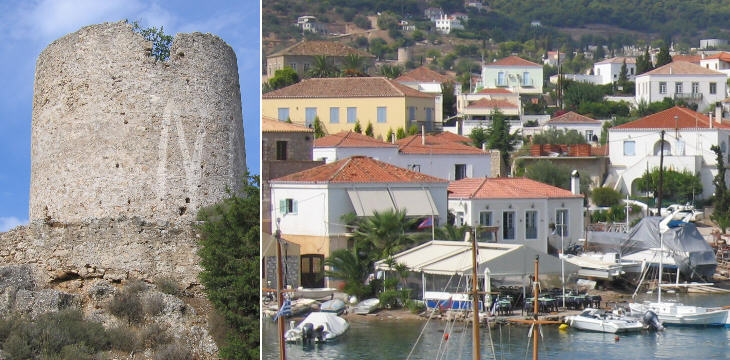
The Venetian system of defence was completed by towers at key points of the island for the early detection of enemies. Spetse played a key role in the Greek fight for independence: a lady from Spetse, Laskarina Bouboulina, led the Greek fleet in the successful blockade of the Malvasia fortress. Introductory page on the Venetian Fortresses Pages of this section: On the Ionian Islands: Corfù (Kerkyra) Paxo (Paxi) Santa Maura (Lefkadas) Cefalonia (Kephallonia) Asso (Assos) Itaca (Ithaki) Zante (Zachintos) Cerigo (Kythera) On the mainland: Butrinto (Butrint) Parga Preveza and Azio (Aktion) Vonizza (Vonitsa) Lepanto (Nafpaktos) Atene (Athens) On Morea: Castel di Morea (Rio), Castel di Rumelia (Antirio) and Patrasso (Patra) Castel Tornese (Hlemoutsi) and Glarenza Navarino (Pilo) and Calamata Modon (Methoni) Corone (Koroni) Braccio di Maina, Zarnata, Passavà and Chielefà Mistrà Corinto (Korinthos) Argo (Argos) Napoli di Romania (Nafplio) Malvasia (Monemvassia) On the Aegean Sea: Negroponte (Chalki) Castelrosso (Karistos) Oreo Lemno (Limnos) Schiatto (Skiathos) Scopello (Skopelos) Alonisso Schiro (Skyros) Andro (Andros) Tino (Tinos) Micono (Mykonos) Siro (Syros) Egina (Aegina) Spezzia (Spetse) Paris (Paros) Antiparis (Andiparos) Nasso (Naxos) Serifo (Serifos) Sifno (Syphnos) Milo (Milos) Argentiera (Kimolos) Santorino (Thira) Folegandro (Folegandros) Stampalia (Astipalea) Candia (Kriti) You may refresh your knowledge of the history of Venice in the Levant by reading an abstract from the History of Venice by Thomas Salmon, published in 1754. The Italian text is accompanied by an English summary. Clickable Map of the Ionian and Aegean Seas with links to the Venetian fortresses and to other locations (opens in a separate window) |