  What's New! Detailed Sitemap All images © by Roberto Piperno, owner of the domain. Write to romapip@quipo.it. Text edited by Rosamie Moore. Page revised in November 2009. |
  Preveza Preveza
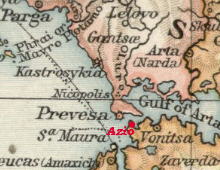
Key dates: 1538 A Spanish-Venetian fleet is defeated by the Turks near Preveza (Battle of Preveza) 1684 Venetians conquer Preveza 1699 Preveza is assigned to the Turks by the peace of Carlowitz 1718 Preveza is assigned to Venice by the peace of Passarowitz 1798 Conquered by Ali Pacha of Tepeleni Preveza is located at the tip of a narrow peninsula which closes a large internal gulf, known as Gulf of Arta or Amvrakikos Gulf. Its strategic importance was such that the town changed hands several times. In the small map at the top of the page the cartographers of the 1900 Times Atlas used for Preveza the symbol meaning fortress, because at that time the town was protected by three fortresses and a moat. Today Preveza is a thoroughly modern town with little evidence of its past.
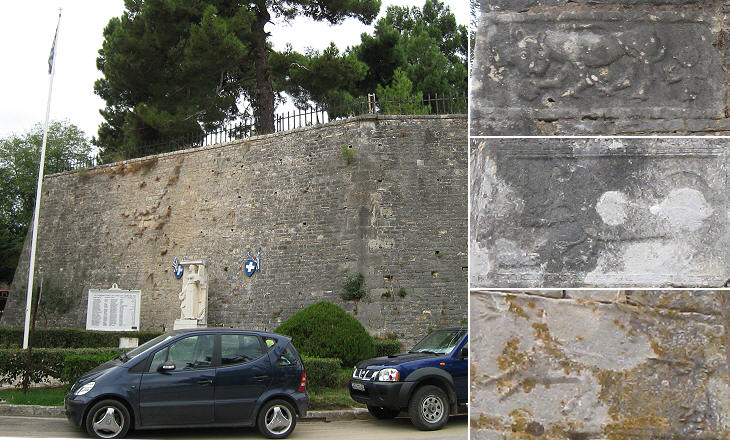
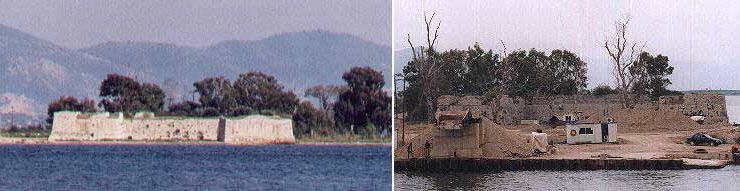
The fortress of St. Andrew is the only one which dates back to the Venetian period: the current set of walls and buildings however is due to an 1807 reconstruction by Ali Pacha and to many later additions/modifications. Some worn out reliefs portraying a man and a beast were placed on the walls; because their design is very naive, it is unlikely that they came from Nikopolis, an ancient town, founded by Emperor Augustus and located 5 miles north of Preveza.
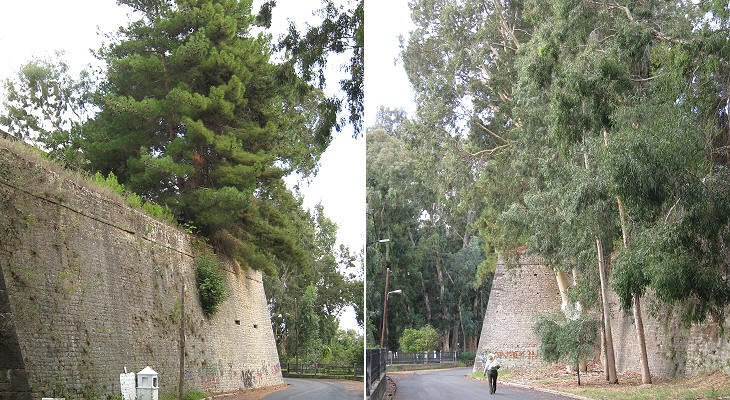
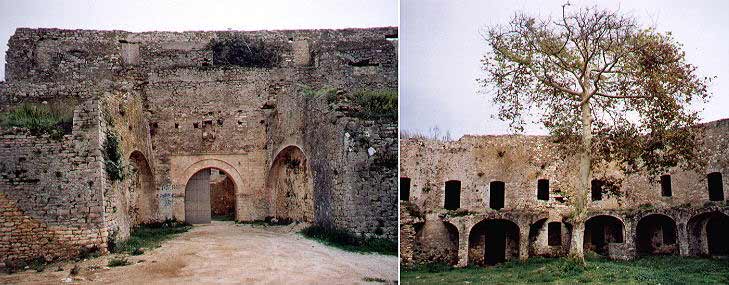
Ali Pacha had a penchant for fortresses; he built at least ten of them along the coast of Epirus. The purpose of this effort is unclear; the Ionian islands of Santa Maura, Paxi and Corfu, after the 1797 fall of the Republic of Venice, were occupied in succession by France, Russia, France again and Britain, but these powers were not interested in invading the extremely poor and inhospitable territory controlled by Ali Pacha. St. George's castle is located at the western end of Preveza and it faces the Ionian Sea, whereas St. Andrew's Castle is inside the Gulf of Arta. It consists of a rather plain rectangular set of walls.
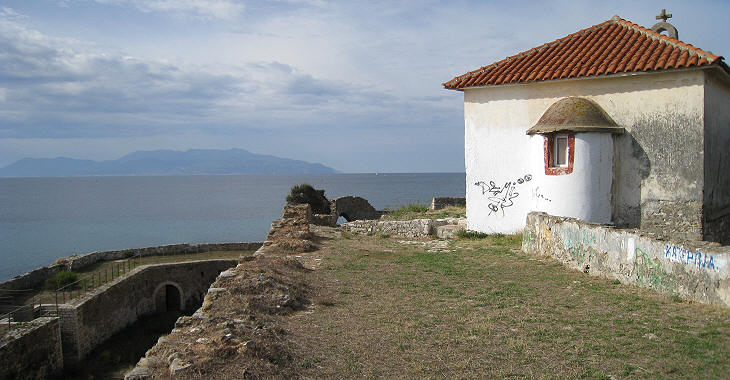
Ali Pacha built another fortress a mile or so north of St. George's Castle; it is called Pantokrator fortress after the name of a small church built on its top (it is shown in the background of this page). The seaward rampart was added in the late XIXth century.
"The site is now abandoned and because it is very easily accessible it looks bound for a rapid deterioration." This statement was written in 2003: unfortunately a visit in September 2009 confirmed that the site continued to be damaged by vandals.
The fortress is built on a cape which protrudes from the coastline. This affords a clear view over Santa Maura. Ali Pacha made an attempt to conquer that island, but he did not reach his objective. The image above shows the battlefield of the 1538 engagement between the Ottoman fleet led by Hayruddin Barbarossa and a Christian fleet under the command of Andrea Doria: the Ottomans moved northwards from Santa Maura and although the Christian fleet was larger they forced it to flee. Azio (Actium) For most tourists this is the entry airport for the region, for the military historian it is the site of the naval battle of Actium where in 31 BC Octavian's General Agrippa defeated Antony and Cleopatra in an epic clash of some 800 vessels. In 1812 Ali Pacha built a small fortress at the southern entrance to the Gulf of Arta.
Introductory page on the Venetian Fortresses Pages of this section: On the Ionian Islands: Corfù (Kerkyra) Paxo (Paxi) Santa Maura (Lefkadas) Cefalonia (Kephallonia) Asso (Assos) Itaca (Ithaki) Zante (Zachintos) Cerigo (Kythera) On the mainland: Butrinto (Butrint) Parga Preveza and Azio (Aktion) Vonizza (Vonitsa) Lepanto (Nafpaktos) Atene (Athens) On Morea: Castel di Morea (Rio), Castel di Rumelia (Antirio) and Patrasso (Patra) Castel Tornese (Hlemoutsi) and Glarenza Navarino (Pilo) and Calamata Modon (Methoni) Corone (Koroni) Braccio di Maina, Zarnata, Passavà and Chielefà Mistrà Corinto (Korinthos) Argo (Argos) Napoli di Romania (Nafplio) Malvasia (Monemvassia) On the Aegean Sea: Negroponte (Chalki) Castelrosso (Karistos) Oreo Lemno (Limnos) Schiatto (Skiathos) Scopello (Skopelos) Alonisso Schiro (Skyros) Andro (Andros) Tino (Tinos) Micono (Mykonos) Siro (Syros) Egina (Aegina) Spezzia (Spetse) Paris (Paros) Antiparis (Andiparos) Nasso (Naxos) Serifo (Serifos) Sifno (Syphnos) Milo (Milos) Argentiera (Kimolos) Santorino (Thira) Folegandro (Folegandros) Stampalia (Astipalea) Candia (Kriti) You may refresh your knowledge of the history of Venice in the Levant by reading an abstract from the History of Venice by Thomas Salmon, published in 1754. The Italian text is accompanied by an English summary. Clickable Map of the Ionian and Aegean Seas with links to the Venetian fortresses and to other locations (opens in a separate window) |