  What's New! Detailed Sitemap All images © by Roberto Piperno, owner of the domain. Write to romapip@quipo.it. Text edited by Rosamie Moore. Page added in December 2006. |
 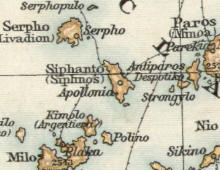 Serifo (Seriphos) Serifo (Seriphos)
Key dates: 1207 Marco Sanudo a Venetian adventurer conquers Nasso and founds the Duchy of Nasso which includes most of the Cycladic Islands: Serifo is partitioned among other Venetian families. In the early XVth century Alvise Michiel establishes his rule over the whole island. 1537 The Ottomans conquer Serifo Serifo, like nearby Sifno and Argentiera was known for its mines: these were exploited also in modern times and the island was the site of one of the first major Greek strikes (1916): it ended in bloodshed. The mines were eventually closed in the 1980s and this caused a dramatic economic crisis with a significant reduction of the island population.
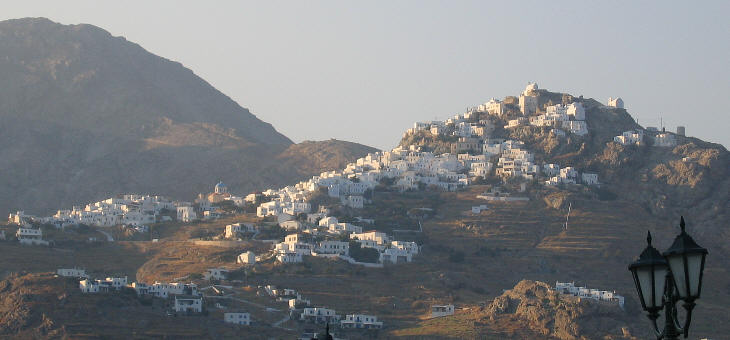
Chora, the main village, is located at the very top of a hill near a bay on the southern coast of the island; the old part is still clearly distinguishable from the later expansion of Chora on a lower terrace.
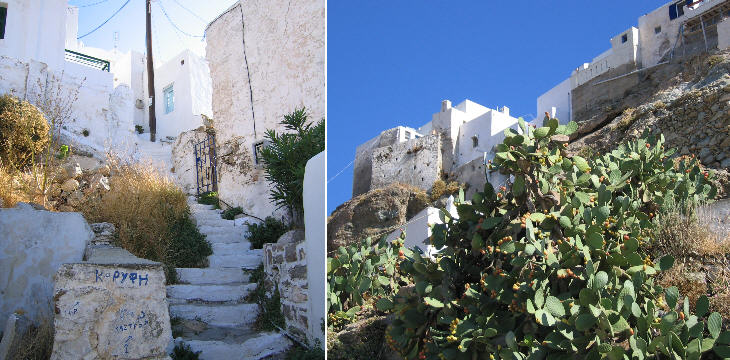
The houses which formed a sort of enclosure have been largely modified: the access to the top of the hill through a series of narrow and long steps remains rather difficult.
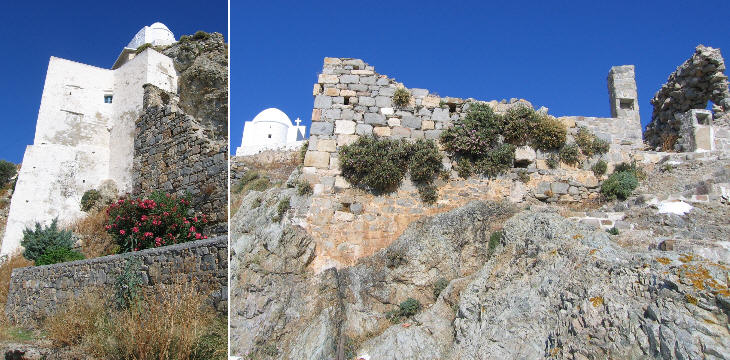
The walls of the fortifications have almost disappeared, but there is still a very old building clinging to the rock (left image).
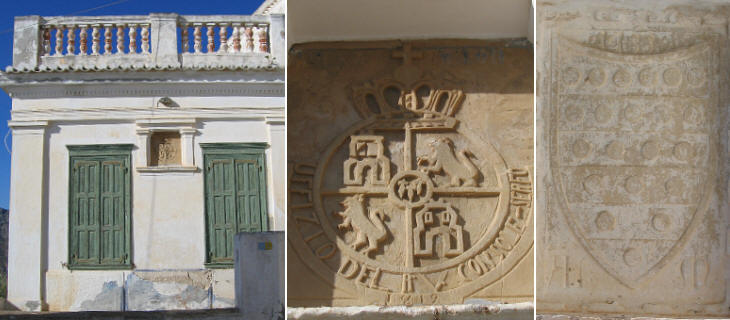
An unusually elegant house is decorated with a coat of arms of the Bourbon family: it was the residence of the vice-consul of the Kingdom of the Two Sicilies: the inscription is in Italian, which was largely spoken in the Aegean Islands and was used as the official language for commercial transactions until the beginning of the XIXth century. Introductory page on the Venetian Fortresses Pages of this section: On the Ionian Islands: Corfù (Kerkyra) Paxo (Paxi) Santa Maura (Lefkadas) Cefalonia (Kephallonia) Asso (Assos) Itaca (Ithaki) Zante (Zachintos) Cerigo (Kythera) On the mainland: Butrinto (Butrint) Parga Preveza and Azio (Aktion) Vonizza (Vonitsa) Lepanto (Nafpaktos) Atene (Athens) On Morea: Castel di Morea (Rio), Castel di Rumelia (Antirio) and Patrasso (Patra) Castel Tornese (Hlemoutsi) and Glarenza Navarino (Pilo) and Calamata Modon (Methoni) Corone (Koroni) Braccio di Maina, Zarnata, Passavà and Chielefà Mistrà Corinto (Korinthos) Argo (Argos) Napoli di Romania (Nafplio) Malvasia (Monemvassia) On the Aegean Sea: Negroponte (Chalki) Castelrosso (Karistos) Oreo Lemno (Limnos) Schiatto (Skiathos) Scopello (Skopelos) Alonisso Schiro (Skyros) Andro (Andros) Tino (Tinos) Micono (Mykonos) Siro (Syros) Egina (Aegina) Spezzia (Spetse) Paris (Paros) Antiparis (Andiparos) Nasso (Naxos) Serifo (Serifos) Sifno (Syphnos) Milo (Milos) Argentiera (Kimolos) Santorino (Thira) Folegandro (Folegandros) Stampalia (Astipalea) Candia (Kriti) You may refresh your knowledge of the history of Venice in the Levant by reading an abstract from the History of Venice by Thomas Salmon, published in 1754. The Italian text is accompanied by an English summary. Clickable Map of the Ionian and Aegean Seas with links to the Venetian fortresses and to other locations (opens in a separate window) |