  What's New! Detailed Sitemap All images © by Roberto Piperno, owner of the domain. Write to romapip@quipo.it. Text edited by Rosamie Moore. Page revised in November 2009. |
  Vonizza (Vonitsa) Vonizza (Vonitsa)
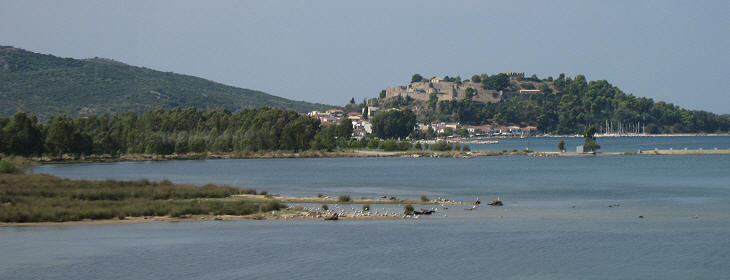
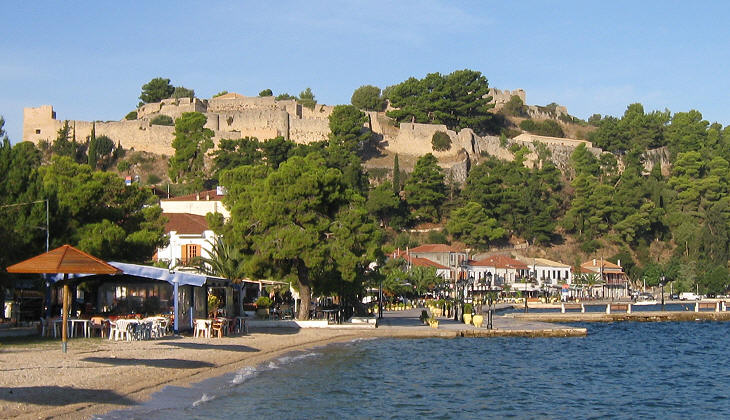
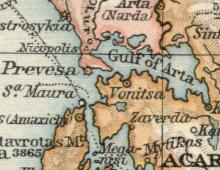
Key dates: 1204 After the fall of Constantinople, Vonizza becomes part of the Byzantine Despotate of Epirus 1472 The Ottomans conquer Vonizza 1684 The Venetians conquer Vonizza 1715-16 Second Ottoman occupation 1798 After the fall of the Republic of Venice, the fortress becomes a possession of Ali Pacha of Tepeleni Vonizza, is located on the southern coast of the Gulf of Arta (or Avramkikos Gulf), some ten miles to the east of Preveza. Because of its commanding view over the Gulf of Arta and over a small natural harbour, the hill of Vonizza was fortified by the Byzantines and after them by the Ottomans and the Venetians.
Today Vonizza is a sought after location by holiday makers who enjoy sailing and in particular by those who are in the learning process, as the shallow waters of the Gulf of Arta are usually very calm (... although, according to a popular saying, calm seas never make skilful sailors).
The hill chosen for the construction of the fortress had a cliff on its western side, but on the eastern one it gently sloped towards the sea. For this reason this side was protected by three curtains of walls.
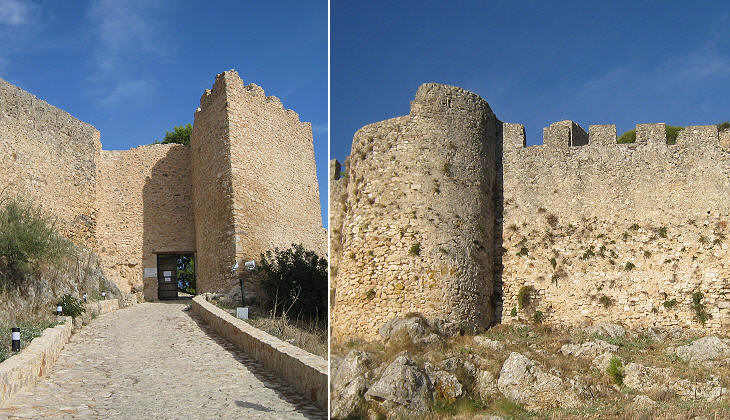
The entrance to the fortress is hidden behind a tower and this is typical of medieval warfare, when attacks were conducted by using battering-rams: a lateral gate increased the exposure of the assailants. The inner circle of walls was strengthened by round towers. There is little space between the outer and the inner walls and the latter are on higher ground; in this way assailants who had succeeded in breaching the former were impeded in continuing their attack.
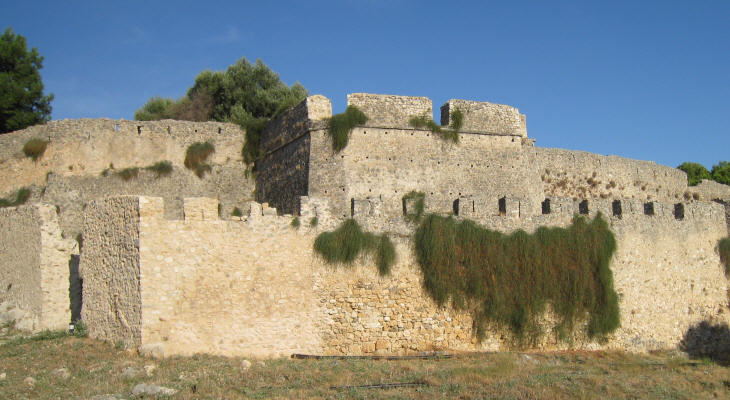
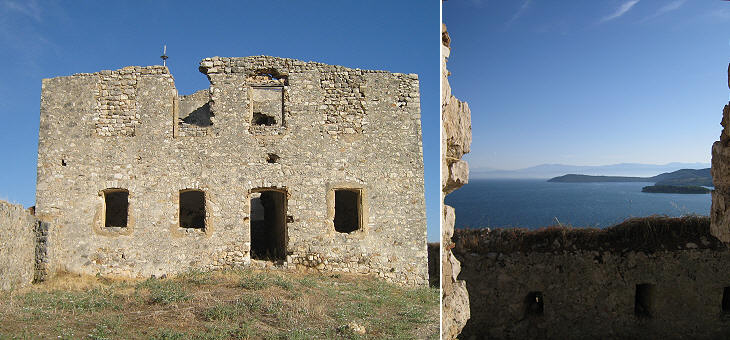
The last defence was entrusted with a stronghold where the residence of the commander and other key buildings were located. The square tower shown in the photo was most likely built by the Venetians.
It is unlikely that many Venetians wished to become the commander of Vonizza. The fortress was the most advanced possession of the Republic on the Greek mainland, but because of its position inside the Gulf of Arta, ships did not call at Vonizza and life at the fortress was very monotonous.
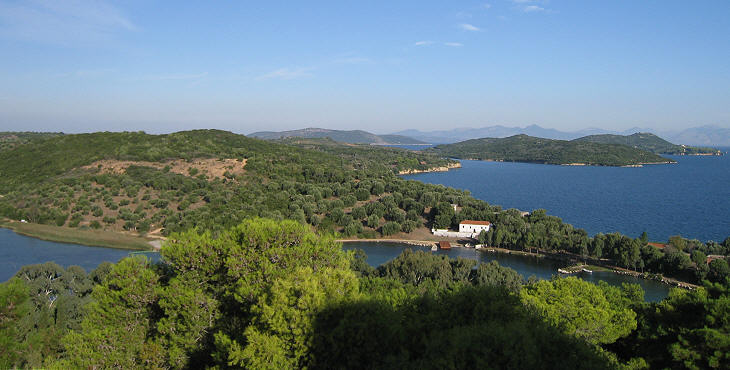
As usual the view from a fortress is very rewarding of the effort made to climb to its top. The closed waters of the Gulf of Arta give the impression of being part of a lake, rather than of a sea.
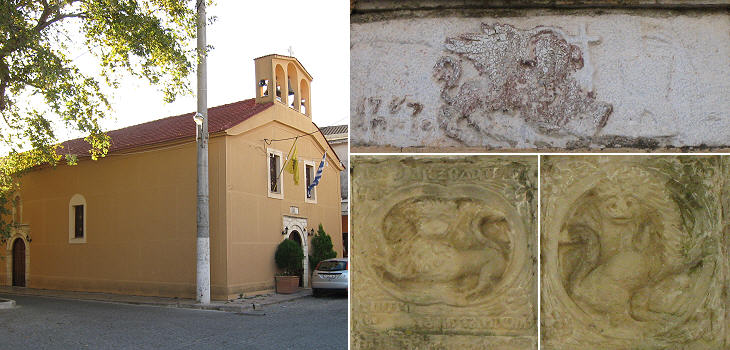
The fortress, which was used by the Greek army until a few years ago, does not have any winged lion of the Venetian period, but the church at the foot of the fortress has some small reliefs showing this symbol of Venice. The church was enlarged in modern times, but its ceiling retains a fine painting of the Venetian school.
Introductory page on the Venetian Fortresses Pages of this section: On the Ionian Islands: Corfù (Kerkyra) Paxo (Paxi) Santa Maura (Lefkadas) Cefalonia (Kephallonia) Asso (Assos) Itaca (Ithaki) Zante (Zachintos) Cerigo (Kythera) On the mainland: Butrinto (Butrint) Parga Preveza and Azio (Aktion) Vonizza (Vonitsa) Lepanto (Nafpaktos) Atene (Athens) On Morea: Castel di Morea (Rio), Castel di Rumelia (Antirio) and Patrasso (Patra) Castel Tornese (Hlemoutsi) and Glarenza Navarino (Pilo) and Calamata Modon (Methoni) Corone (Koroni) Braccio di Maina, Zarnata, Passavà and Chielefà Mistrà Corinto (Korinthos) Argo (Argos) Napoli di Romania (Nafplio) Malvasia (Monemvassia) On the Aegean Sea: Negroponte (Chalki) Castelrosso (Karistos) Oreo Lemno (Limnos) Schiatto (Skiathos) Scopello (Skopelos) Alonisso Schiro (Skyros) Andro (Andros) Tino (Tinos) Micono (Mykonos) Siro (Syros) Egina (Aegina) Spezzia (Spetse) Paris (Paros) Antiparis (Andiparos) Nasso (Naxos) Serifo (Serifos) Sifno (Syphnos) Milo (Milos) Argentiera (Kimolos) Santorino (Thira) Folegandro (Folegandros) Stampalia (Astipalea) Candia (Kriti) You may refresh your knowledge of the history of Venice in the Levant by reading an abstract from the History of Venice by Thomas Salmon, published in 1754. The Italian text is accompanied by an English summary. Clickable Map of the Ionian and Aegean Seas with links to the Venetian fortresses and to other locations (opens in a separate window) |