  What's New! Detailed Sitemap All images © by Roberto Piperno, owner of the domain. Write to romapip@quipo.it. Text edited by Rosamie Moore. Page revised in December 2011. |
 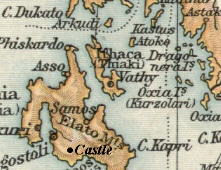 Asso (Assos) Asso (Assos)
In the early XVIth century the Ottoman Empire extended its influence over today's Algeria and Tunisia by supporting the local Muslim leaders in their fight against Spain. Khayr al-Din (aka Hayruddin) (known in Europe as Barbarossa, because of his red beard) was the ruler of Algiers and he led several raids on the coasts of Spain and Italy. The Ionian Islands were a target for these raids even during the periods of peace between the Ottoman Empire and Venice. The villages of the northern part of Cefalonia were far from the main fortress and in 1586 their inhabitants appealed to the Venetian Senate for a better defence.
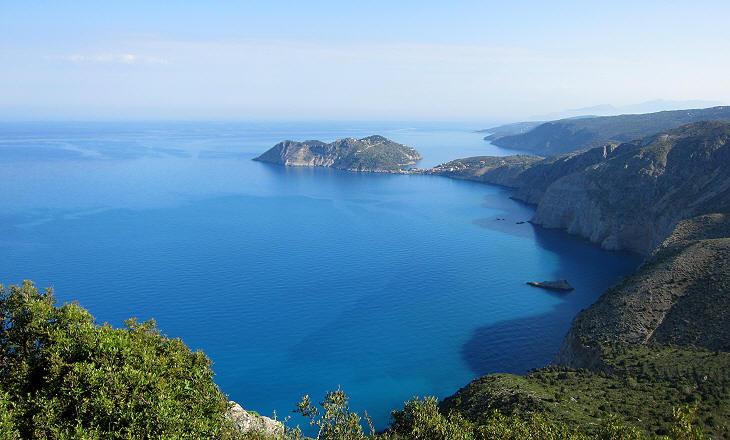
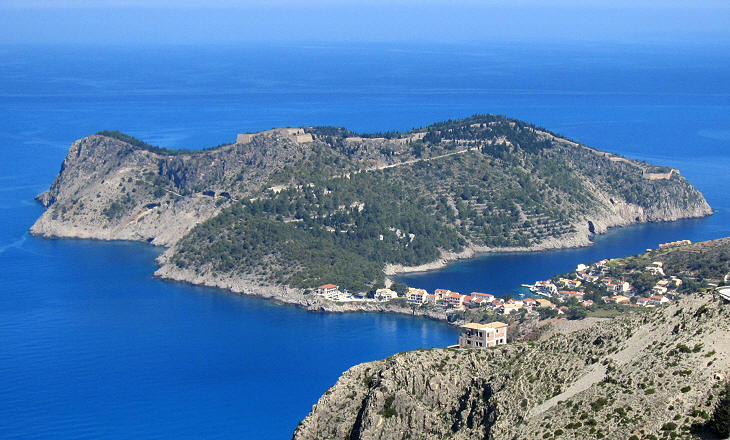
The Senate decided to build a brand new fortress on an islet linked to the north-western coast of the island by a tiny strip of land; the location was excellent from a military viewpoint, however it was rather remote from the villages it was meant to protect.
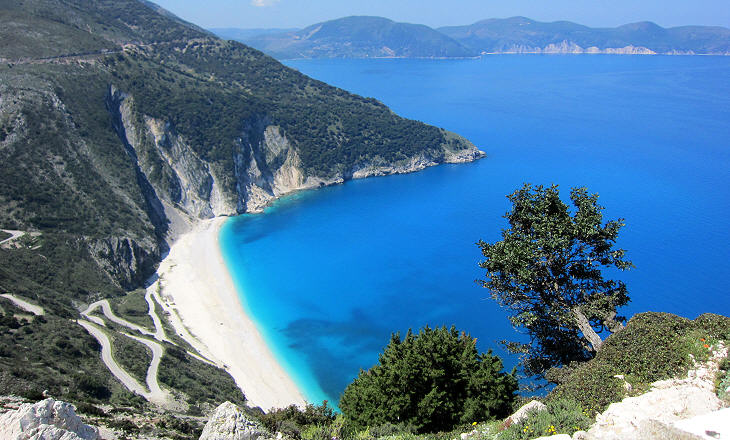
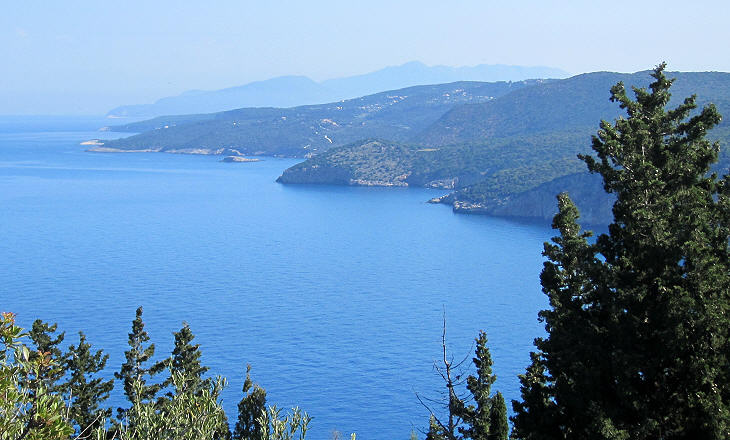
The modern road along the western coast of the island allows spectacular views of the sea and of many coves. Myrtos Beach, together with a view of the sea from a church of Oia (Santorini), appears on most posters of the Greek Tourist Board. As a matter of fact the beach is made of very small white pebbles, rather than of sand and swimming in its blue waters can be pretty dangerous because of undercurrents.
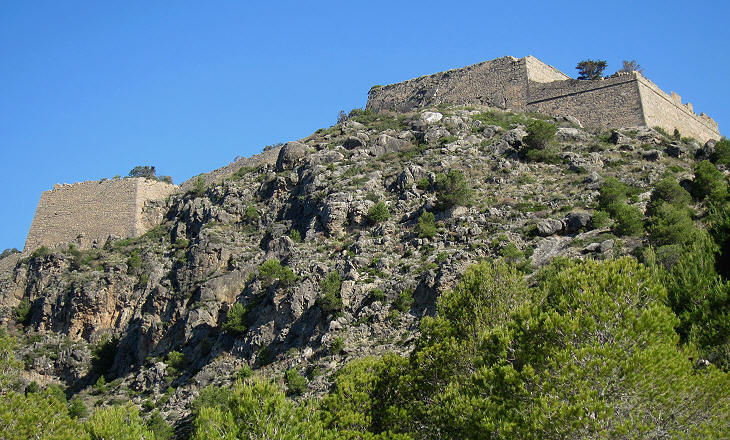
The Venetians built a very large fortress with the intent of attracting a sizeable population, but this objective was not achieved because the cove where ships were expected to moor was too small and the access to it was made dangerous by big boulders which had fallen from the cliffs into the sea.
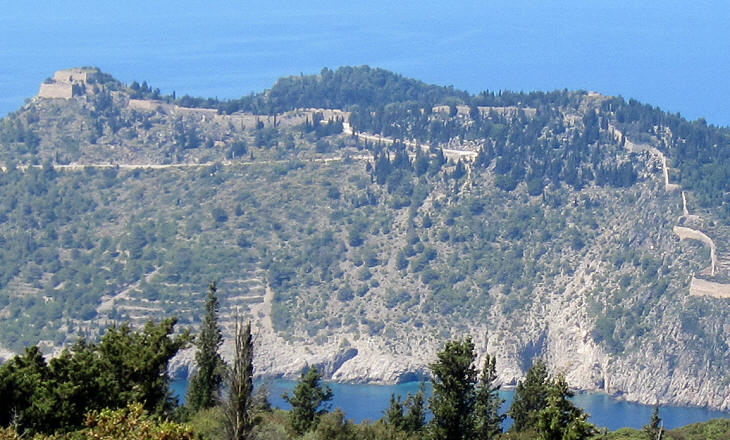
Venetian military architects, such as Michele Sammicheli at Candia, developed elaborate patterns for optimizing the design of fortresses, but at Asso these patterns could not be applied because of the nature of the ground, so the walls were built on the edge of the cliffs, rather than according to a geometrical model.
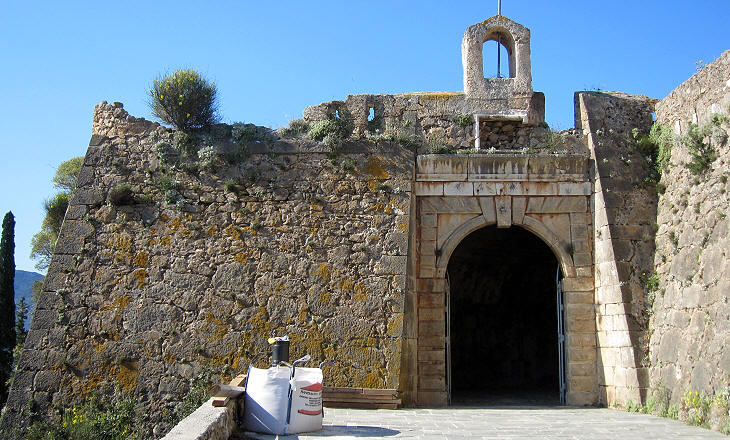
The southern bastion is actually a small fortress where the Venetians could retreat for a last defence in case the enemy managed to penetrate inside the long curtain of walls. The defenders could hope to receive help because Asso could be easily reached by the Venetian fleet which was stationed at Corfu.
Cefalonia is located in a highly seismic area and the fortress of Asso has been struck by several earthquakes including the 1953 Great Ionian Earthquake. Records indicate that in 1658 many buildings inside the fortress collapsed because of an earthquake, but overall the external walls seem to have withstood that and other catastrophes (and a long period of abandonment too).
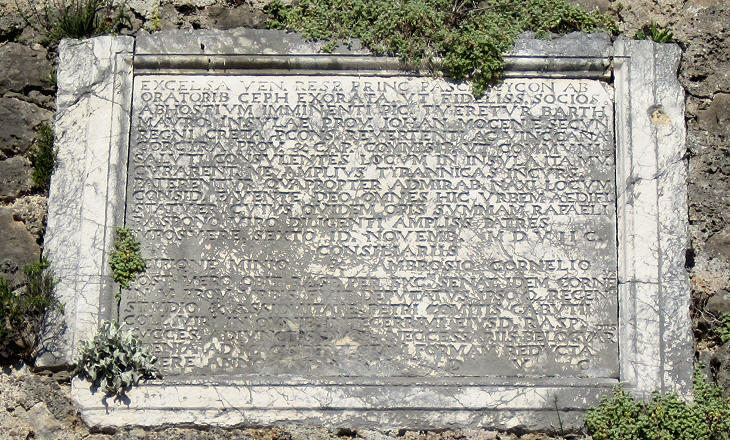
A very long inscription near the main gate provides details on the history of the fortress and makes clear reference to corsair raids: NE AMPLIUS TYRANNICAS INCURS(iones) PATERENTUR : so that (the inhabitants) would not suffer because of the tyrannical raids any longer. The inscription sheds light on the decisional process which led to the construction and completion of the fortress by mentioning the various officers who were involved in them.
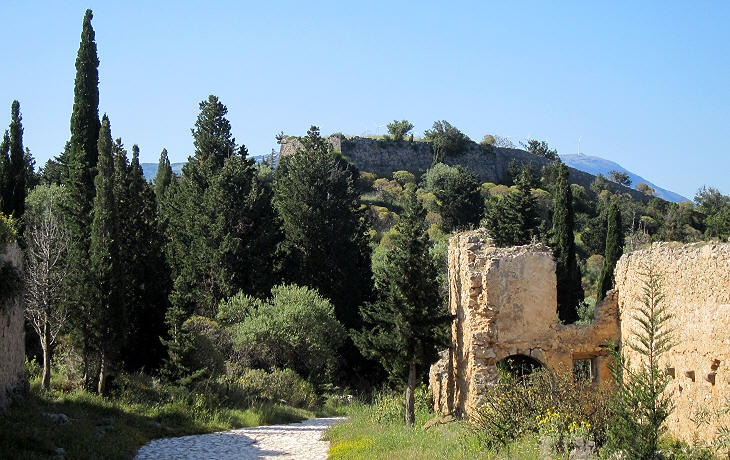
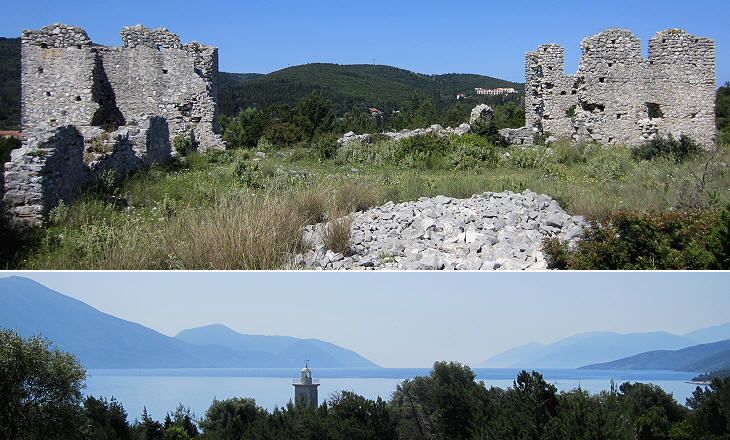
The old buildings inside the fortress are falling apart and it is difficult to see them at close range to understand their purpose because of weeds (the access to the fortress instead is very well kept). The image in the background of this page shows the ruin of a watchtower at the northern tip of the fortress.
The fortress enjoys impressive views towards the northern part of the island (the peninsula of Fiscardo) and beyond it towards the southern part of Santa Maura, an island which was in Ottoman hands when Asso was built. Santa Maura was conquered by the Venetians in 1684 and this fact reduced the importance of Asso. Fiscardo
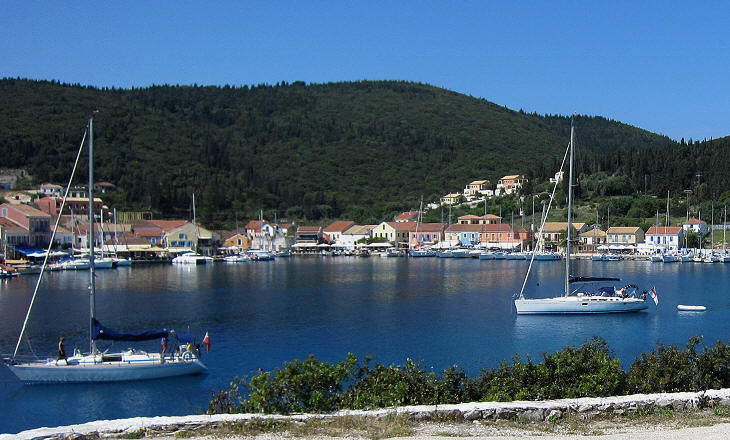
Fiscardo is a village where Robert Guiscard died in July 1085 of fever (probably malaria) and which is named after him. Robert was called Guiscard (the Cunning or the Resourceful) because of the ability he showed in becoming the ruler of southern Italy and Sicily. He then waged war on the Byzantine Empire and he occupied Corfu and Cefalonia. Fiscardo was spared by the 1953 Great Ionian Earthquake.
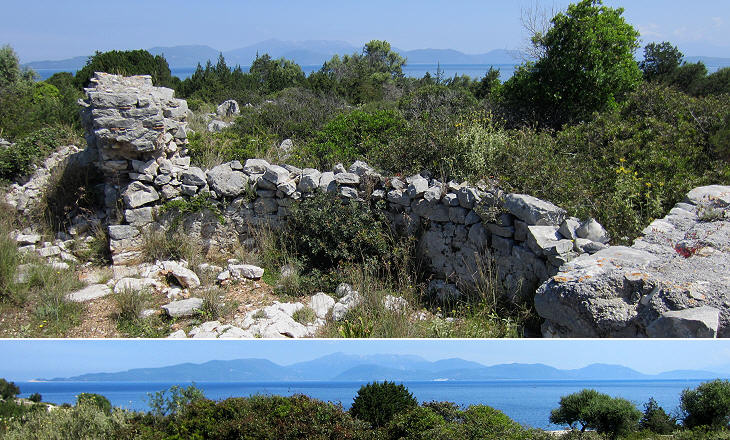
The hill which closes the bay on its northern side retains evidence of a large church, probably Byzantine, but it might have been restored and modified by the Normans when they conquered the island. Its size indicates that the village had a relatively large population.
The ruins of the church bell towers were thought to belong to a small castle, hence some old books speak of a Castel Viscardo at the northern tip of Cefalonia. The location of Fiscardo very near Santa Maura and Ithaca and relatively close to the Greek mainland favoured its development in antiquity. In recent years Greek archaeologists have unearthed traces of a Roman era theatre and of several tombs. Ithaca Ithaca is witin easy reach from Fiscardo, but ... As you set out for Ithaca hope the voyage is a long one, full of adventure, full of discovery. Laistrygonians and Cyclops, angry Poseidon - don't be afraid of them: you'll never find things like that on your way as long as you keep your thoughts raised high, as long as a rare excitement stirs your spirit and your body. Laistrygonians and Cyclops, wild Poseidon - you won't encounter them unless you bring them along inside your soul unless your soul sets them up in front of you. Hope the voyage is a long one. There may be many a summer morning when, with what pleasure, with what joy, you come into harbors seen for the first time; may you stop at Phoenician trading stations to buy fine things, mother of pearl and coral, amber and ebony, sensual perfume of every kind - as many sensual perfumes as you can; and may you visit many Egyptian cities to gather stores of knowledge from their scholars. Keep Ithaca always in your mind. Arriving there is what you are destined for. But do not hurry the journey at all. Better if it lasts for years, so you are old by the time you reach the island, wealthy with all you have gained on the way, not expecting Ithaca to make you rich. Ithaca gave you the marvelous journey. Without her you would not have set out. She has nothing left to give you now. And if you find her poor, Ithaca won't have fooled you. Wise as you will have become, so full of experience, you will have understood by then what these Ithacas mean. "Ithaca" by Constantine Kavafis - 1910 - Alexandria, Egypt Translation by Edmund Keeley and Philip Sherrard - Princeton Paperbacks Excerpts from Memorie Istoriografiche del Regno della Morea Riacquistato dall'armi della Sereniss. Repubblica di Venezia printed in Venice in 1692 and related to this page:
Introductory page on the Venetian Fortresses Pages of this section: On the Ionian Islands: Corfù (Kerkyra) Paxo (Paxi) Santa Maura (Lefkadas) Cefalonia (Kephallonia) Asso (Assos) Itaca (Ithaki) Zante (Zachintos) Cerigo (Kythera) On the mainland: Butrinto (Butrint) Parga Preveza and Azio (Aktion) Vonizza (Vonitsa) Lepanto (Nafpaktos) Atene (Athens) On Morea: Castel di Morea (Rio), Castel di Rumelia (Antirio) and Patrasso (Patra) Castel Tornese (Hlemoutsi) and Glarenza Navarino (Pilo) and Calamata Modon (Methoni) Corone (Koroni) Braccio di Maina, Zarnata, Passavà and Chielefà Mistrà Corinto (Korinthos) Argo (Argos) Napoli di Romania (Nafplio) Malvasia (Monemvassia) On the Aegean Sea: Negroponte (Chalki) Castelrosso (Karistos) Oreo Lemno (Limnos) Schiatto (Skiathos) Scopello (Skopelos) Alonisso Schiro (Skyros) Andro (Andros) Tino (Tinos) Micono (Mykonos) Siro (Syros) Egina (Aegina) Spezzia (Spetse) Paris (Paros) Antiparis (Andiparos) Nasso (Naxos) Serifo (Serifos) Sifno (Syphnos) Milo (Milos) Argentiera (Kimolos) Santorino (Thira) Folegandro (Folegandros) Stampalia (Astipalea) Candia (Kriti) You may refresh your knowledge of the history of Venice in the Levant by reading an abstract from the History of Venice by Thomas Salmon, published in 1754. The Italian text is accompanied by an English summary. Clickable Map of the Ionian and Aegean Seas with links to the Venetian fortresses and to other locations (opens in a separate window) |