  What's New! Detailed Sitemap All images © by Roberto Piperno, owner of the domain. Write to romapip@quipo.it. Text edited by Rosamie Moore. Page revised in November 2011. |
  Micono (Mykonos) Micono (Mykonos)
Key dates: 1207 Marco Sanudo, a Venetian adventurer, conquered Naxos and the nearby islands including Mykonos 1566 Jacopo IV Crispo, the last Duke of Naxos, was ousted by the Ottomans, but before that date the Republic of Venice took control of Mykonos; it already ruled nearby Tinos. 1715 The Ottomans landed on Tinos with a large army and conquered its fortress; this led to the end of the Venetian rule on Mykonos.
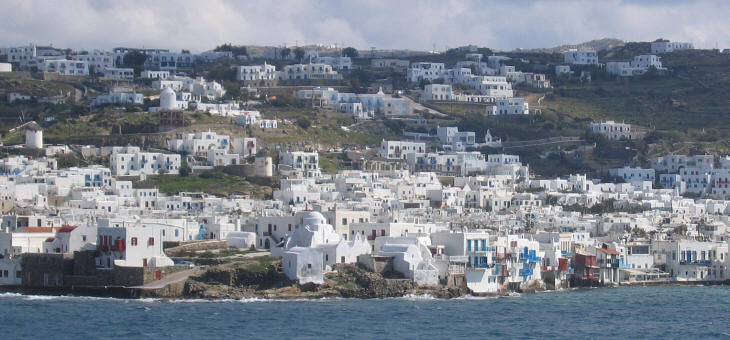
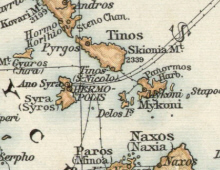
Mykonos is located at the centre of the Aegean Sea; it is very close to Delos, the site of a very important ancient sanctuary to Apollo and to Tinos and not far from Syros, Naxos and Paros. It did not have the same importance as the other islands because its natural harbours had no protection from meltemi, the strong northern wind which blows on the Aegean Sea.
The Venetian town was built on a low and small headland which only partially protected a cove. The harbour faced north so when the meltemi blew ships could not moor.
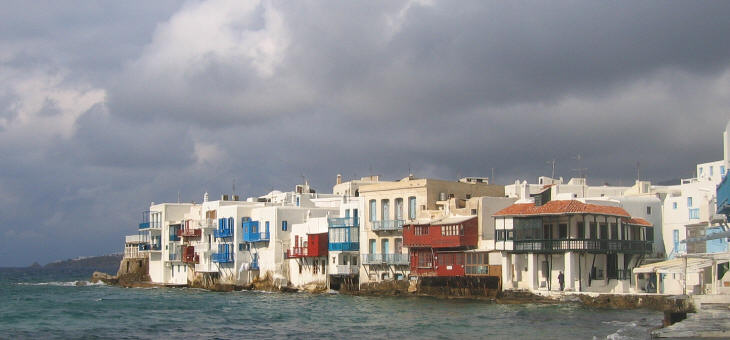
Venetian houses were built right on the edge of the low cliff: they probably did not have as many balconies as they have today. "Little Venice" is known for its many restaurants and shops.
During the long period of Venetian rule Mykonos was a sort of appendage of Tinos and the Roman Catholic Bishop of Tinos had authority over Mykonos.
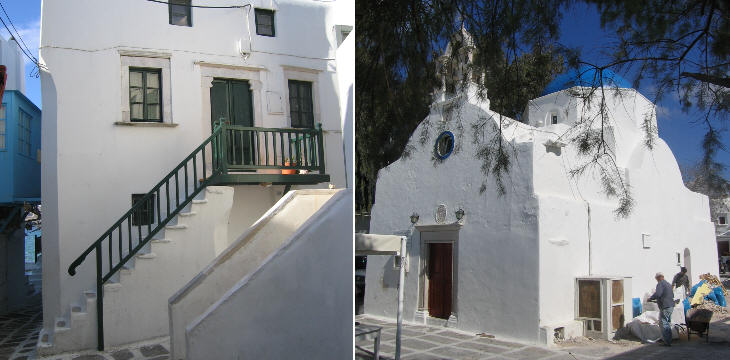
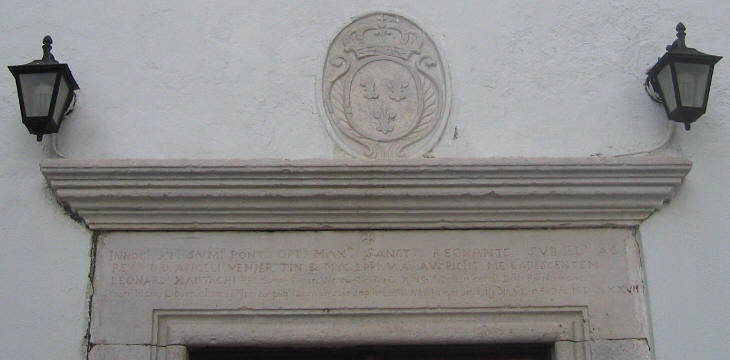
The church was renovated by Bishop Angelo Venier during the pontificate of Pope Innocent XI. This pope supported the Republic of Venice financially during the 1685-99 war which led to the conquest of Morea (Peloponnese). The coat of arms of the King of France was most likely placed above the inscription after 1715, the year Mykonos became an Ottoman possession. France acted, with the permission of the Sultans, as protector of the Catholics living in the Ottoman Empire: the coat of arms meant the church was under French protection.
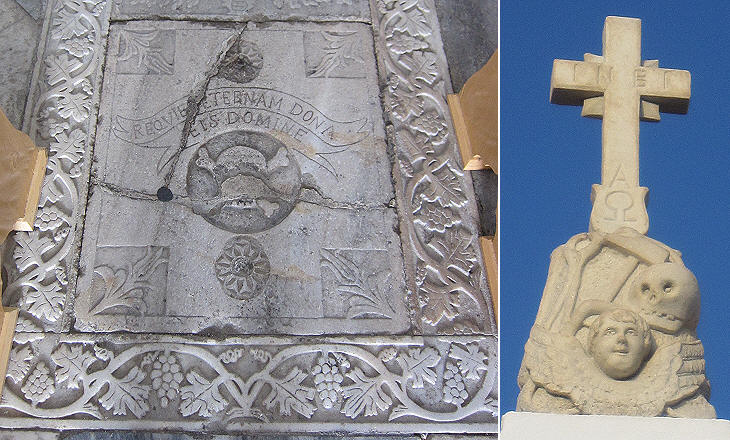
During the XVIIth and XVIIIth centuries the decoration of many Roman churches and funerary monuments was based on reminders of Death (Memento Mori). This fashion was not limited to Rome and bones and skulls can be seen even at Mykonos, although the island was very poor and scarcely populated.
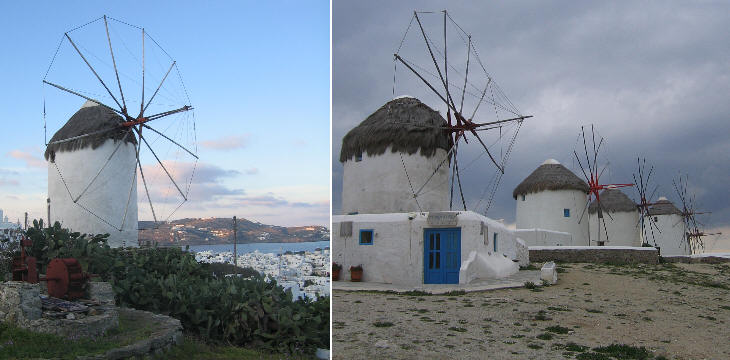
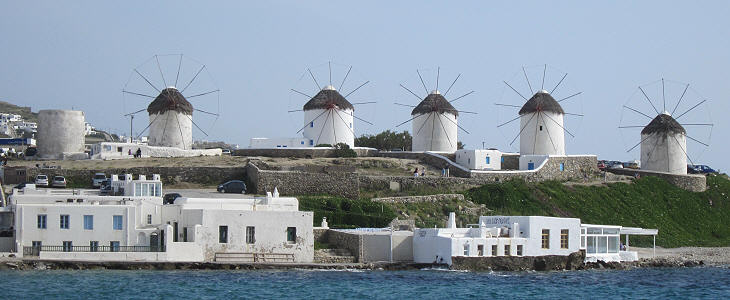
In the late XVIIIth century and in the early XIXth century Tinos and Syros, as well as other Greek islands, developed a large merchant navy which supplied the various provinces of the Ottoman Empire. The corn bought in Syria or in the Anatolian tableland was processed in Mykonos and this explains why so many windmills were built near the harbour (from this point of view the meltemi was a positive factor).
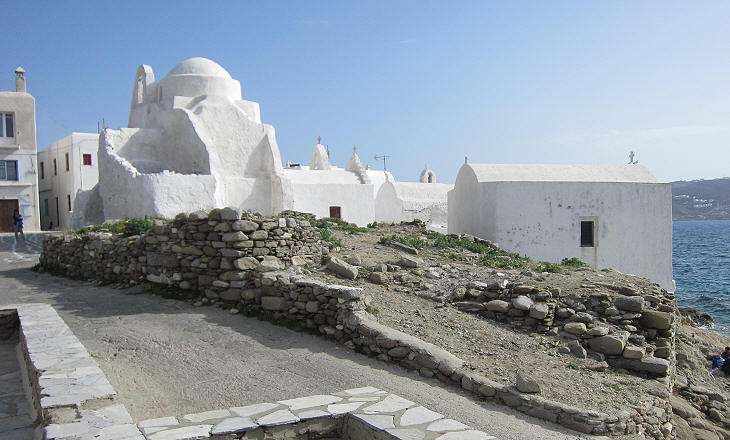
The image used as background for this page shows Panagia Paraportiani. Mykonos became very popular in the 1960s for its naturist and somewhat transgressive beaches; unfortunately this brought such a touristic development that it led to disfiguring the character and the landscape of the island: SUVs everywhere, very anonymous and expensive hotels, the kind of shops you find in big cities, the kind of bars you find in big cities and the kind of people you find in big cities. Introductory page on the Venetian Fortresses Pages of this section: On the Ionian Islands: Corfù (Kerkyra) Paxo (Paxi) Santa Maura (Lefkadas) Cefalonia (Kephallonia) Asso (Assos) Itaca (Ithaki) Zante (Zachintos) Cerigo (Kythera) On the mainland: Butrinto (Butrint) Parga Preveza and Azio (Aktion) Vonizza (Vonitsa) Lepanto (Nafpaktos) Atene (Athens) On Morea: Castel di Morea (Rio), Castel di Rumelia (Antirio) and Patrasso (Patra) Castel Tornese (Hlemoutsi) and Glarenza Navarino (Pilo) and Calamata Modon (Methoni) Corone (Koroni) Braccio di Maina, Zarnata, Passavà and Chielefà Mistrà Corinto (Korinthos) Argo (Argos) Napoli di Romania (Nafplio) Malvasia (Monemvassia) On the Aegean Sea: Negroponte (Chalki) Castelrosso (Karistos) Oreo Lemno (Limnos) Schiatto (Skiathos) Scopello (Skopelos) Alonisso Schiro (Skyros) Andro (Andros) Tino (Tinos) Micono (Mykonos) Siro (Syros) Egina (Aegina) Spezzia (Spetse) Paris (Paros) Antiparis (Andiparos) Nasso (Naxos) Serifo (Serifos) Sifno (Syphnos) Milo (Milos) Argentiera (Kimolos) Santorino (Thira) Folegandro (Folegandros) Stampalia (Astipalea) Candia (Kriti) You may refresh your knowledge of the history of Venice in the Levant by reading an abstract from the History of Venice by Thomas Salmon, published in 1754. The Italian text is accompanied by an English summary. Clickable Map of the Ionian and Aegean Seas with links to the Venetian fortresses and to other locations (opens in a separate window) |