  What's New! Detailed Sitemap All images © by Roberto Piperno, owner of the domain. Write to romapip@quipo.it. Text edited by Rosamie Moore. Page added in December 2005. |
  Andro (Andros) Andro (Andros)
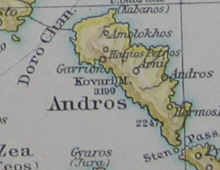
Key dates: 1204: the Byzantine Empire is parcelled out among the leaders of the Fourth Crusade after they conquer Constantinople, but the small Aegean islands (including Andro) soon fall directly or indirectly into the hands of Venice: Andro is ruled by several Venetian families (Dandolo, Ghisi, Zeno) under the tutelage of the Duchy of the Archipelago, established by Marco Sanudo in Nasso. 1440: Andro is acquired by Domenico Sommaripa (or Sommariva): his family will rule the island until 1566. 1537: Khayr al Din (Barbarossa - red beard), corsair and admiral of the Turkish fleet, seizes Andro, but the island is returned to the Sommaripa who accept the tutelage of the Ottoman Sultan. 1566: the inhabitants of Andro, realizing that their rulers are unable to effectively protect them, drive out the last Baron, Giovanni Francesco Sommaripa. They voluntarily surrender to the Ottomans and in return they are granted a sort of self-government. The island of Andro is a prolongation of the long mountainous ridge of Negroponte. A very narrow strait divides Andro from Tino: for this reason it is called Steno (short) Passage.
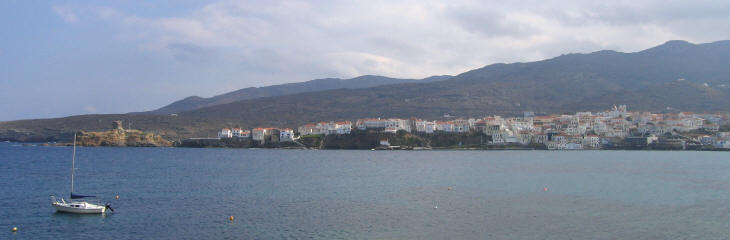
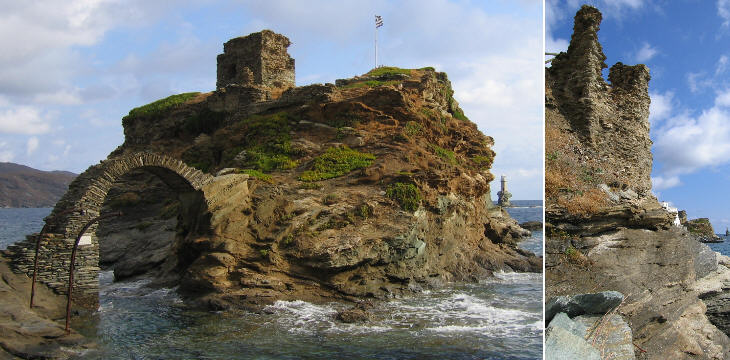
The main town (Andro or Chora) is located on the eastern coast of the island on a low ridge which separates two bays. The Venetians fortified the small town with walls and towers, but the strongest point of their fortification system was the Castelo da Mar (Sea Castle), a castle built on an islet at the end of the ridge.
The ruins of the XIIIth century bridge which linked the sea castle with the town are rather picturesque and provide those who have climbing skills with an opportunity to reach the surviving tower of the sea castle.
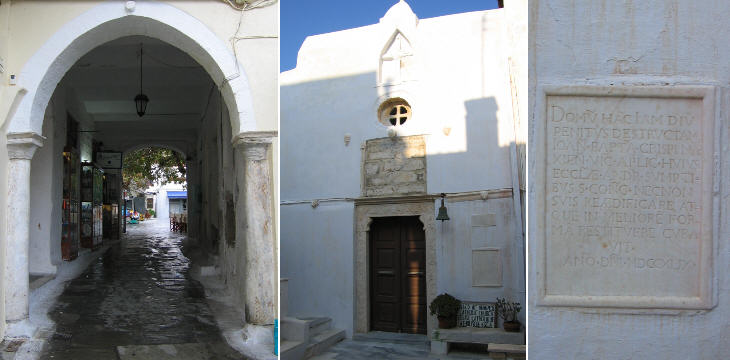
In the late XVIIIth century Andro became a leading centre of the Greek merchant navy. This development occurred also in nearby Tino and in Spezzia. Andro accounts for some of the most important families of Greek ship-owners. With the gains of their trading activity or just with the salary earned as seamen, the inhabitants of Andro enlarged and embellished their old medieval town. They retained however the Venetian gate facing the sea castle and a few of them retained also the Roman Catholic faith their ancestors had embraced during the Venetian rule. A relief on the wall of the surviving Catholic church celebrates a major 1749 restoration.
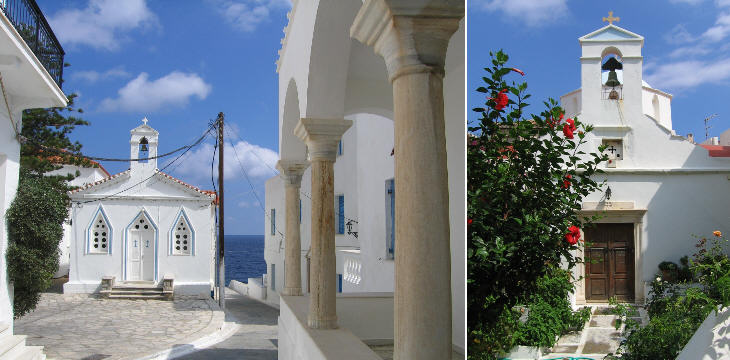
While the western coast of the island, which faces the Attic peninsula, has several tourist resorts, the eastern coast and chiefly the town of Andro seem to turn their back on today's holidaymakers. The inhabitants of Andro keep for themselves the clean streets, the elegant houses and the many small churches of their cosy town. In the short main street several pastry shops still sell the full array of the traditional honey-based Greek sweets.
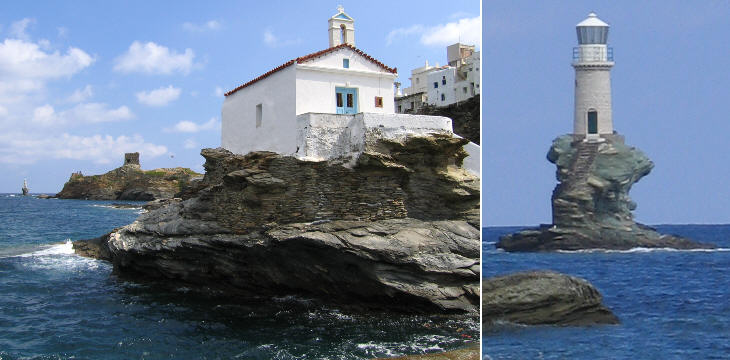
Ships no longer moor in the harbour of Andro. Ferries go back and forth from the port of Rafina on the eastern coast of Attica to Gavrio, a small town in a well protected bay on the north western coast of the island. The harbour of Andro was protected by a rock: the church built upon it is maybe dedicated to the sea as its name Aghia Thalassini suggests (thalassa=sea). The sea castle is visible behind the church and beyond it there is a modern lighthouse built on a small rock.
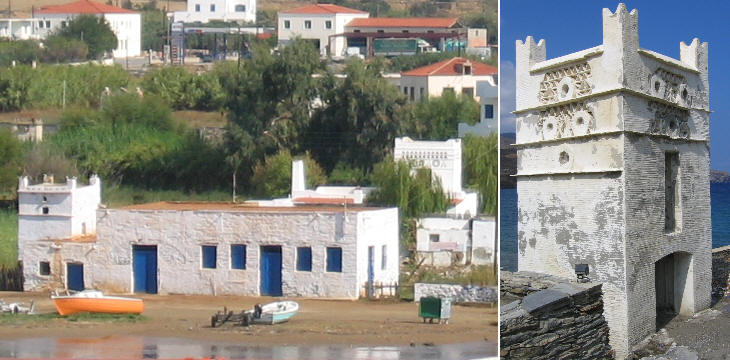
A distinctive mark which Andro shares with Tino is the number of dovecots in some parts of the island. The decoration of the dovecots can be seen also in modern buildings - such a shelter for those who are waiting for a bus! Introductory page on the Venetian Fortresses Pages of this section: On the Ionian Islands: Corfù (Kerkyra) Paxo (Paxi) Santa Maura (Lefkadas) Cefalonia (Kephallonia) Asso (Assos) Itaca (Ithaki) Zante (Zachintos) Cerigo (Kythera) On the mainland: Butrinto (Butrint) Parga Preveza and Azio (Aktion) Vonizza (Vonitsa) Lepanto (Nafpaktos) Atene (Athens) On Morea: Castel di Morea (Rio), Castel di Rumelia (Antirio) and Patrasso (Patra) Castel Tornese (Hlemoutsi) and Glarenza Navarino (Pilo) and Calamata Modon (Methoni) Corone (Koroni) Braccio di Maina, Zarnata, Passavà and Chielefà Mistrà Corinto (Korinthos) Argo (Argos) Napoli di Romania (Nafplio) Malvasia (Monemvassia) On the Aegean Sea: Negroponte (Chalki) Castelrosso (Karistos) Oreo Lemno (Limnos) Schiatto (Skiathos) Scopello (Skopelos) Alonisso Schiro (Skyros) Andro (Andros) Tino (Tinos) Micono (Mykonos) Siro (Syros) Egina (Aegina) Spezzia (Spetse) Paris (Paros) Antiparis (Andiparos) Nasso (Naxos) Serifo (Serifos) Sifno (Syphnos) Milo (Milos) Argentiera (Kimolos) Santorino (Thira) Folegandro (Folegandros) Stampalia (Astipalea) Candia (Kriti) You may refresh your knowledge of the history of Venice in the Levant by reading an abstract from the History of Venice by Thomas Salmon, published in 1754. The Italian text is accompanied by an English summary. Clickable Map of the Ionian and Aegean Seas with links to the Venetian fortresses and to other locations (opens in a separate window) |