  What's New! Detailed Sitemap All images © by Roberto Piperno, owner of the domain. Write to romapip@quipo.it. Text edited by Rosamie Moore. Page added in 2002. |
  Malvasia (Monemvassia) Malvasia (Monemvassia)
Key dates: Early XIVth century The Venetians occupy Malvasia 1540 The Venetians concede Malvasia to the Sultan Suleiman I as part of a peace treaty 1690 The Turkish garrison capitulates after three years of Venetian siege 1715 The Venetian garrison capitulates without fighting Malvoisie and malmsey are names of strongly flavoured sweet wines which replaced in Europe the Vin di Malvasia, often quoted in the description of Renaissance banquets. Before the Venetians lost the fortress of Malvasia this wine was shipped to Italy from this port. The Greek name of Malvasia, Monemvassia is in itself a description of the fortress as it means one entrance because there is only one access to the fortress.
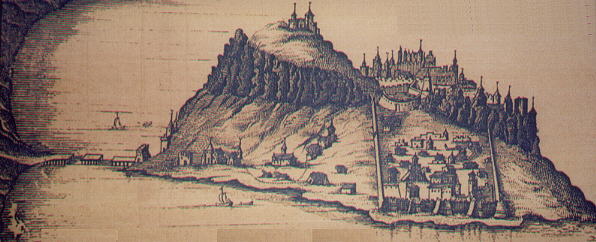
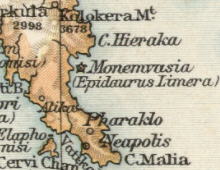
This Venetian print shows Malvasia when it was still in Turkish hands (most of the tall buildings are minarets) and by forcing perspective laws it shows the bridge linking the islet of Malvasia to the mainland and at the same time the town of Malvasia which is located at the opposite side and which cannot be seen from the mainland.
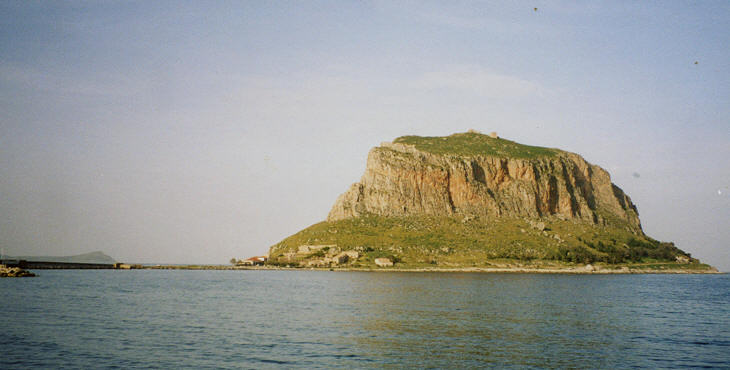
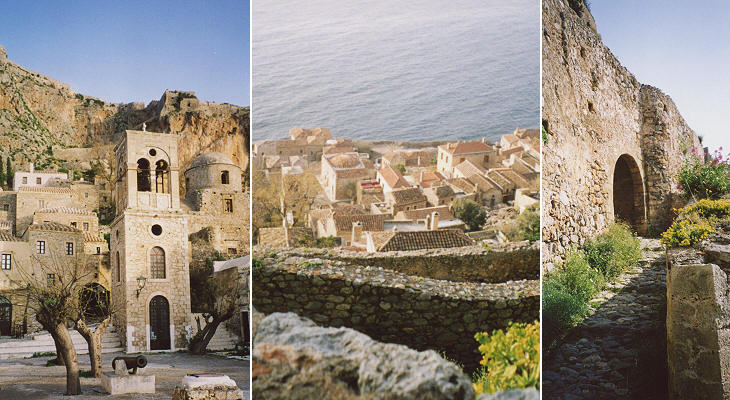
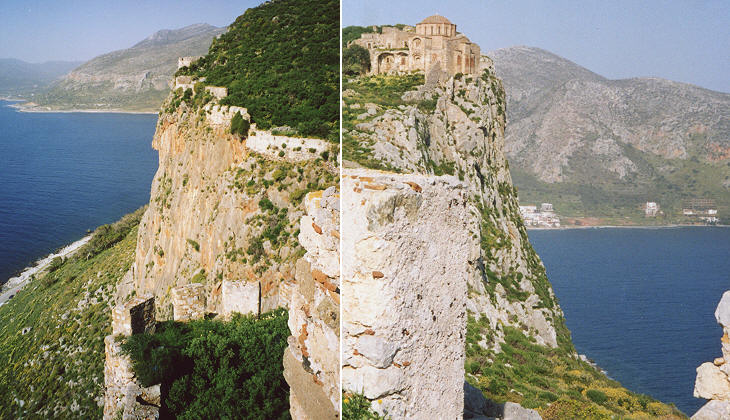
The Venetians used to say that nature itself had built the fortress and that little was needed to strengthen it. Malvasia was made of two parts: Borgo on a little terrace at the foot of the rock and Castello on the relatively flat space on its top.
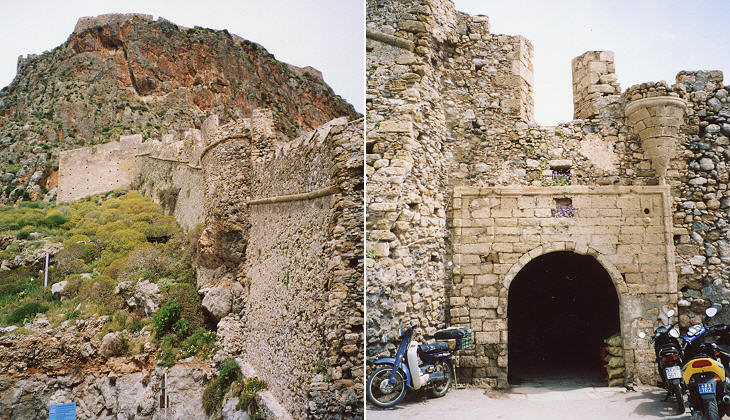
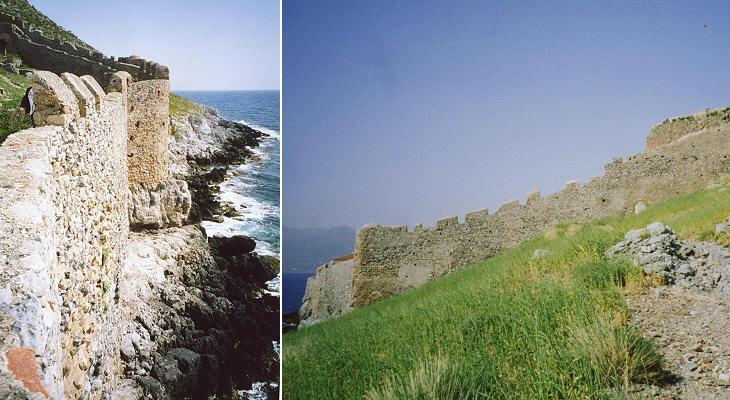
The walls protecting Borgo did not reach the fortifications of Castello: they just reached the almost vertical flanks of the rock and that was enough, because, although the Turks had a reputation for being very agile climbers of walls, they had little hope of being able to climb these rocks.
Enemies trying to assail Borgo from the sea had difficulties in landing because there is no beach and there is little space in which to site a camp.
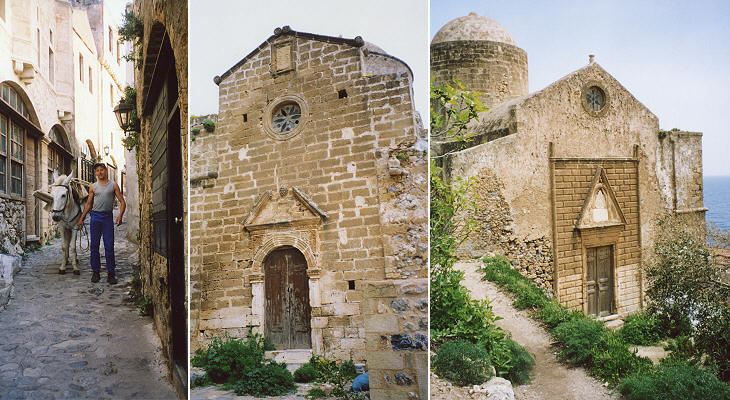
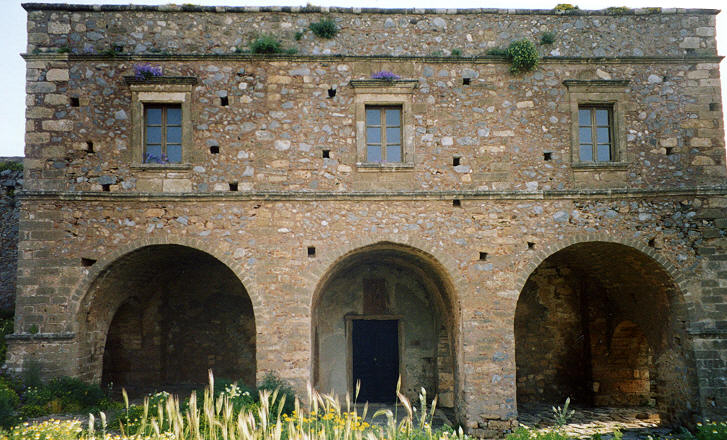
During the first Venetian occupation Malvasia was an important trade center and Borgo had fine houses and churches (the image used as a background for this page shows a Venetian relief in Borgo). Almost abandoned until very recent times, it is now flourishing again and a large number of houses are being restored; unfortunately also some new "cosy" buildings are being erected which in a few years will make Borgo look too pretty to be true. The fact that only donkeys can be used to carry materials inside Malvasia is just a delaying factor in this process, so travellers should hurry up and see Malvasia before it is too late.
Notwithstanding its defences Borgo was not an impossible target for a successful assault: what really looked impregnable was Castello. Only a steep and winding road led to it and it was interrupted by several walls. There was no space to place the artillery or to dig trenches or build fortifications.
In general Castello was protected by low walls, but in some spots the rock is so precipitous that the Venetians did not even care to strengthen these natural defences. In 1538 Suleiman I, the Magnificent vainly tried to seize Castello and in 1540 he promised the Venetians a lasting peace in return for Malvasia (and Napoli di Romania). The Venetian Senate had given his envoy to the peace talks the authority to give up Malvasia as a last resort to reach a settlement. From the very beginning the envoy was confronted with a Turkish request for Malvasia and eventually he gave his consent. A peace settlement was agreed and the two fortresses were handed over to the Turks. The Turkish insistence had however raised some suspicions and after lengthy investigations the Venetians discovered that the authorities granted to their envoy had been leaked to the French Ambassador in Venice, who passed this piece of information to his government. At that time Francis I, King of France, was allied with Suleiman against Charles V King of Spain and Emperor (of the Sacred Roman Empire) and he decided to let the Turks know the latitude of the powers given to the Venetian envoy.
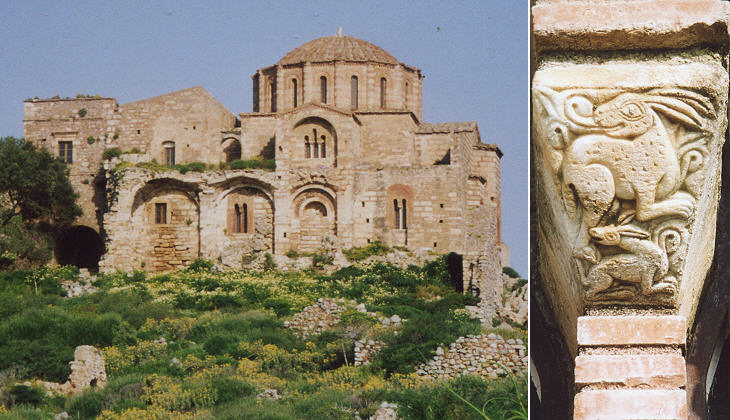
In 1690 the Turks capitulated after a three years' naval blockade, but in 1715 the Venetian commander surrendered without any attempt at resistance. The Turks did not have a clean record in their compliance with agreed capitulation terms, in particular due to their treacherous behaviour in Famagosta in 1571, but in their 1714-15 campaign they made a point from the very beginning of offering generous capitulation terms and to comply with them. The policy proved very effective because the demoralized Venetian commanders and their mercenary troops quickly surrendered their fortresses. The 1687 print at the top of the page shows that there were many buildings in Castello: today they are all in ruins except for the fine Byzantine church of Agia Sofia and a nearby Venetian residence.
Excerpts from Memorie Istoriografiche del Regno della Morea Riacquistato dall'armi della Sereniss. Repubblica di Venezia printed in Venice in 1692 and related to this page:
Introductory page on the Venetian Fortresses Pages of this section: On the Ionian Islands: Corfù (Kerkyra) Paxo (Paxi) Santa Maura (Lefkadas) Cefalonia (Kephallonia) Asso (Assos) Itaca (Ithaki) Zante (Zachintos) Cerigo (Kythera) On the mainland: Butrinto (Butrint) Parga Preveza and Azio (Aktion) Vonizza (Vonitsa) Lepanto (Nafpaktos) Atene (Athens) On Morea: Castel di Morea (Rio), Castel di Rumelia (Antirio) and Patrasso (Patra) Castel Tornese (Hlemoutsi) and Glarenza Navarino (Pilo) and Calamata Modon (Methoni) Corone (Koroni) Braccio di Maina, Zarnata, Passavà and Chielefà Mistrà Corinto (Korinthos) Argo (Argos) Napoli di Romania (Nafplio) Malvasia (Monemvassia) On the Aegean Sea: Negroponte (Chalki) Castelrosso (Karistos) Oreo Lemno (Limnos) Schiatto (Skiathos) Scopello (Skopelos) Alonisso Schiro (Skyros) Andro (Andros) Tino (Tinos) Micono (Mykonos) Siro (Syros) Egina (Aegina) Spezzia (Spetse) Paris (Paros) Antiparis (Andiparos) Nasso (Naxos) Serifo (Serifos) Sifno (Syphnos) Milo (Milos) Argentiera (Kimolos) Santorino (Thira) Folegandro (Folegandros) Stampalia (Astipalea) Candia (Kriti) You may refresh your knowledge of the history of Venice in the Levant by reading an abstract from the History of Venice by Thomas Salmon, published in 1754. The Italian text is accompanied by an English summary. Clickable Map of the Ionian and Aegean Seas with links to the Venetian fortresses and to other locations (opens in a separate window) |