  What's New! Detailed Sitemap All images © by Roberto Piperno, owner of the domain. Write to romapip@quipo.it. Text edited by Rosamie Moore. Page added in March 2012. |
 - Introduction - Introduction(detail of a statue of St. Catherine of the Wheel in the parish church of Zejtun) In 1291 Acre, a port in northern Palestine, fell into the hands of the Mameluke Sultan of Egypt: it was the last remnant of the Christian Kingdom of Jerusalem: its loss led Pope Boniface VIII to call the first Jubilee Year, in 1300, which granted special indulgences to those sinners who visited Rome and prayed at St. Peter's tomb, thus replacing the pilgrimages to Jerusalem. Two Christian military orders showed all their valour in the defence of Acre: the Templars and the Hospitallers (Knights of St. John). The latter order had as its primary objective providing shelter and medical care to pilgrims, but it also protected them during their journey, which accounts for its military organization: the knights who joined it came mainly from southern France: they were usually cadets of noble families who looked for an opportunity to serve their faith and show their gallantry. The Order was named after the first hospice which was dedicated to St. John (most likely St. John the Baptist). After the capitulation of Acre the Hospitallers went to Cyprus which at the time was a Christian kingdom ruled by the Lusignan family. The Order was able to reorganize its structure and its ranks there and in 1308, with the endorsement of Pope Clement V, the Hospitallers established themselves at Rhodes. In the following years they occupied Kos and some smaller islands and they built a fortress at today's Bodrum on the Asian mainland. After the 1453 conquest of Constantinople by the Ottomans, the Hospitallers started to build new imposing fortifications at Rhodes and at other sites, fearing that the Ottomans would sooner or later attack them. An Ottoman siege of Rhodes in 1480 failed, but in June 1522 Sultan Suleyman the Magnificent landed on the island with an army of 100,000. After six months of siege Grand Master Philibert Villiers De l'Isle Adam agreed to surrender the town and all the other castles which were still controlled by the Order. On January 1, 1523 the Knights and the Catholic inhabitants of Rhodes left the town carrying with them their banners and their holy images.
When the Knights left Rhodes, the season was not favourable for sailing, so they reached Candia (Crete), a Venetian possession, where they waited for weather conditions which allowed them to reach Sicily. Grand Master Villiers de l'Isle then started a sort of pilgrimage across Europe to talk to the Pope, to the Kings of England and France and to Charles, who was at the same time Holy Roman Emperor (V) and King of Spain (I). The Grand Master hoped to be given another island or a maritime territory from which the Knights could continue to operate against the Ottomans and possibly reconquer Rhodes. Results of the mission were disappointing as all the leaders he met tried to make use of the Knights for their own profit. Eventually he accepted the proposal of Charles V who offered the Order: a) the County of Malta (Malta, Gozo and three nearby islets), which was a fiefdom of Sicily; b) Tripoli, in today's Libya, which the Spaniards had conquered in 1510.
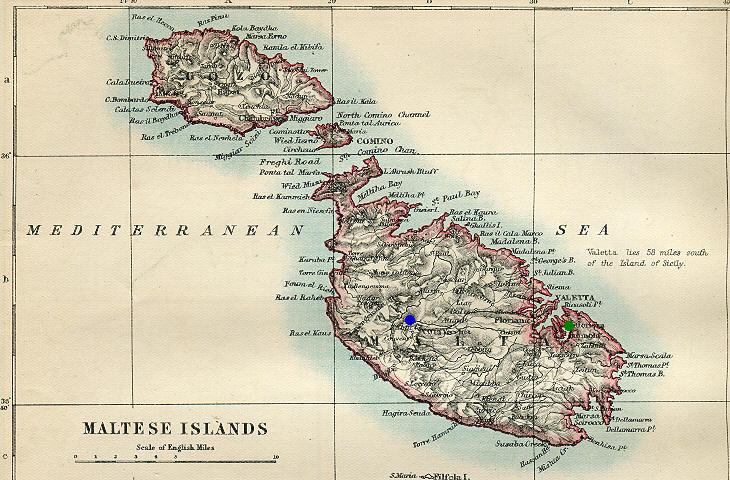
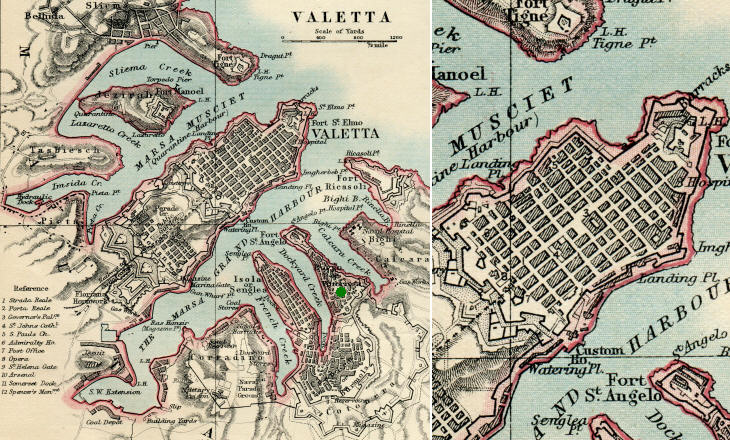
Hopes of reconquering Rhodes soon vanished because of the political and religious divisions among the Christian Nations which were supposed to help the Knights. Tripoli was lost in 1551, so Malta became by necessity the permanent home of the Order of St. John. Città Notabile (today's Mdina) was the main town of the island and the see of its bishop, but it was located inland so the Knights chose to place their headquarters at Borgo (the name in Italian indicates a settlement outside a town) which was well positioned inside a very large natural harbour. Auberges, hostels where the knights of each tongue (country) lodged or just met, were therefore built at Borgo, which was renamed Città Vittoriosa after having withstood an Ottoman siege in 1565. Consistent with the motto of the Order Pro Fide, Pro Utilitate Hominum (For the Faith, In the Service of Humanity), the Knights built a small hospital, although no pilgrims called at Malta on their way to the Holy Land.
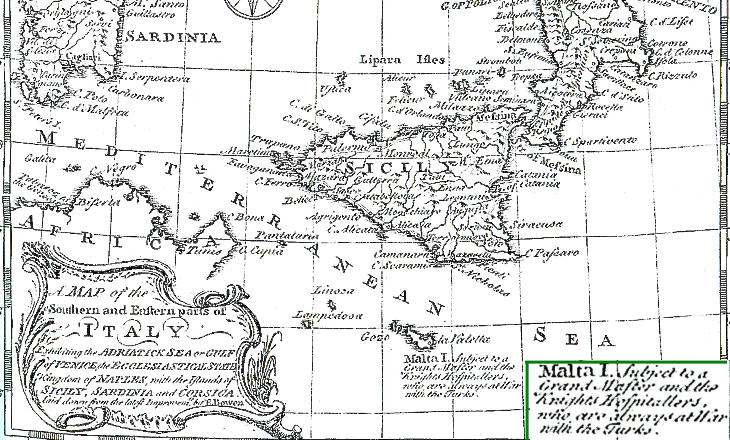
The mission of the Knights during their stay at Malta focused on attacking Ottoman ships and raiding the coasts of Ottoman territories, especially those of Tunisia. They also confiscated goods belonging to Muslim or Jewish merchants on board Christian ships. Their constant aggressive behaviour was summarized by Emanuel Bowen, Royal Mapmaker to King George II of England, in the note shown above. The title of this section is The Pro Fide Knights because during their stay on Malta the Hospitallers did not attach great importance to Pro Utilitate Hominum, the second half of their motto. The image used as background for this page shows a detail of a painting in the Grand Masters Palace at Valletta showing a Maltese warship in action. Note: the naming of Maltese locations is often confusing: today's Mdina was Melita for the Romans, Medina (walled town) for the Arabs, Città Notabile during the Aragonese rule, Città Vecchia (old) after the foundation of Valletta and eventually Mdina in 1934 when Maltese became an official language alongside English and Italian was dropped from official use. In this section locations are referred to by the names they had at the time the event occurred/the monument was built. Move to: Brief outline of the history of Malta before 1530 The Grand Masters of the XVIth century The Grand Masters of the XVIIth century The Grand Masters of the XVIIIth century Valletta: the fortifications Valletta: the churches Valletta: other monuments Borgo/Città Vittoriosa (Birgu) Senglea (Isla) Città Cospicua (Bormla) Floriana Other Fortifications Città Vecchia (Mdina) Gozo Island Churches in the minor towns Other monuments in the minor towns Rome and Malta You may wish to see a section on the Castles of the Crusaders in Syria some of which belonged to the Hospitallers.     |