  What's New! Detailed Sitemap All images © by Roberto Piperno, owner of the domain. Write to romapip@quipo.it. Text edited by Rosamie Moore. Page added in March 2012. |
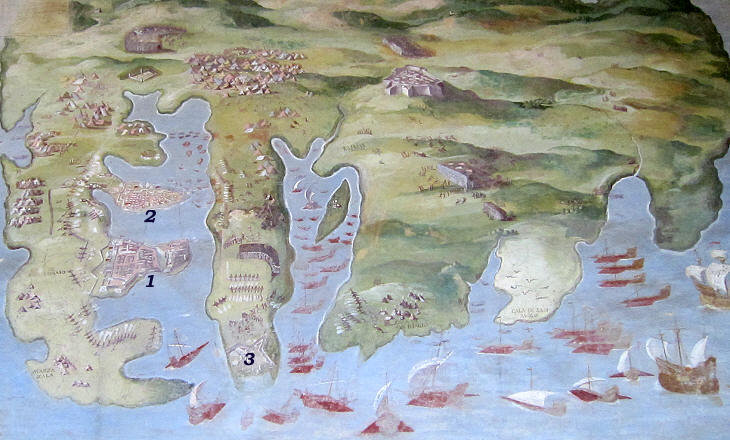
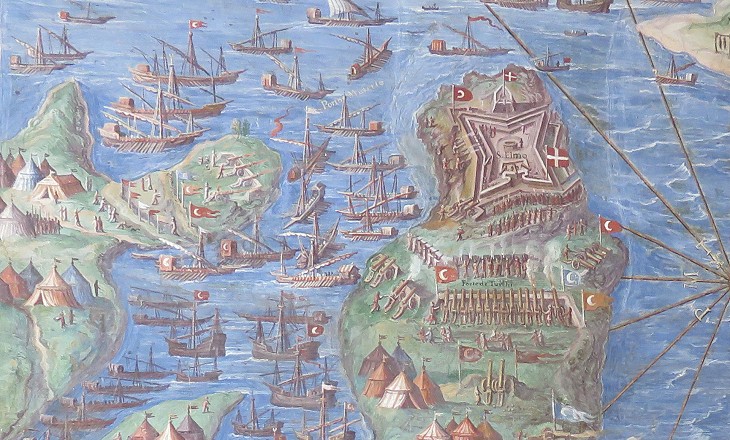
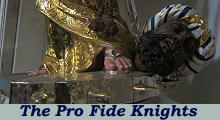 - Valletta - The Fortifications - Valletta - The Fortifications(detail of a statue of St. Catherine of the Wheel in the parish church of Zejtun) In late May 1565 a large Ottoman army landed on Malta and it laid siege to the three fortresses of the Knights which protected the main harbour of the island. The Knights managed to withstand Ottoman assaults throughout the whole summer, thus giving time for the Viceroy of Sicily to come to their rescue. In September the Ottomans left the island on learning the news that a Spanish relief army had landed on its northern coast.
The (failed) Great Siege of Malta interrupted a long series of Spanish setbacks at sea (Battle of Preveza in 1538) and on land (failed siege of Algiers in 1541, loss of Tripoli in 1551 and loss of Bougie, a key port in Algeria, in 1555).
The Ottoman first attack was on Fort St. Elmo which was located at the entrance of the great harbour of Malta. The Knights managed to defend it for a month thus delaying the Ottoman siege of Borgo, the residence of the Grand Master. Fort St. Elmo was a well designed fortress, but it was dominated by a nearby hill where the Ottomans placed their artillery. It was virtually destroyed when the last knights abandoned it.
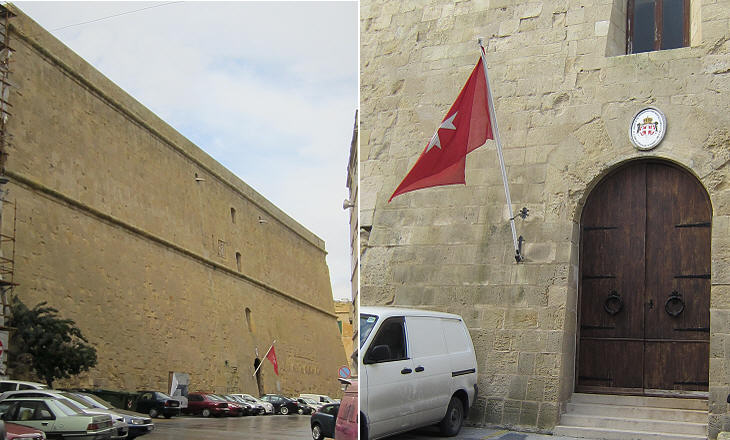
The reconstruction of Fort St. Elmo started immediately after the Ottomans left Malta, because Grand Master de Valette was convinced of its key importance. The design of the fortress is similar to that of many Italian star forts, but owing to the shape of the ground, the bastions are very angled. Fort St. Elmo was eventually incorporated into wider fortifications built by the Knights and during the period of British rule. Today it houses Malta's Police Academy.
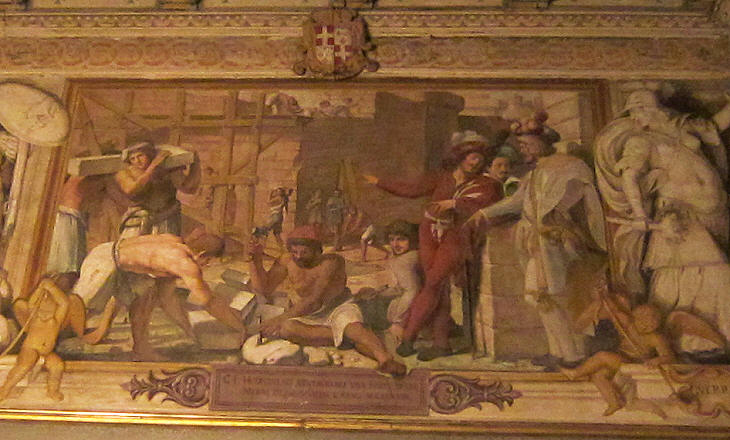
The Great Siege of Malta increased the reputation enjoyed by the Knights of St. John which had suffered from the 1522 surrendering of Rhodes and other possessions in the Aegean Sea. Grand Master de Valette felt that the Order needed a more adequate location and he decided to build a new town on the hill where the Ottomans had placed their artillery to hit Fort St. Elmo, thus remedying the key weakness of the fortress. The town was named La Valetta after its founder.
The design of the fortifications of the new town were entrusted to Francesco Laparelli, an Italian military engineer who had designed the new walls of Castel Sant'Angelo in Rome for Pope Pius IV. In 1669 Laparelli left Malta and Girolamo Cassar, his Maltese assistant, supervised the completion of the fortifications.
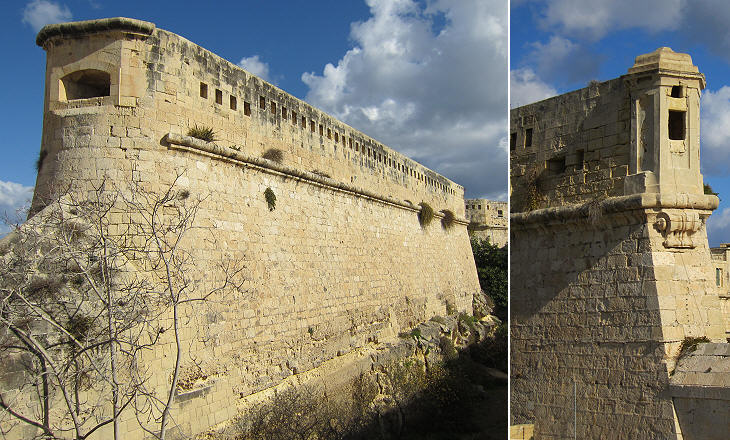
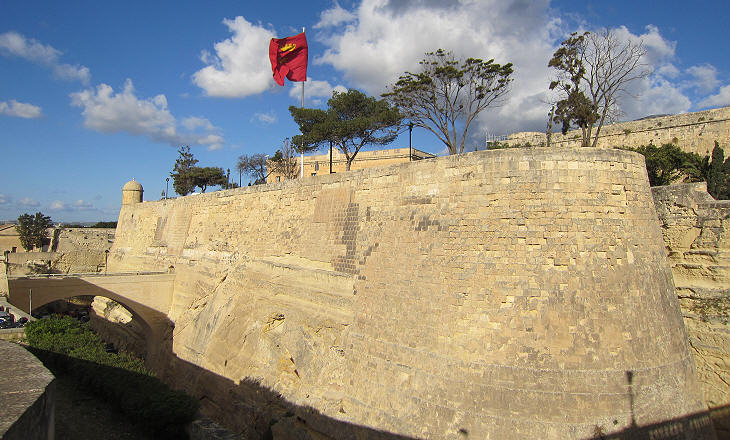
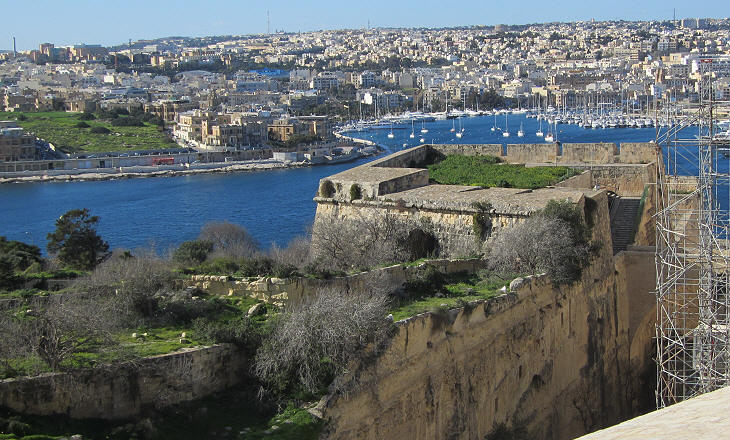
The defence of Valletta from attacks by land was based on two massive bastions named after St. John and St. James. Overall the main components of St. James' Bastion have not been modified significantly by later additions/modifications and by the opening of modern roads. The bastion itself had the shape of a gigantic orecchione (big ear), very similar to those built by Michele Sammicheli at Candia, a few years earlier.
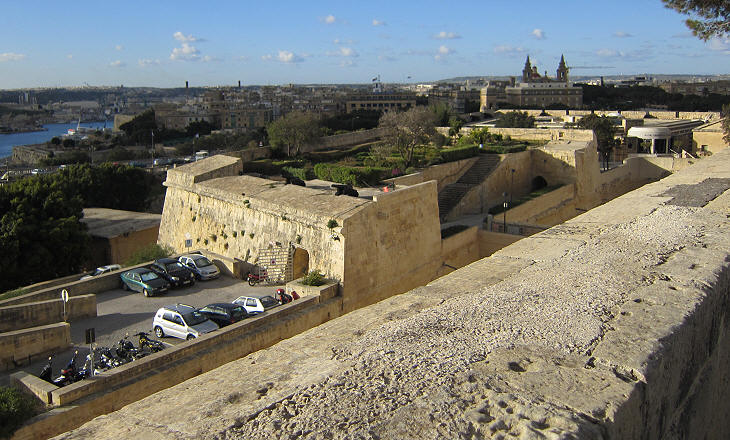
The bastion was protected by a counterguard, a smaller bastion located at a lower level; the defenders could easily move between the bastion and the counterguard via underground passages which could be blown up in case the counterguard was no longer defendable. The enemy who had managed to seize the counterguard would have found himself coming under attack from the bastion. Today St. James's Counterguard houses offices of the National Bank of Malta.
A huge cavalier was the last resort for the defenders of St. James' Bastion. In 1686, probably because the 1683 failed Siege of Vienna had reduced the threat of an Ottoman invasion, the cavalier was turned into a granary by Grand Master Carafa.
In 1798 the Knights surrendered their rights to Malta to the French and abandoned the island. The Order continues to survive and today its Grand Priory is located in Rome. The Grand Master resides at the Order's palace in Via Condotti. The exact status of the Order according to international law is uncertain, but in recent years the number of states which have established diplomatic relations with it has grown to ca 100. The current full name of the Order is Sovereign Military Hospitaller Order of Saint John of Jerusalem of Rhodes and of Malta.
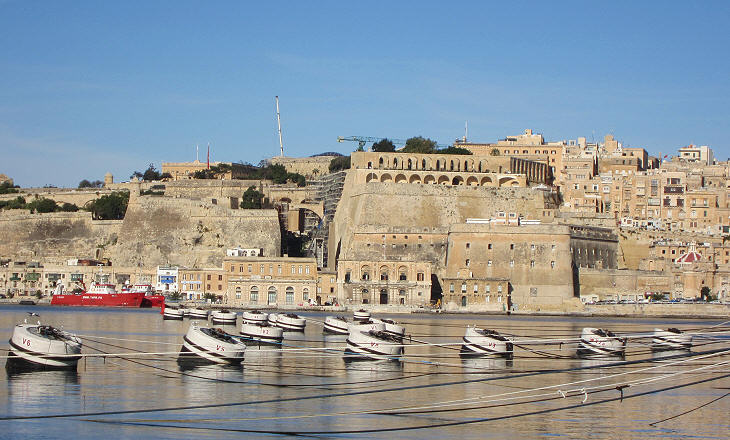
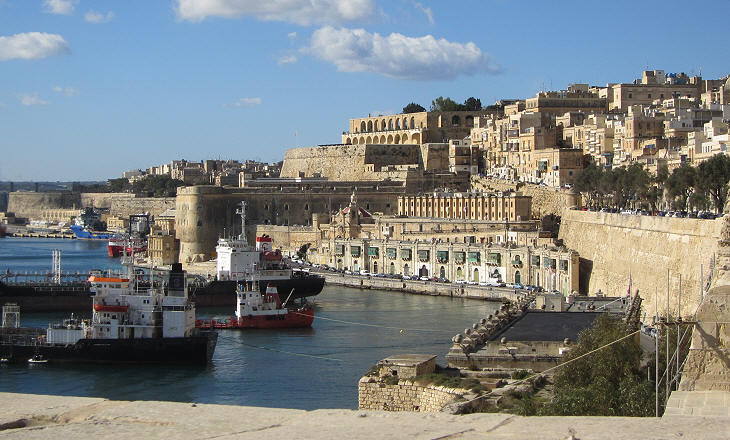
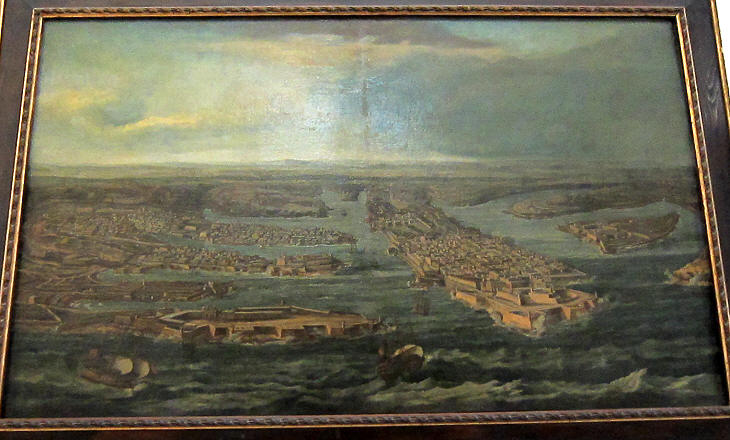
The peninsula upon which Valletta was built divides the natural harbour into two sections; the northern one is small and for some time was known as Quarantine Harbour, because of a lazaretto built on an islet. Today it is called Marsamxett Harbour. The southern section housed Porto delle Galere, the actual harbour of the Knights. For this reason the fortifications of Valletta on this side are more imposing than those on the northern one.
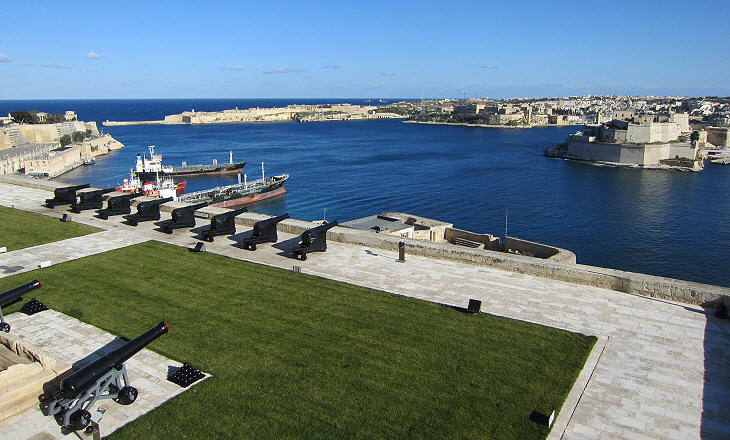
In addition to protecting Porta Marina, the sea gate of Valletta which was demolished in 1885, Sts. Peter and Paul's Bastion contributed to the defence of Fort S. Angelo, at the tip of Borgo/Vittoriosa. Today the gardens built by the British on the top of the bastion provide the best view over the Knights' complex system of fortifications. During WWII the British Operational Headquarters in Malta were located inside this bastion in underground rooms built by Grand Master Lascaris.
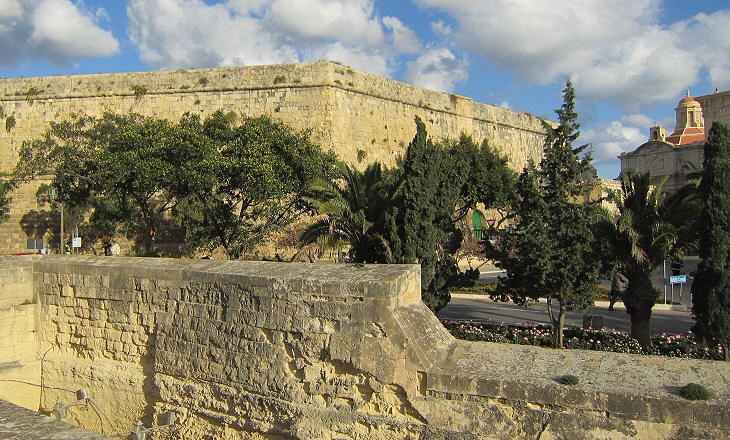
St. Michael's Bastion is the equivalent to Sts. Peter's and Paul's Bastion on the northern side of the land walls. While the fortifications of Valletta can still be admired almost as they were designed, the original gates are lost. Porta S. Giorgio was opened by Laparelli between the two main bastions; it was probably designed giving more importance to defensive requirements, than to appearance. In 1632 it was replaced by a second gate designed by Tommaso Dingli at the time of Grand Master de Paule. The new gate resembled an ancient triumphal arch with three archways, but in the XIXth century it was pulled down and replaced by a third gate, which in turn was replaced by a fourth one in 1964. This fourth gate was pulled down in 2011 as part of a very, very, very large real estate development. In January 2012 a new gate designed by Renzo Piano (external link) was in the process of being built.
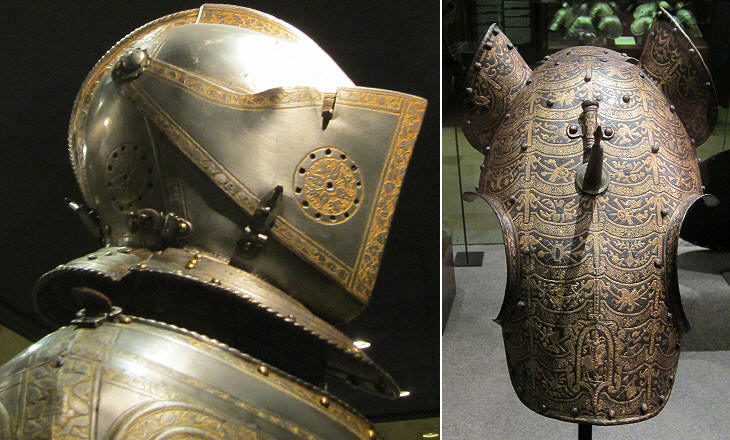
The Knights had little opportunity for showing their military skills as cavalrymen. The heavy armouries some of them commissioned to Lombard makers, including Pompeo della Cesa (you may wish to see a helmet by him at The Art Institute of Chicago - external link), were utilized only for parades and tournaments or for being portrayed wearing them as in the portrait of Grand Master Alof de Wignacourt by Caravaggio (external link - the page was rumoured to be the lover of both men).
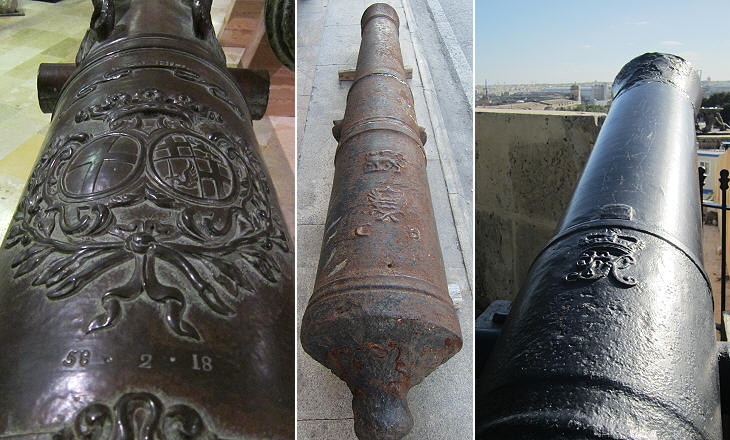
Effective artillery was the natural complement to solid bastions in ensuring the defence of Valletta. While other branches of warfare required physical exercise, courage and strength, the effectiveness of artillery was based on mathematical knowledge and advanced metallurgy. The defensive scheme designed by Laparelli was never put to the test as the Ottomans did not make a second attempt to conquer Malta. In 1798 Grand Master von Hompesch surrendered Valletta to the French, practically without fighting. Chronicles report that when General Napoleon Bonaparte made his entrance into the town he pointed at its imposing bastions and said to one of his assistants: I am very glad that they opened the gate for us.
Move to: Introductory Page Brief outline of the history of Malta before 1530 The Grand Masters of the XVIth century The Grand Masters of the XVIIth century The Grand Masters of the XVIIIth century Valletta: the churches Valletta: other monuments Borgo/Città Vittoriosa (Birgu) Senglea (Isla) Città Cospicua (Bormla) Floriana Other Fortifications Città Vecchia (Mdina) Gozo Island Churches in the minor towns Other monuments in the minor towns Rome and Malta     |