  What's New! Detailed Sitemap All images © by Roberto Piperno, owner of the domain. Write to romapip@quipo.it. Text edited by Rosamie Moore. Page revised in August 2015. |
  - The Acropolis - The Acropolis
(detail of a statue of either Trajan or Hadrian) The grand plain of Pergamus was in full view before us (..) and in the front distance rose its majestic acropolis. Francis Vyvyan Jago Arundell - A Visit to the Seven Churches of Asia - 1826
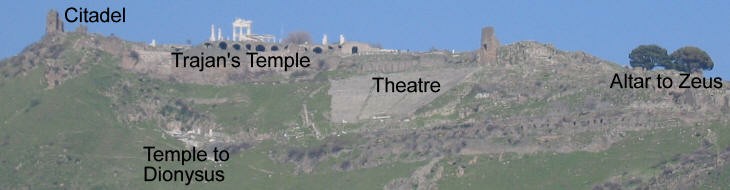
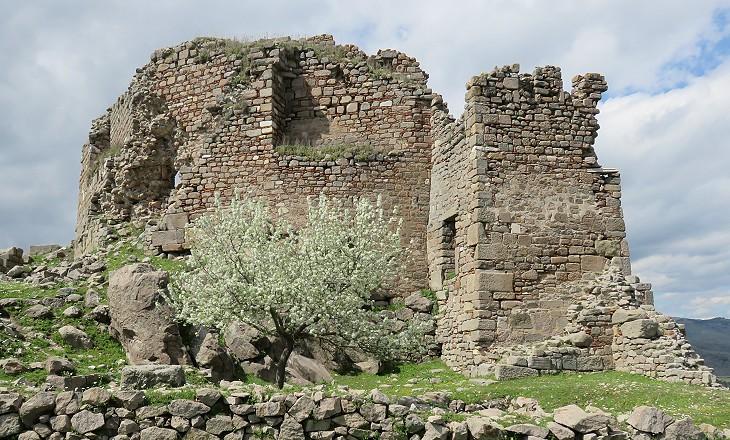
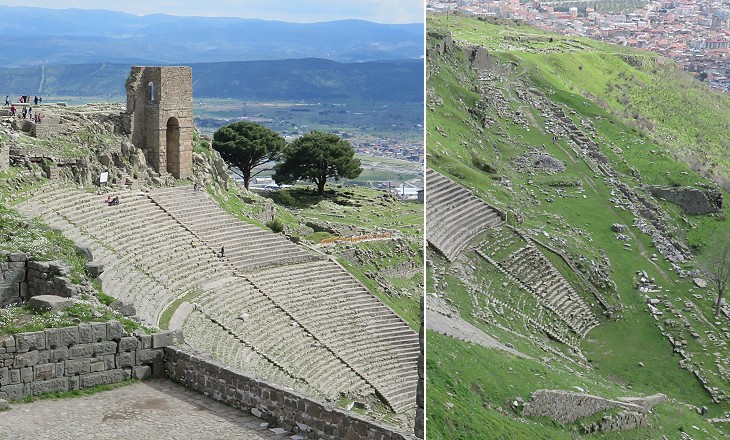
The castle, which covers the whole summit of the mountain, includes about eight acres, resembling those at Smyrna and Aiasoluk, and probably contemporary with them. James Dallaway - Constantinople Ancient and Modern with Excursions to the Shores of the Islands of the Archipelago and to the Troas - 1797 Only some fallen columns of the Temple to Trajan and parts of the theatre were visible to the first western travellers who described the Acropolis of Pergamum. Major archaeological activity began in 1878 and it initially consisted of removing most of the walls of the castle which had been built over the ancient monuments. A few Byzantine towers can still be seen on the northern peak of the Acropolis and near the theatre.
The marbles found here are numerous, and are continually taken off for the museums of Europe. The French sent a vessel last year for a bath and statue (and a funerary vase which is now on display at the Louvre Museum in Paris), which had been for years unnoticed. Charles Fellows - Journal Written during an Excursion in Asia Minor in 1838 The splendour of Pergamum in the IInd century BC can only be understood by visiting the reconstruction of the Altar to Zeus at the Pergamonmuseum (it opens in another window) in Berlin. The altar was decorated with a 120-meter-long frieze, portraying the Gigantomachy, the battle between the Olympian gods led by Zeus and the giants led by Alcyoneus.
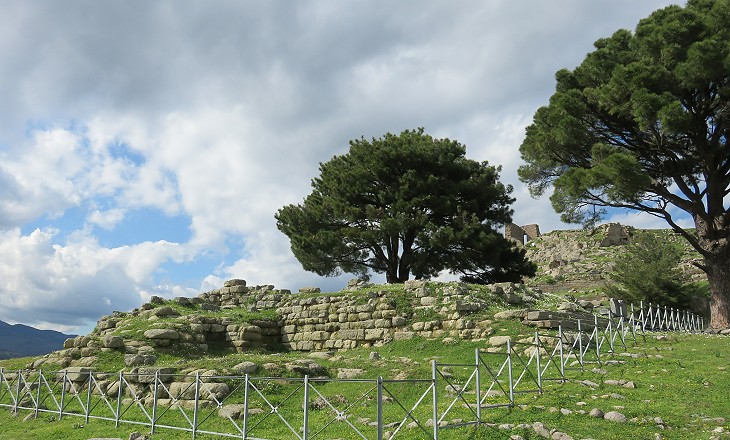
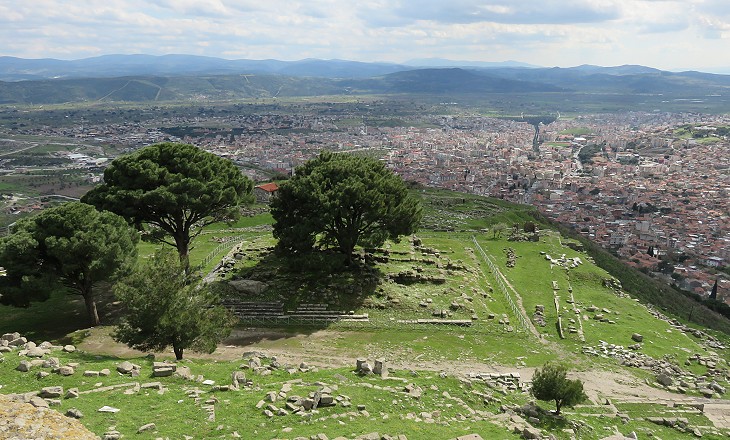
Visitors who view the few remaining stones of the altar may feel betrayed by their guidebooks claiming that the Altar to Zeus is a "must see" for any traveller in Turkey: nevertheless those who are in the right state of mind, not too tired, not perspiring too much, not in much of a hurry, may find this (not much crowded) site very evocative. The Altar is westwards oriented and it has a commanding view over the Lower Town (on a clear day one can see the Aegean Sea shining in the distance).
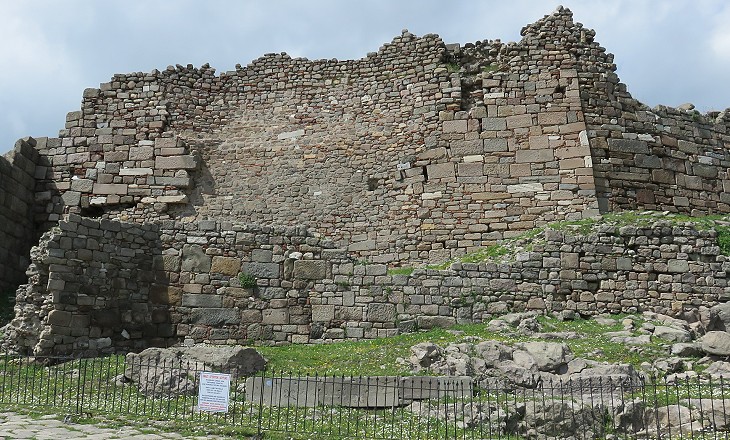
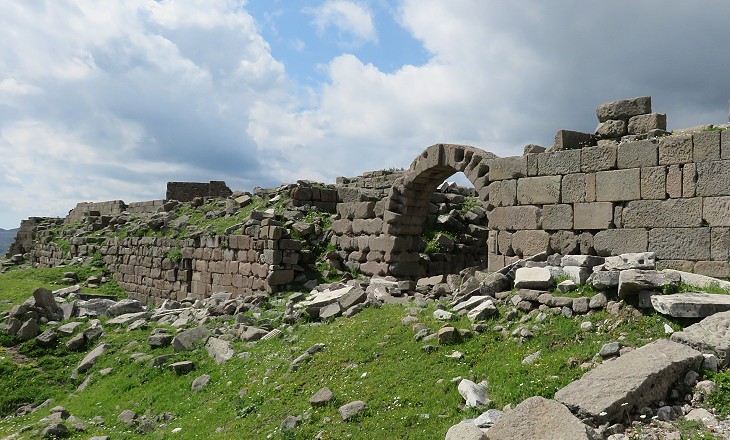
Archaeologists stopped dismantling the castle where they noticed that the lower sections of some of its walls were very ancient. It has thus been possible to identify the enclosure which protected the palaces, barracks and cisterns of the Acropolis in the IIIrd century BC.
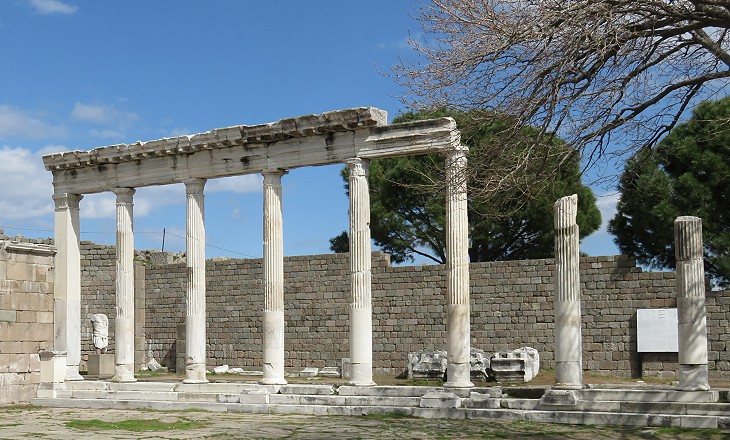
The palaces of the Kings of Pergamum were situated on a terrace on the eastern side of the Acropolis. Access to the palaces was controlled by small gates. This part of the Acropolis was a sort of keep. It does not appear it had temples or markets, however the exact location of a monument erected by King Attalus I has not been identified yet.
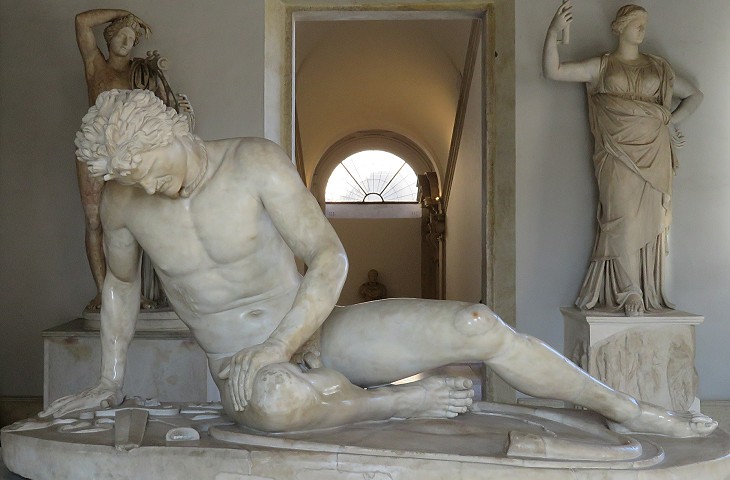
The monument celebrated a victory over the Galatians, a tribe living on the Anatolian tableland. It was decorated with (lost) bronze statues, two of which we know after Roman marble copies.
Archaeologists have found stretches of ancient stone walls in relatively good condition, but they rarely show evidence of being high enough to support a ceiling. It is therefore possible that the buildings had stone foundations, but were completed with timber panels and roofs (similar to traditional Ottoman houses e.g. those of Safranbolu). Pergamum was not conquered by the Romans. In 133 BC Attalus III, its last king, bequeathed the city to the Romans and this granted its inhabitants the continued benevolence of the new rulers (the only exception being Marcus Antonius who deprived the Library of Pergamum of many of its volumes to replenish that of Alexandria, which had been damaged by Julius Caesar).
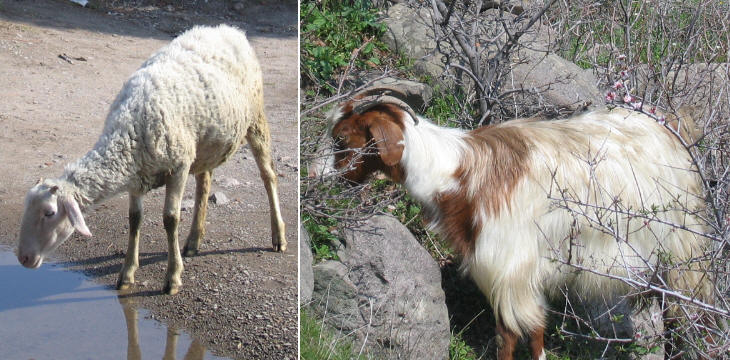
Pergamum was famous for its Library and its volumes written on parchment (paper obtained from the skin of sheep and goats): of this building only some low walls are visible near the ancient royal palaces. So in a way the sheep and goats which graze in the archaeological site are a better memory of the Library, than a few stones scattered here and there.
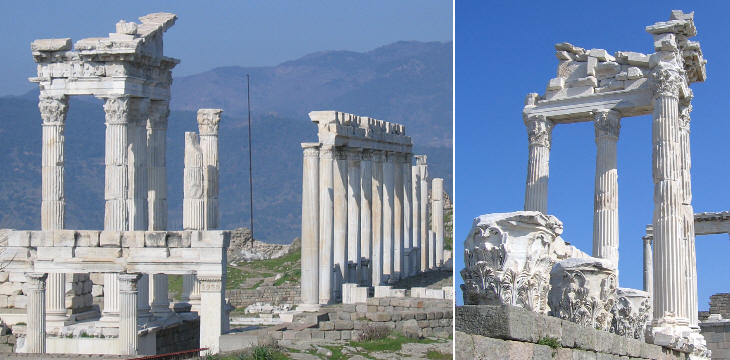
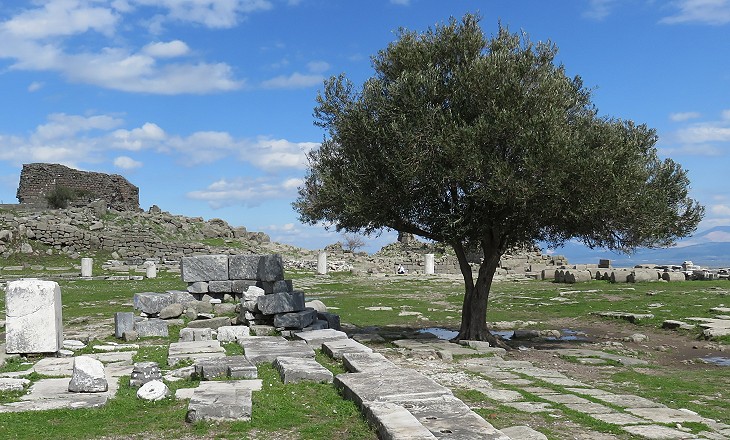
Four columns of Corinthian, as first adopted by the Romans, with capitals, and angles of the cornice and pediment, in the highest ornament, lie in a lofty heap. (..) It is, however, worthy remark, that the columns are sculptured with wreaths of laurel, and the friezes have deep festoons of the fame, with eagles; a mode of decoration characterising many edifices created in the days of Trajan, who, it is therefore a fair supposition, was honoured by this edifice. J. Dallaway
The temple stood at the centre of a rectangular square surrounded on three sides by porticoes/ancillary buildings. It was completed by Emperor Hadrian whose name is associated with other buildings in Pergamum i.e. a library in the Asklepion and the Temple to Serapis in the Lower Town. It was dedicated to Zeus Philios (Zeus, God of Friendship, that between Rome and Pergamum) in addition to Trajan (and Hadrian). Parts of the temple have been reconstructed with capitals and broken columns found on the site.
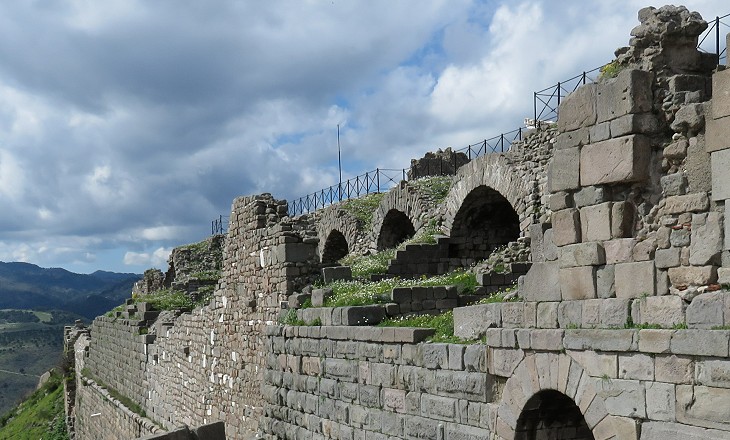
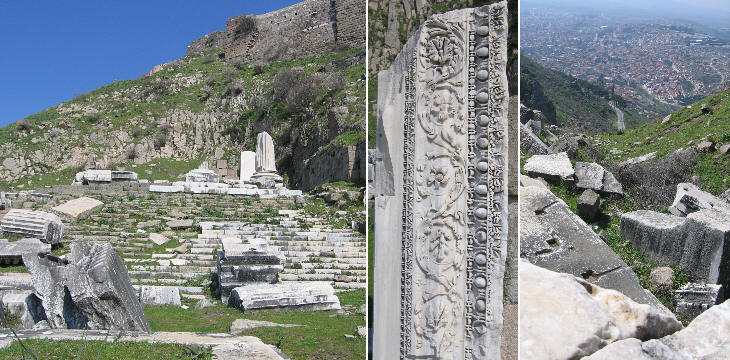
Facing the south is a wall of hewn granite, at least a hundred feet deep, ingrafted into the rock; and above that a course of large substructions, forming a spacious area, upon which once rose a temple unrivalled in sublimity of situation, being visible from the vast plain and the Aegean Sea. J. Dallaway The gigantic wall supporting the terrace of the temple and its net of vaulted passages which reduced the impact of earthquakes are an excellent example of the construction techniques which have made Roman monuments withstand the ravages of time.
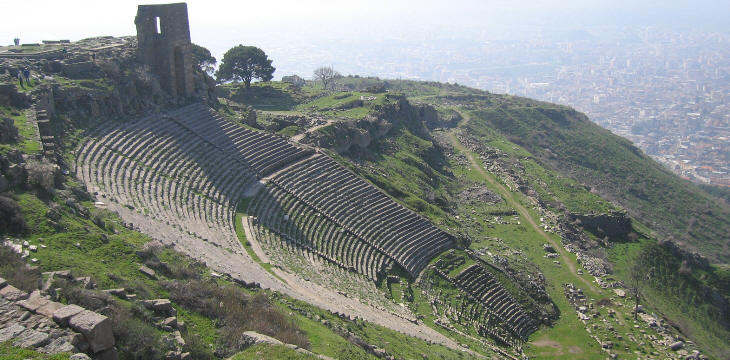
The theatre of Pergamum is incredibly steep and it was initially designed during the reign of the kings of Pergamum. It was enlarged by the Romans so that with its 80 rows of seats it could accommodate an audience of 10,000. In order to facilitate the access of the public a long colonnaded street (its path is still visible) led to the lowest section of the theatre.
Had Mark Twain visited Pergamum in his 1867 tour of the Levant he would have dubbed this theatre as "The only Theatre in the World where you do not have to bother about a tall person seating in front of you!". In the IInd century AD Pergamum had four theatres because also the Lower Town and the Asklepion had theatres.
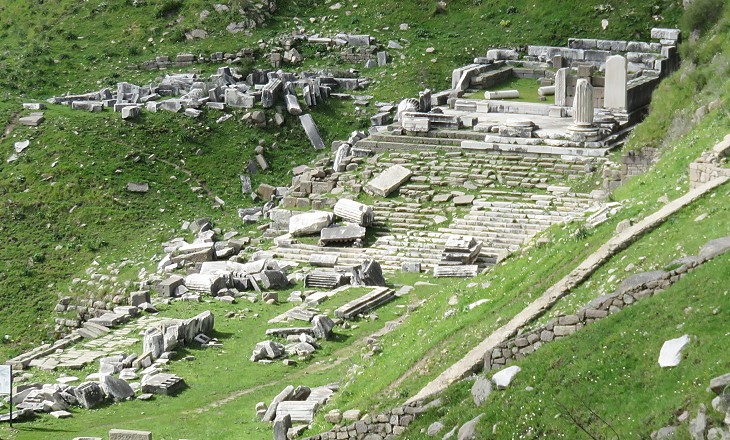
Dionysus (Bacchus to the Romans) was the god of theatre and this explains why a temple dedicated to him was built near the theatre stage. It was not the only reason, because the kings of Pergamum claimed to descend from Dionysus Kathegemon (he who leads) and another temple to the god existed on the other side of the Acropolis (and in other towns of the kingdom).
In the IInd century AD the temple was destroyed by fire. It was rebuilt by order of Emperor Caracalla who visited Pergamum in ca 214. Its scattered stones recall those of Termessos, a town which was destroyed by an earthquake.
What is said about the Altar to Zeus applies to the Temple to Athena. The grand entrance to the sacred area surrounding the temple was reconstructed in the Pergamonmuseum (it opens in another window). It was built in the early IInd century BC. A small frieze from the temple can be seen at the Archaeological Museum of Pergamum.
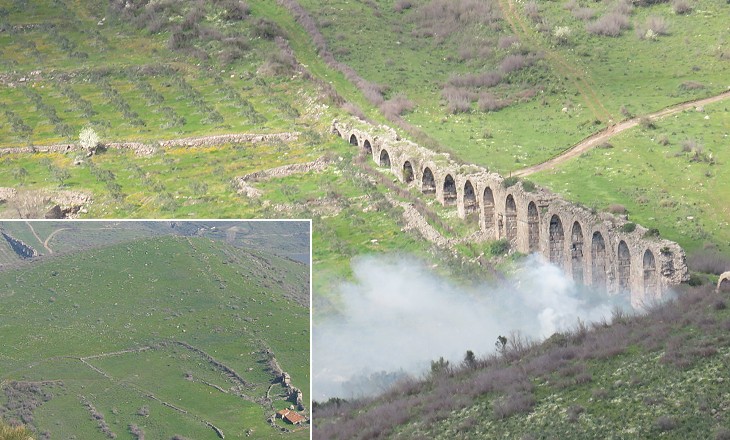
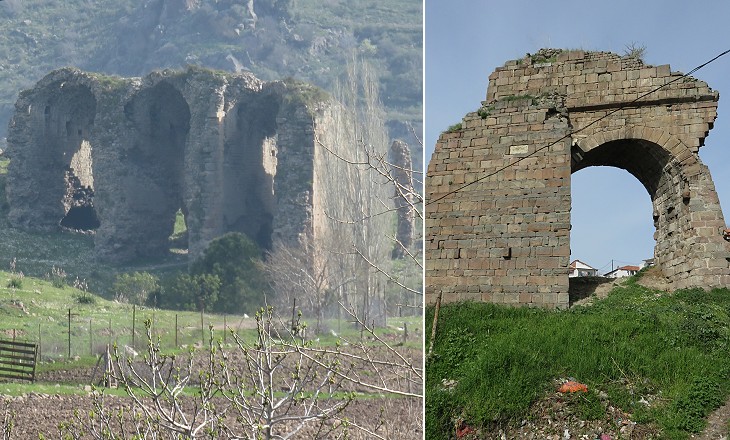
With a descent, almost perpendicular on the north and western sides, is a very narrow valley, over which, at one extremity, the great aqueduct of one row of lofty arches is constructed, and at the other a pile of massive building, which, filling the whole breadth of the valley, was the front and grand entrance into the naumachia, an amphitheatre. J. Dallaway We left Bergama at nine o'clock, and proceeded directly into the mountains towards the north, at the foot of which the town stands. On the right I saw in two places the ruins of aqueducts; these connect the hills, which are picturesque. C. Fellows
Some forty aqueducts provided Pergamum with an ample supply of water, even to the acropolis which stood at the top of an isolated hill. Roman engineers managed to create such pressure conditions that the water reached a cistern located on the highest point of the acropolis. Sections of the aqueducts and of an amphitheatre can be seen in the countryside immediately outside the Lower Town.
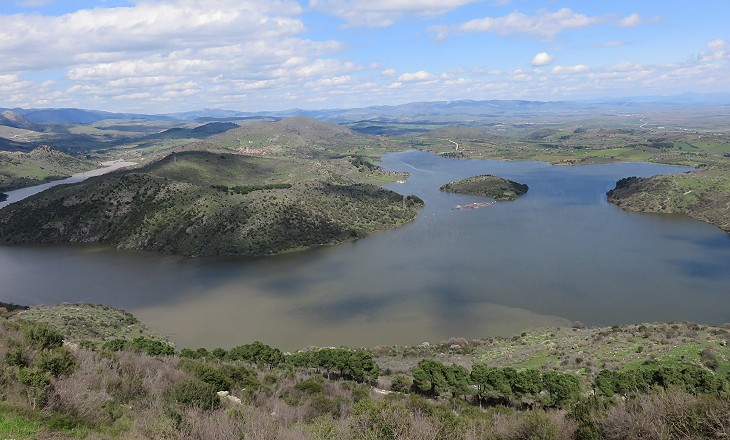
(In Turkey) dams swallow monuments of importance. (..) The responsibility of the cultural property to remain under the lake of Kestel Dam near Bergama was taken by the Ministry of Culture. Roman sites and an Ottoman bridge were excavated and documented. A Roman aqueduct was surveyed photogrammetrically. From a lecture on Conservation and Restoration of Historic Monuments in Turkey at an International Congress in Québec City in 1981. A fine sarcophagus found in the area covered by the lake can be seen at the Archaeological Museum. Move to: The Lower Town The Asklepion The Archaeological Museum Map of the Ionian and Aegean Seas with links to other locations covered in this website (opens in a separate window) Clickable Map of Turkey showing all the locations covered in this website (opens in another window).     |