  What's New! Detailed Sitemap All images © by Roberto Piperno, owner of the domain. Write to romapip@quipo.it. Text edited by Rosamie Moore. Page added in March 2007. |
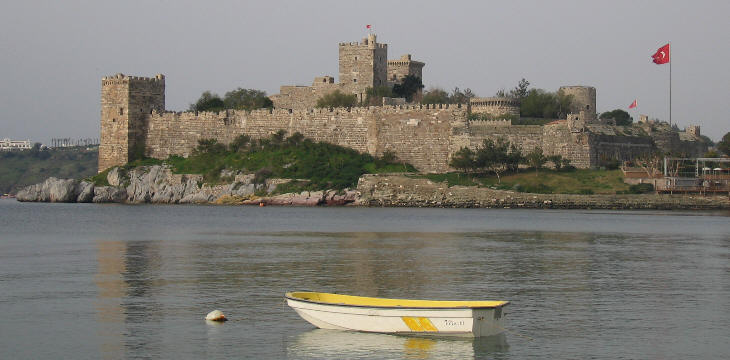
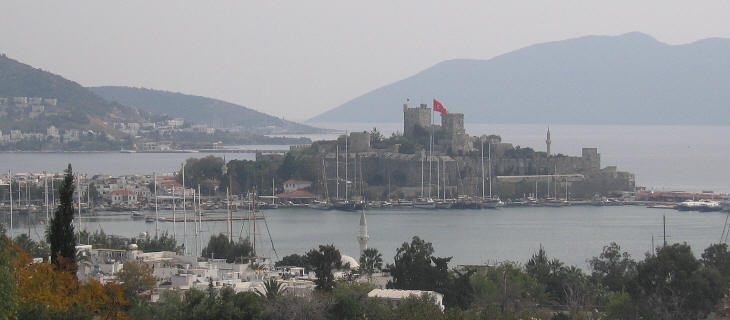
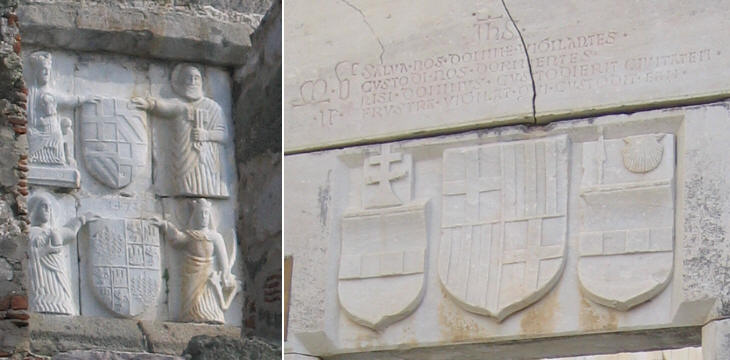
 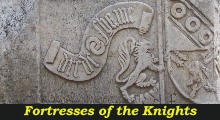 St Peter's Castle (Bodrum) St Peter's Castle (Bodrum)(relief in the fortress of Bodrum) Today's Bodrum is one of the leading Turkish resorts: its marina is full of luxury boats, the town has plenty of restaurants and cafés. On the promenade along the harbour there are more real estate agents than other shops: they sell a variety of buildings from luxury villas to one bedroom flats in large apartment blocks, but regardless of size, facilities and location all the offers promise a view over the fortress of the Knights.
Bodrum owes its name to that given by the Knights to St Peter's Castle, the fortress they built on the site of the palace of Mausolus, the Persian governor of Halicarnassus (Engl Peter; Greek Petrunion; hence Bodrum). The name of Mausolus is associated with the noun mausoleum which indicates a large and stately tomb. Artemisia, Mausolus' wife (and sister) built in memory of her beloved husband such a large monument that it was included among the Seven Wonders of the World. The ruins of the Mausoleum were excavated in the XIXth century by the British archaeologist Charles Newton: he found some slabs of a frieze which are now in London's British Museum. In nearby Mylasa a replica of the Mausoleum was built in the IInd century AD.
In 1402 the Knights' fortress of Smyrna was seized by Timur, the leader of Turco-Mongol tribes, who invaded most of western Asia. Grand Master Naillac (1396-1421) made an attempt to reconquer Smyrna, but it is said that his troops lost heart when the heads of their fellow-knights who had capitulated were thrown at them from the walls of the town. It was important for the Knights to have a fortress on the mainland in order to control the coastal route: in 1406 Naillac therefore decided to fortify the ruins of ancient Halicarnassus which was located opposite Kos: the new fortress was called St Peter's Castle.
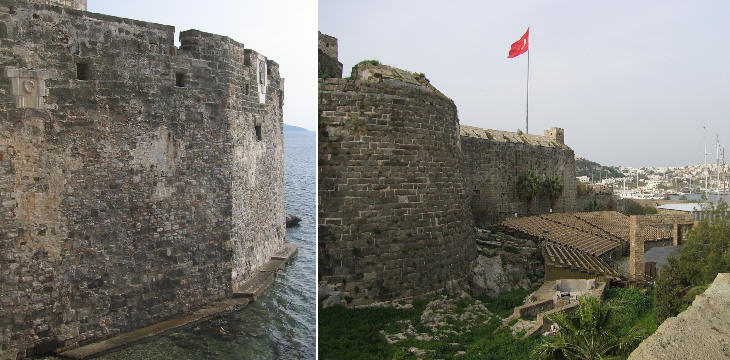
The palace of Mausolus was known for its secret harbour: its entrance is still visible in the fortress while its site is now silted: it allowed Mausolus and later on the Knights to receive direct supplies and to shelter a few ships. Grand Master Del Carretto (1513-21) built a round bastion to strengthen the land side of the fortress: he had done the same at Kos and at Rhodes.
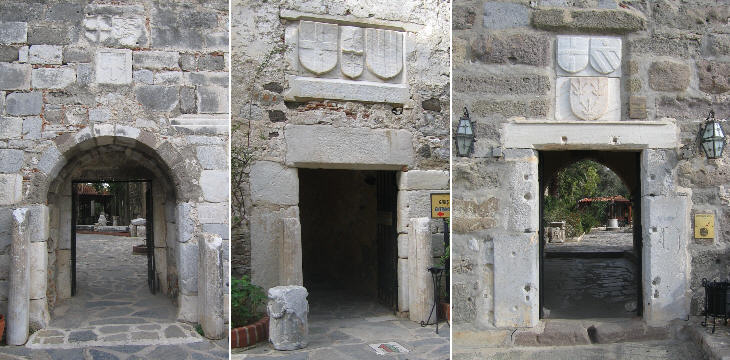
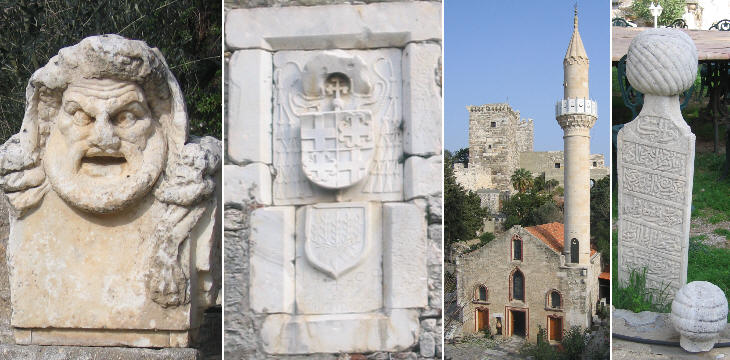
The access to the inner part of the fortress was protected by seven gates, which were built making use of ancient stones; in many parts of the fortress one can see pieces of columns, reliefs, statues which at first were all thought to come from Mausolus' monument, but which now are assigned to a later period of the history of Halicarnassus. The passage leading to the gates was full of twists and turns and the assailants had no protection from the arrows, stones and boiling oil which were thrown at them by the defenders.
The Knights did not forget they were a religious order and by placing sacred images on the walls they called for celestial help; several inscriptions did the same; that shown above is particularly moving:
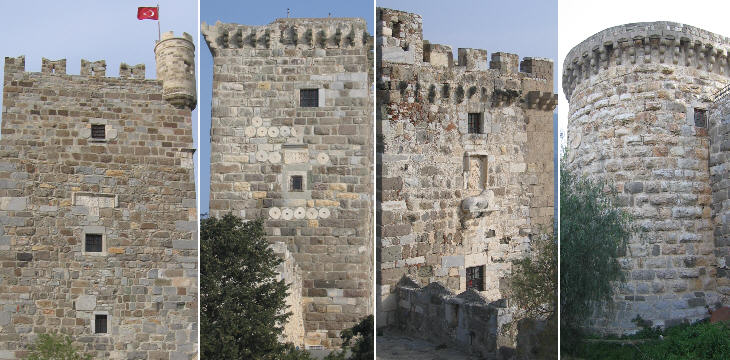
Each Langue had its own tower, the tallest one being that of France; the variety of their design adds to the beauty of the fortress and one understands why real estate agents advertise the view over the castle as a benefit of the houses they sell. From the fortress however the view over modern Bodrum is a very depressing one.
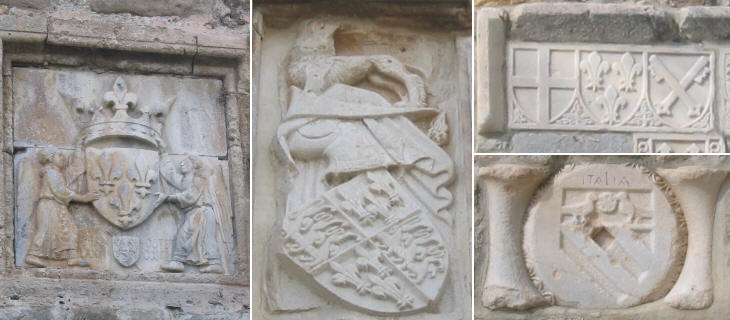
There are more than 200 coats of arms in the fortress; in addition to those of the Grand Masters some make reference to the countries of origin of the knights: these coats of arms are often part of a larger decoration. On January 5, 1523 the knights surrendered the fortress to the army of Sultan Suleyman; they did so in compliance with the agreement concerning the capitulation of Rhodes.
The fortress, in addition to being an open air museum by itself, houses a permanent exhibition of statues, potteries and other artefacts found on board ancient vessels which sank in the region. Move to: Fortresses of the Knights: introductory page Rhodes: the Gates Rhodes: the fortifications Rhodes: the town of the Knights Rhodes: Byzantine, Ottoman and Jewish memories Rhodes: modern Italian architecture Kos: the fortress Kos: the ancient town Castelrosso Calimno Lero Symi Nissiros Lindos Other fortresses Fortress of the Orthodox church Patmo (Patmos) Clickable Map of the Ionian and Aegean Seas with links to other locations covered in this website (opens in a separate window)     |