  What's New! Detailed Sitemap All images © by Roberto Piperno, owner of the domain. Write to romapip@quipo.it. Text edited by Rosamie Moore. Page added in November 2006. |
 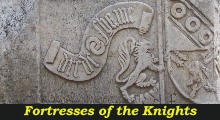 Calimno (Kalymnos) Calimno (Kalymnos)(relief in the fortress of Bodrum) Key dates: 1310 The island was acquired by the Knights of Jerusalem, who after having lost their possessions in Palestine and Syria, resettled on Rhodes and the nearby islands. They became known as the Knights of Rhodes 1457 and 1460 Ottoman attempts to seize the island 1522 Sultan Suleyman the Magnificent conquered Rhodes and the other possessions of the Knights (who resettled on Malta in 1530 and were since known as the Knights of Malta) 1912-43 Italian rule
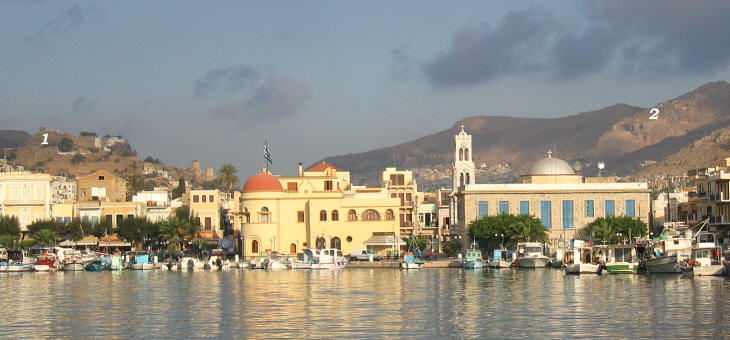
Pothia, the main town, is located on a bay at the southern end of the island: it is rather modern because until the end of the XVIIIth century most of Kalimnos population lived inside the walled town which is now known as Megalo Kastro (Great Castle). At the centre of the modern town there is a yellow building which housed the offices of the Italian administration: the image used as a background for this page shows a detail of that building.
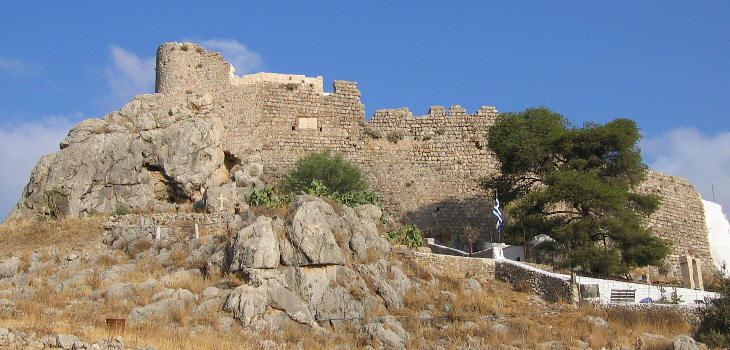
This small fortress protected the natural harbour of the island where is now Pothia: it was built on a small rocky hill located one mile inland.
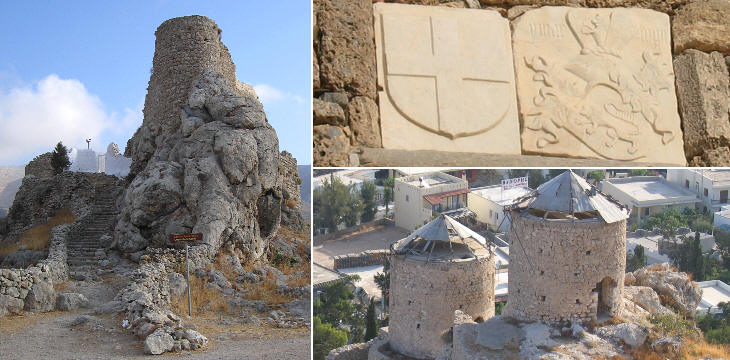
Inside the fortress there are now some small churches while next to it two windmills were built after the fall of the castle. The Order of the Knights of Rhodes was led by a Grand Master.
Megalo Kastro was actually the ancient Chora (main town) of Kalymnos: a walled town rather than a castle: it was located on an isolated hill which in itself was a fortified location.
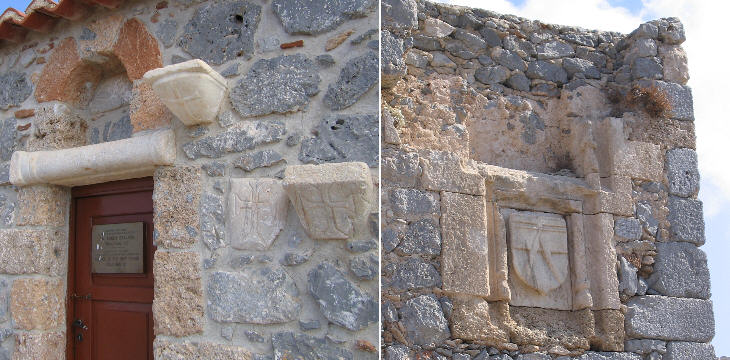
After the fall of Constantinople in 1453, the Knights of Rhodes, with the support of Pope Paul II strengthened their fortresses: from the coats of arms of the Grand Masters it is possible to identify the period during which the fortifications were improved: the coat of arms shown above (the upper one) belonged to Fabrizio Del Carretto, who was Grand Master between 1513 and 1521, right before the fatal year 1522 during which Sultan Suleyman forced the Knights to capitulate in Rhodes and to surrender all their possessions to the Ottomans.
Chora has been a ghost town for a very long period during which most of its buildings collapsed. In recent years the remaining churches and fortifications were included in a program of restoration.
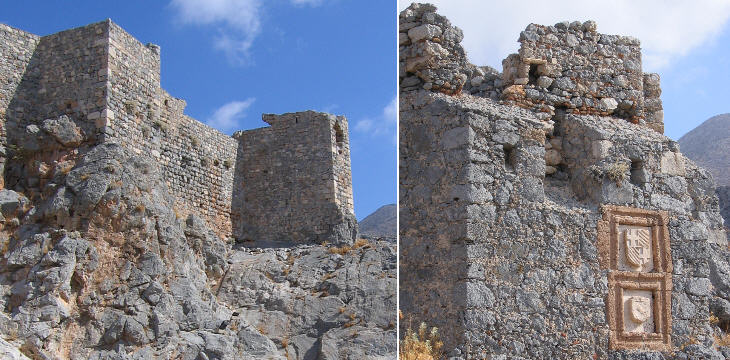
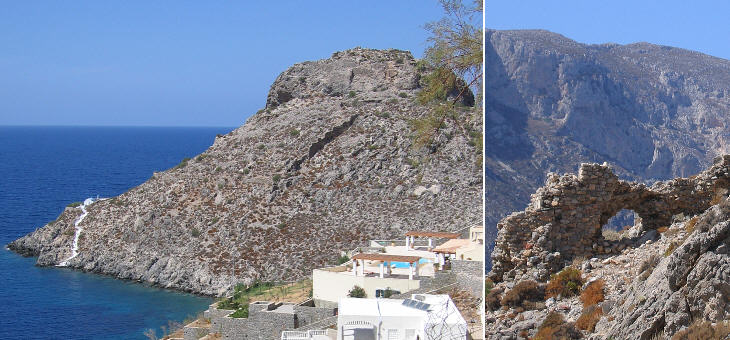
The Knights of Rhodes built a castle also on the western coast of the island: the site (a headland) is still called Kastelli, but at first sight one does not see any sign of a castle; only a more careful survey of the area reveals the ruins of a long wall which from the top extended down to sea level.
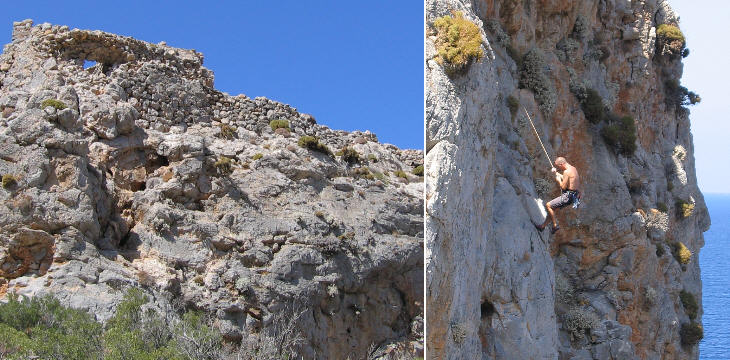
A few walls of the keep still remain at the top of the hill above a very precipitous rock which today attracts climbers who maybe are unaware they are re-enacting an Ottoman assault (click here to see how a Turk assailant was equipped). Move to: The Knights of Rhodes - Introduction Rhodes: the Gates Rhodes: the fortifications Rhodes: the town of the Knights Rhodes: Byzantine, Ottoman and Jewish memories Rhodes: modern Italian architecture Kos: the fortress Kos: the ancient town St Peter's Castle (Bodrum) Castelrosso Lero Symi Nissiros Lindos Other fortresses Fortress of the Orthodox church Patmo (Patmos) Clickable Map of the Ionian and Aegean Seas with links to other locations covered in this website (opens in a separate window) |