  What's New! Detailed Sitemap All images © by Roberto Piperno, owner of the domain. Write to romapip@quipo.it. Text edited by Rosamie Moore. Page added in August 2006. |
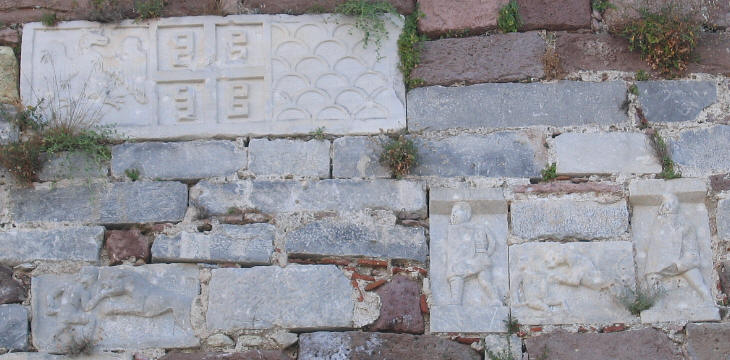
  Metelino (Mytilini) Metelino (Mytilini)(coats of arms at a gate of the fortress) The Greek island of Lesbos is usually associated with the poetess Sappho, who is thought to have lived in Mytilini, the island's main town, in the VIIth century BC. We know very little of her poems, but in antiquity she was regarded as a symbol of homosexual love. This may be due to the fact that a strong matriarchal society had existed on the island and on nearby Limnos until the Greek culture prevailed.
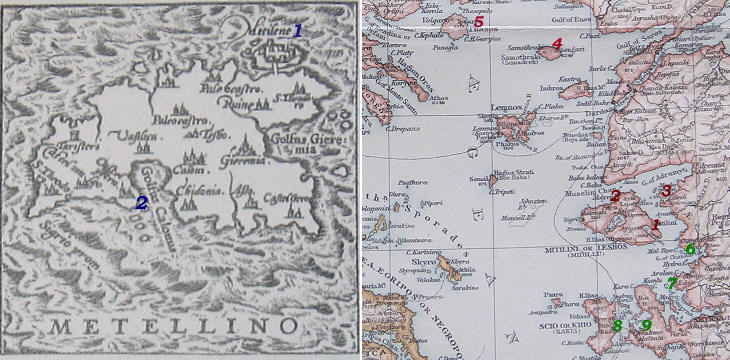
The town of Metelino (as it was called by Genoese and Venetian seamen) was initially built on an islet very close to the coast: the town knew a great expansion during the Roman rule: the narrow which separated the islet from the mainland was reduced by engineering works to a canal crossed by bridges and the town occupied also the hill opposite the islet, where a theatre was built. Recent excavations have found evidence of several Roman villas: their mosaics are now on display in a brand new Archaeological Museum (you can see similar mosaics at Antioch). The Romans built a long aqueduct to provide the town with an ample supply of water.
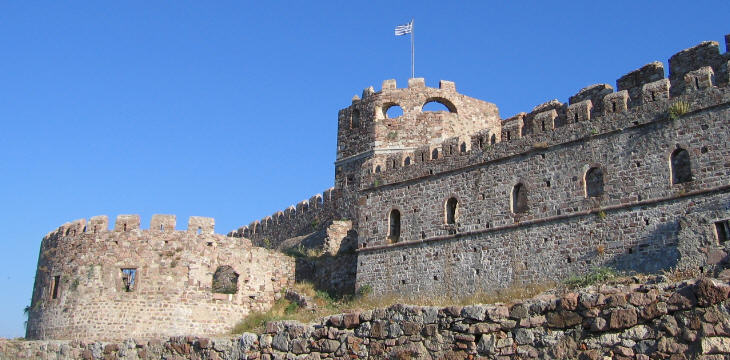
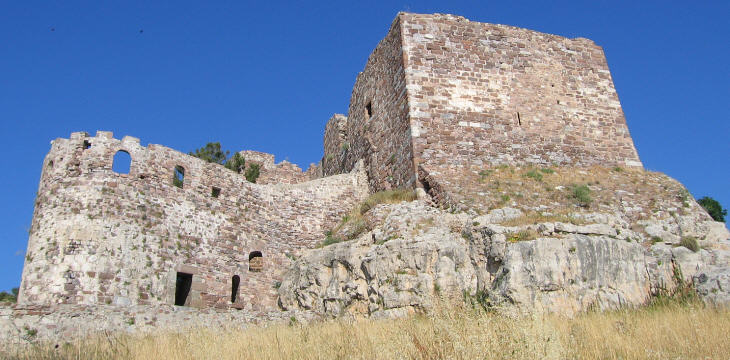
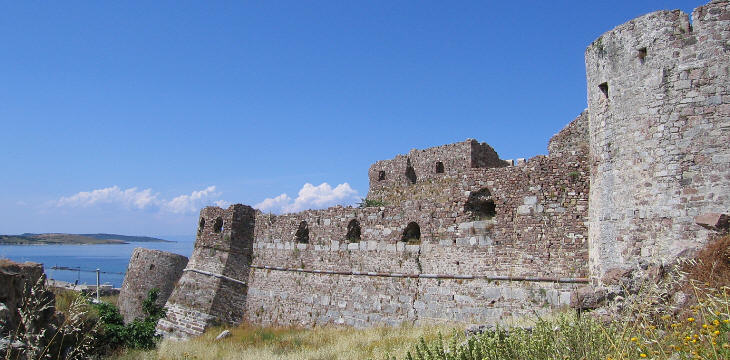
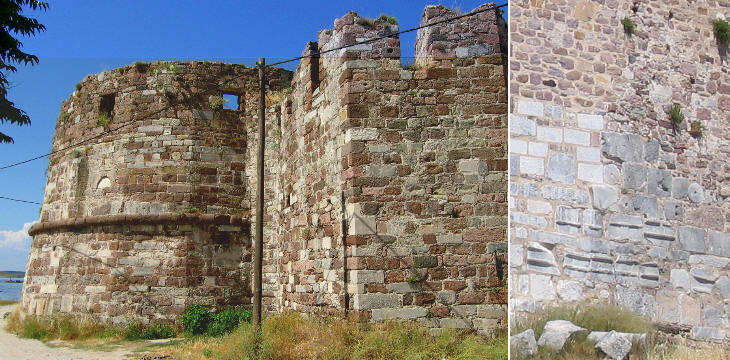
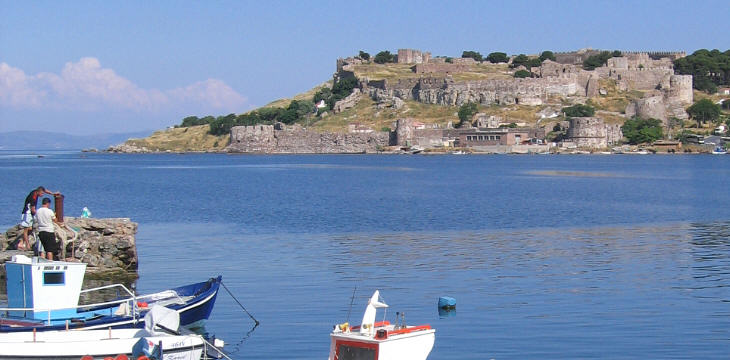
The old acropolis of the Greek/Roman town is today entirely occupied by a very large fortress which was built in various steps. During the Byzantine period the population of Metelino shrunk and the island was subject to Arab raids: the remaining inhabitants fortified the acropolis and in doing so they started a process of cannibalization of the ancient buildings, making use of their columns and lintels to build walls and towers.
The island had always had a very developed agriculture: in particular its wines were celebrated by many Roman poets: but wine became a luxury commodity during the Byzantine period and many fields were turned into olive groves. Olives and their oil played (and still play) a key role in the diet of both Greeks and Turks. In addition the olive oil was a commodity which could be traded easily.
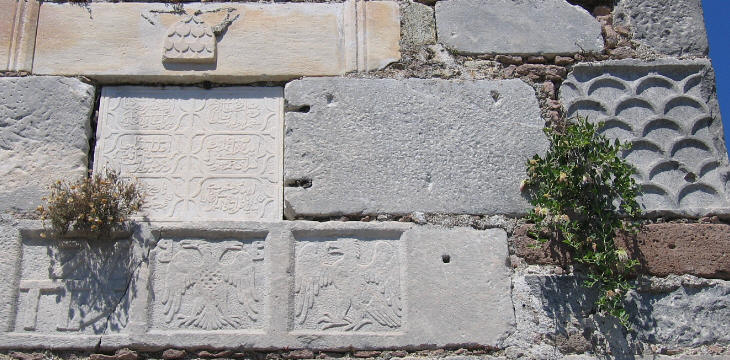
In the XIVth century Genoa and Venice were competing for supremacy in the Levant: Venice had hegemony over the Aegean Sea, Genoa had the monopoly of trade in the Black Sea. Genoa had better relations than Venice with the Byzantine Empire and in 1355 the Byzantine Emperor John V in recognition of the help received by the Gattilusio (a Genoese family) in his fight against John Kantacouzenos who had usurped the throne during his minority, granted them the right to rule over Lesbo. In addition Francesco Gattilusio married the emperor's sister. The Gattilusio became the lords of the island, although as formal vassals of the Byzantine emperors. Their coat of arms is thought to represent a section of a mail, a military armour made of metal rings joined together: it is shown next to an imperial eagle; between the two, there are four B: these letters stand for Basileus (emperor) and two of them are inverted because according to the tradition the Byzantine emperor reigned both in the West and in the East. The Gattilusio decorated the fortress of Metelino by placing some ancient reliefs next to their coat of arms.
In 1453 Ottoman Sultan Mehmet II conquered Constantinople and put an end to the Byzantine Empire. He was convinced (and not without some merit) that he should have been regarded as the new emperor. In 1458 Domenico Gattilusio, Lord of Lesbos, was killed by his brother Niccolò who claimed the throne for himself. Sultan Mehmet regarded the change of power as having occurred without his consent and in 1462 he landed on the island. Niccolò Gattilusio refused to surrender, but Ottoman cannon had no difficulties in opening breeches in the walls of the fortress of Metelino. The Ottomans did not erase the symbols of the previous lords of the fortress, they just added their own.
The Ottomans had little interest in this island and notwithstanding a Venetian raid in the year 1500, they did not do a lot to strengthen the fortress of Metelino. They changed their minds in 1657 when the Venetians managed to block the Dardanelles and even made an attempt to reach Constantinople. After that event the fortresses of the islands near the entrance of the straits (Tenedo, Imbro and Lesbos) were all upgraded. In 1697 the Venetians seized the nearby island of Scio and the Ottomans were glad they had a strong fortress at Metelino where their fleet could be safe.
The strengthening of the fortress was completed by a series of towers and walls right on the sea shore. At many points of these walls one can see parts of ancient buildings.
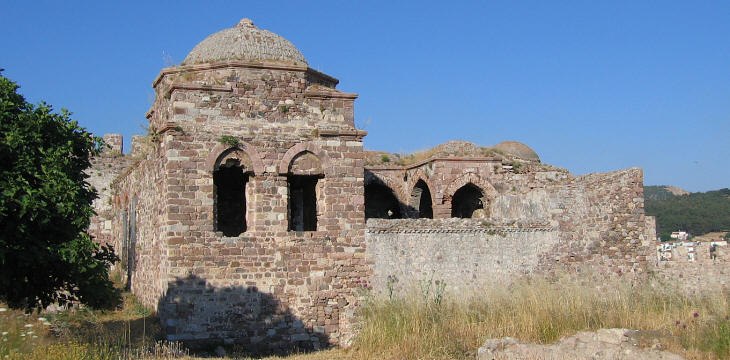
In 1912 the island was occupied by Greek forces and in 1923 the agreements which put an end to the war between Greece and the newly born Republic of Turkey confirmed the assignment of Lesbos to Greece. These agreements established also a massive exchange of population; the Turks lived in the fortress and its immediate whereabouts; the Greeks around the main commercial harbour. The fortress continued to be used for military purposes until a few years ago (here and there you can still read notices preventing you from taking pictures). All the buildings which were not consistent with the military use of the fortress were left to rot. In recent years the trend has been reversed and archaeologists are trying to preserve the remaining Ottoman buildings.
Other pages of this section: Metimno (Molyvos) Aivali/Cunda Samothrace Thassos Clickable Map of the Ionian and Aegean Seas with links to other locations covered in this website (opens in a separate window)    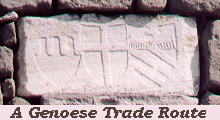 |