What's New!
Detailed Sitemap
All images © by Roberto Piperno, owner of the domain. Write to romapip@quipo.it. Text edited by Rosamie Moore.
Page revised in June 2010.
|

 Part two: The Mosaics of Antioch Part two: The Mosaics of Antioch
The Museum of Antioch was initially built during the French Administration in the 1930s. It was enlarged in the 1970s.
It contains interesting statues and jewellery of the Hittite, Assyrian and Roman periods, but it is known worldwide for its large Roman mosaics.
The mosaics span from the IInd to the Vth centuries AD and they were mainly found in the villas built near Daphne. A few of them were moved to Paris.
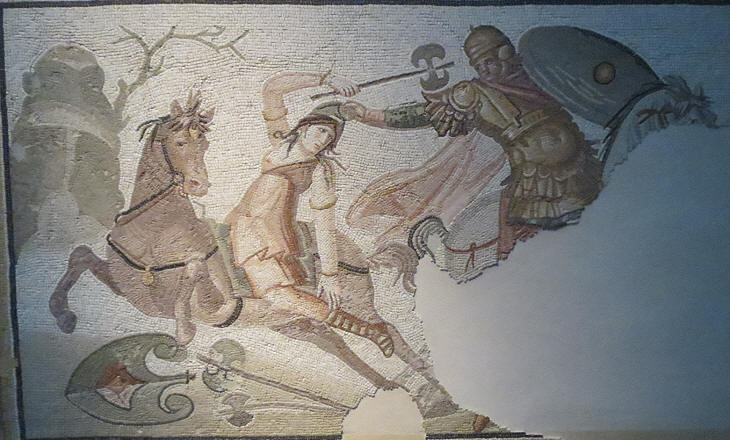
Louvre Museum in Paris: mosaic from Daphne portraying a fight between Greeks and Amazons
The University of Princeton had a major role in the research, restoration and classification of the mosaics.
The photos shown in this page were taken with a basic digital camera and without using flash, thus they do not include some very large mosaics, but only details of them.
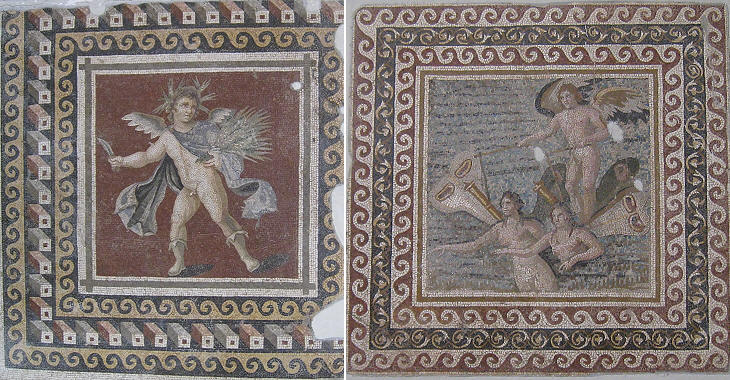
Mosaics from Daphne: (left) Summer; (right) Boat of Psyche
The warmth of the climate disposed the natives (of Antioch) to
the most intemperate enjoyment of tranquillity and opulence; and
the lively licentiousness of the Greeks was blended with the
hereditary softness of the Syrians. Fashion was the only law,
pleasure the only pursuit, and the splendour of dress and
furniture was the only distinction of the citizens of Antioch.Today this quotation by Edward Gibbon's Decline and Fall of the Roman Empire may not be regarded as being scientifically accurate, but it explains the attention paid by the wealthiest inhabitants of Antioch to the decoration of their homes.
The mosaics from Daphne show the maturity reached by the artists who designed them and by the patrons who commissioned them.
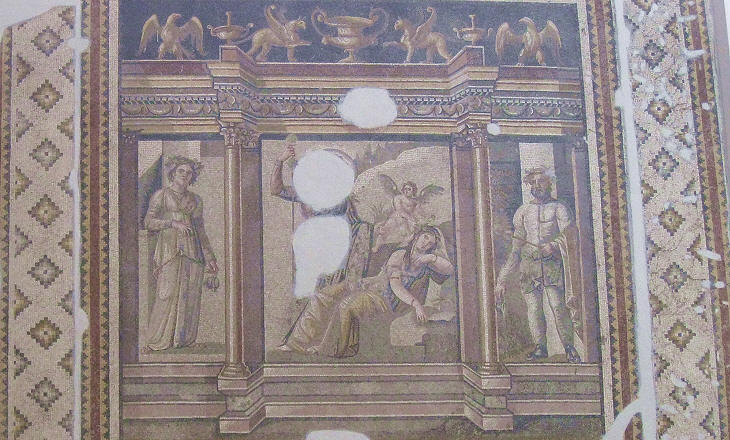
Dionysus and Ariadne
The development of a modern theory of perspective laws in painting is generally associated with a group of Florentine artists of the XVth century (Ghiberti, Brunelleschi, Paolo Uccello, Leon Battista Alberti); at their time however practically all the paintings/mosaics of the ancient world were unknown; paintings in Pompeii and mosaics in many villas throughout the empire show some knowledge of these laws, which in the mosaic shown above is very evident.
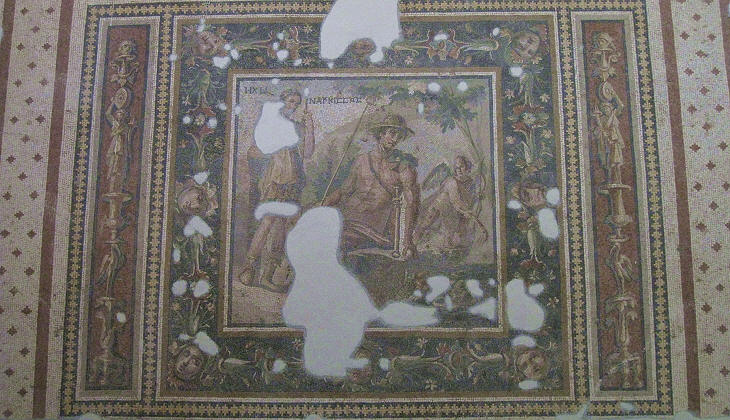
Narcissus and Echo
Baroque sculptors and architects had a predilection for decorating their works with small human heads (see a page on the Laughing Masks of Rome). The mosaic above shows that also the ancient mosaicists did the same: they portrayed eight human heads in different attitude along the decorative band; some of the heads are trying to look upwards towards the central scene.
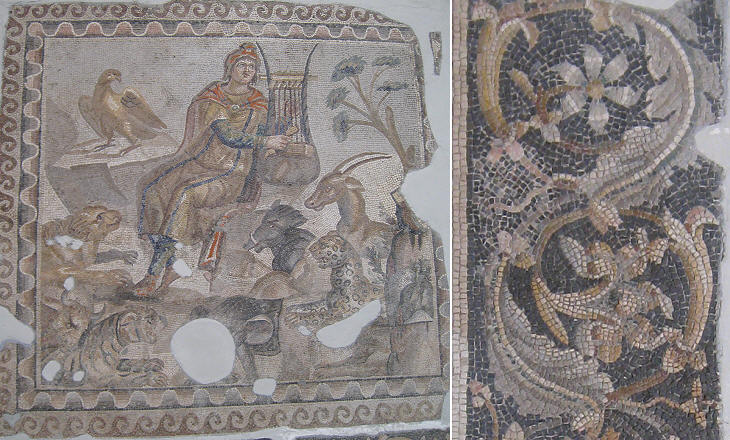
(left) Orpheus appeasing the wild animals (from Tarsus); (right) detail of the decorative band surrounding the central scene
When we were young we all have enjoyed receiving a book with pictures of wild animals; the choice of some subjects of the mosaics was driven by the fact that they offered the opportunity to portray many animals; in this mosaic we can notice that the animals are placed in the space in a rather haphazard way, the focus being on each of them, rather than on the overall scene; the mosaicist made use of a high variety of colour nuances as the detail of the decorative band shows.
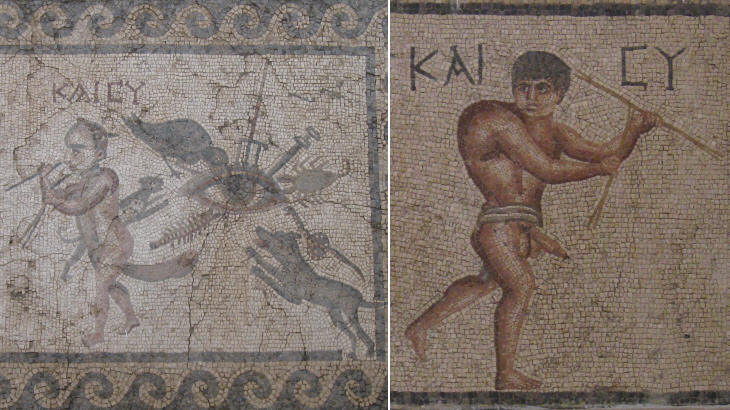
Good luck icons: (left) Evil Eye being chasen away; (right) Lucky Hunchback
The words in the two mosaics mean (good luck) to you.
In a scene of Journey to Italy, a 1954 movie starring George Sanders and Ingrid Bergman, a British couple visits the city of Pompeii; while visiting Casa dei Vettii Bergman is dismayed at learning that she cannot see a painting representing a man weighing his enormous penis; classic artists by general convention portrayed small penises (hypo phallus), but there were some exceptions.
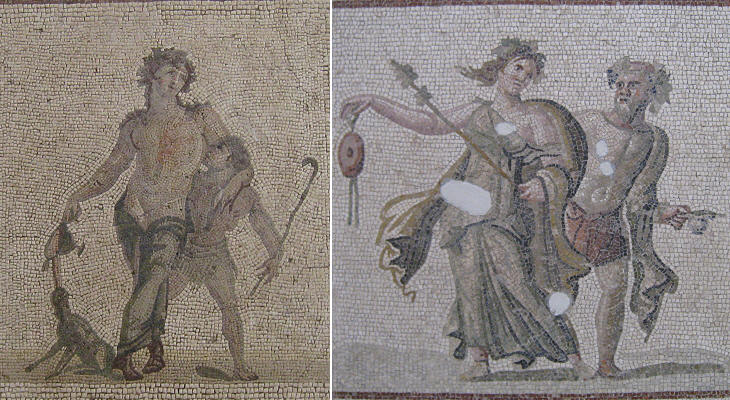
(left) Drunken Dionysus; (right) bacchanal dance
During the Renaissance the prevailing iconography portrayed Bacchus/Dionysus as an aged fat man (see Bacco di Boboli - external link), but the classic iconography showed the god as an androgynous young man and Michelangelo followed this pattern - external link.
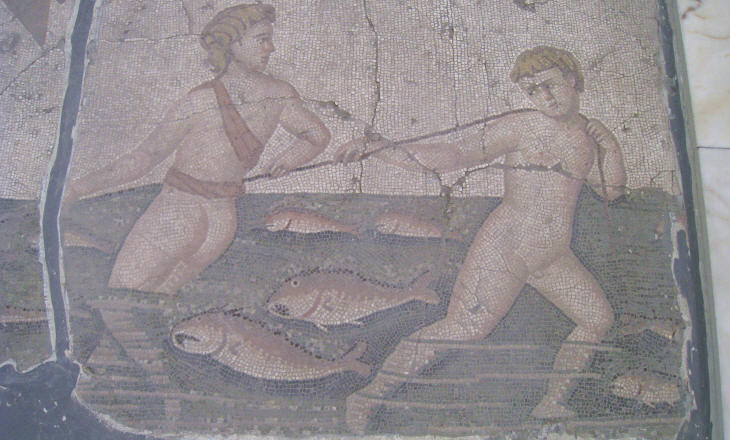
Fishermen from Thalassa mosaic
The two most striking mosaics of the Museum of Antioch are based on marine subjects: such subjects were very popular throughout the ancient world; in Rome they often decorated baths (at Terme di Caracalla and at Ostia), but while the mosaics of Rome were black and white those of Antioch show the talented use of very many colours.
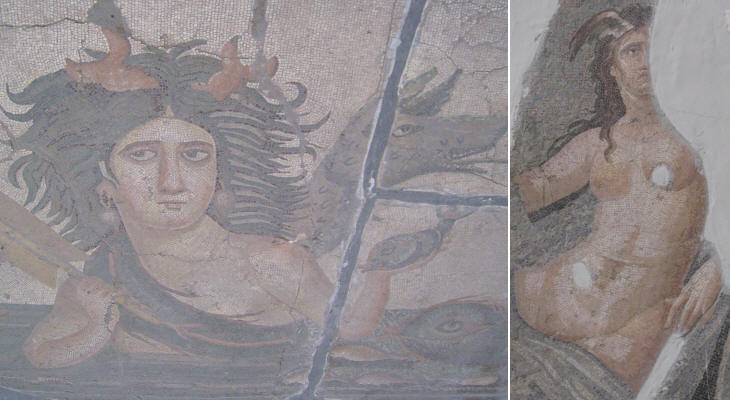
Sea goddesses: (left) Thalassa; (right) Thetys
By comparing the portraits of two sea goddesses one can notice that while Thetys is portrayed in a very naturalistic way, the eyes of Thalassa anticipate those of the Byzantine icons.
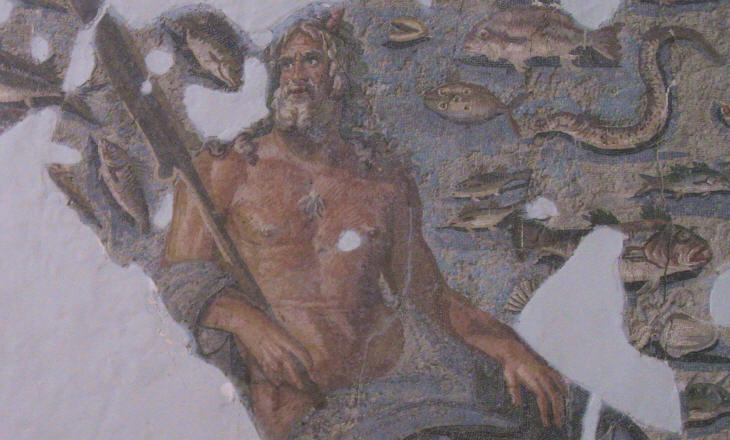
Oceanus
While Orpheus offered the opportunity to represent a zoo, Oceanus provided that of showing an aquarium; the mosaicist had a deep knowledge of the various species of fish which lived in the nearby sea.
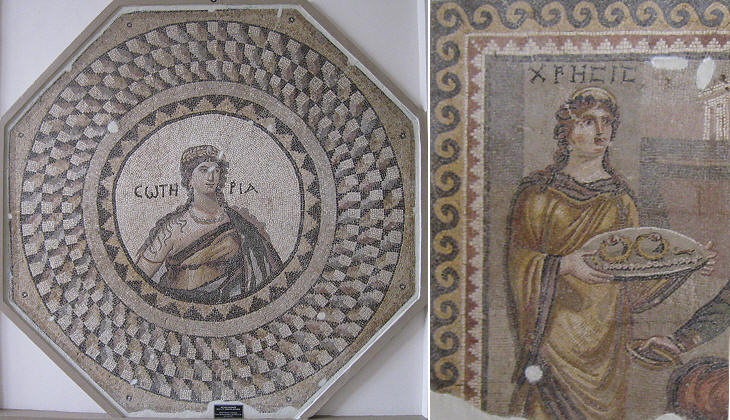
(left) Soteria (goddess of protection/safety); (right) Ktisis (goddess of foundation/creation) carrying jewels
Gradually the subjects of the mosaics departed from the canons of classic art and in particular by the representation of naked personages; even before the Christian faith prevailed, the portrayal of the ancient gods was replaced by that of personified virtues; these mosaics tell us something about the fashion during the Late Roman Empire and about the jewels the richest matrons wore.
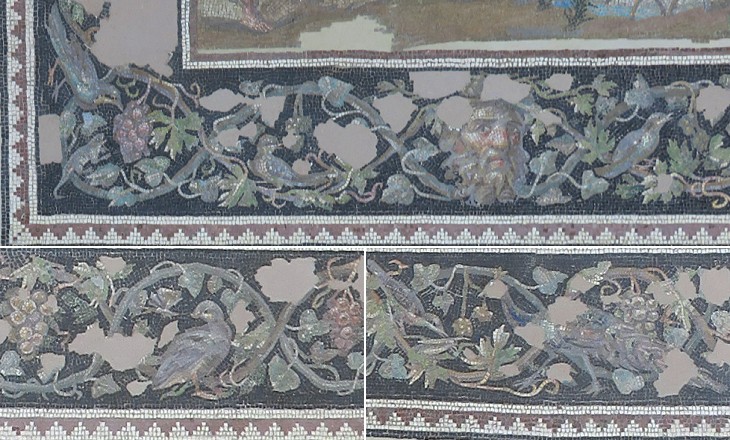
Louvre Museum in Paris: details of the decorative band of a mosaic found near Antioch
You may wish to see the Roman mosaics in the Museum of Gaziantep.

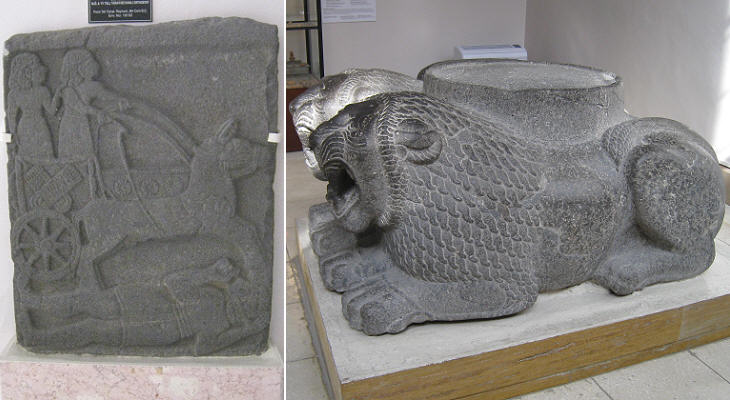
Tell Tainat (8th century BC): relief portraying charioteers running over the body of an enemy; (right) base of a temple column
The Roman statues and reliefs of the museum are not as impressive as the Roman mosaics, while a few exhibits of a Neo-Hittite town near Antioch attract the attention of the visitor; for other Neo-Hittite works of art see pages on Karatepe and Ain Dara.
Move back to part one: En route to Antioch.
Clickable Map of Turkey showing all the locations covered in this website (opens in another window).
|