  What's New! Detailed Sitemap All images © by Roberto Piperno, owner of the domain. Write to romapip@quipo.it. Text edited by Rosamie Moore. |
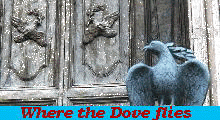 WHERE THE DOVE FLIES WHERE THE DOVE FLIES
The Pamphilj Family
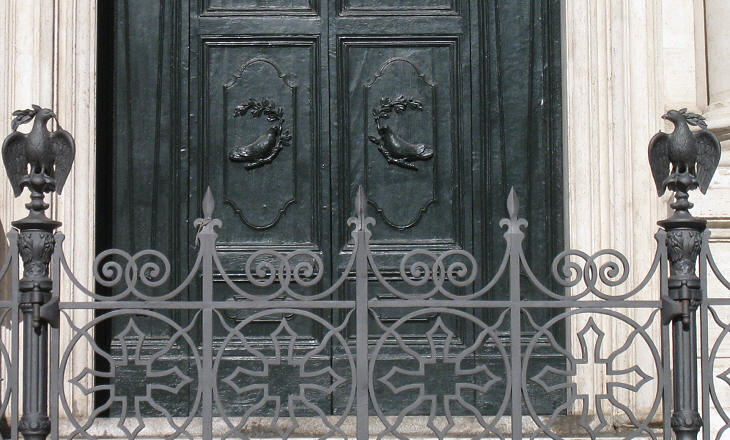
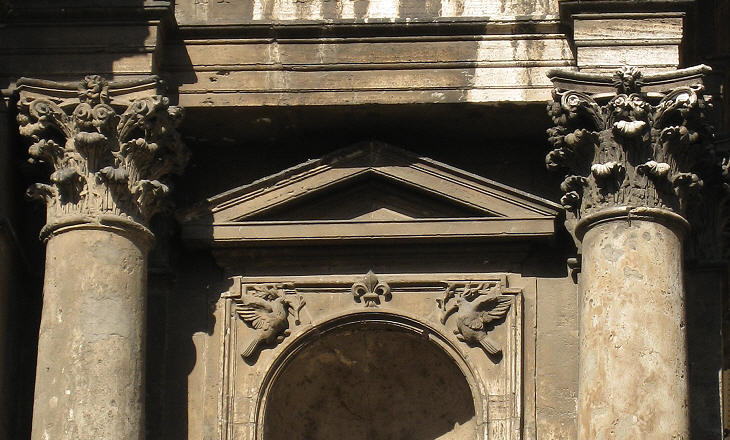
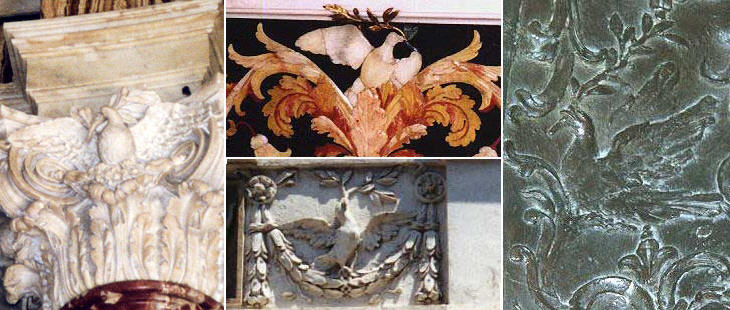
With the election in 1644 of Pope Innocent X (Giovan Battista Pamphilj 1572-1655 ) a Roman family entered history. The Pope was born in the family palace in Piazza Navona (now the Brazilian Embassy) and this explains why he devoted so much effort into transforming the vegetable market among the ruins of the Stadium of Domitianus into one of the most impressive piazza of Rome. The Pamphilj emphasized the assumed Greek meaning of their name (Pan=everybody filios=lover/friend- therefore" everybody's friend") and they made large use of their heraldic dove with the olive leaves, which in their view was a symbol of their friendliness . Here the doves are at the entrance of the church of Santa Agnese in Agone (map1 30/D3), where the Pope is buried. Originally the façade was on Via dell'Anima, but Borromini restructured the church and changed the entrance to Piazza Navona, where it became the focal point, highlighted by the fountain of the Four Rivers by Bernini in front of its door. Doria Pamphilj Palace
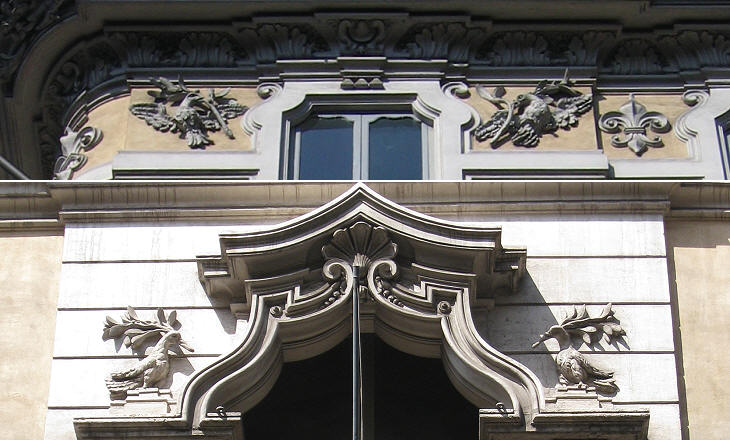
The Pamphilj family was united at the end of the XVIIth century with the Doria family from Genoa and they enlarged their palace at the beginning of Via del Corso near Piazza Venezia (map2 26/E4). In this palace the Doria-Pamphilj still live and have the richest private gallery of Rome. The façade on Via del Corso is a masterpiece of the end of the Baroque period. The decoration relies on the doves, flying in different ways all over the windows. Sant' Andrea al Quirinale
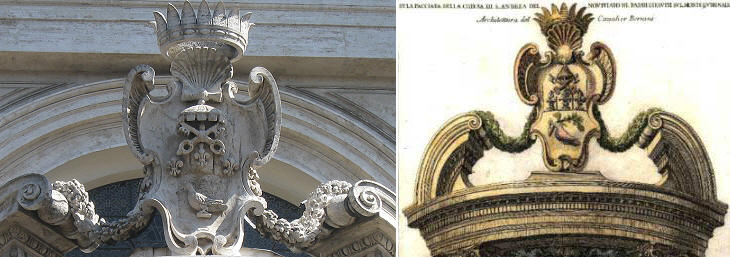
The Church of S. Andrea is perhaps the masterpiece of Gian Lorenzo Bernini. His re-interpretation of classical themes here reached its highest point. He designed a circular porch, which was a new way to make use of the square pronaos, an element of the Greek temples. The interior has an elliptical shape with the longer axis parallel to the façade. The church was commissioned by Cardinal Camillo Pamphilj. The coat of arms is an attempt by Bernini to explore new ways to reformulate the classical pattern. In itself it is a little masterpiece to which are devoted many studies, as the old print shows (see also the plate by Filippo Juvarra and that by Giuseppe Vasi). Villa Doria - Pamphilj
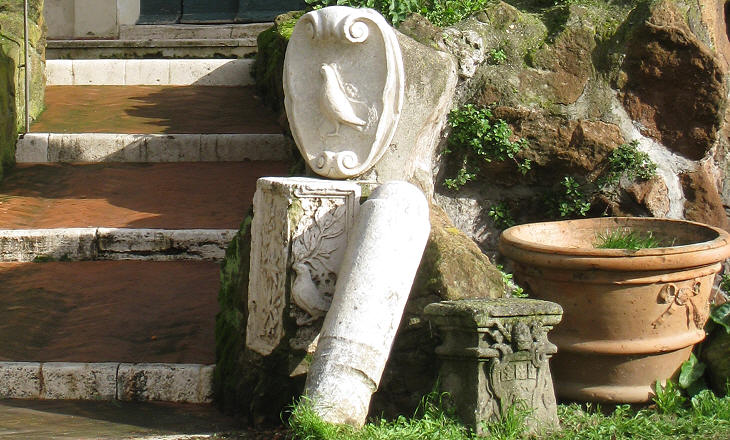
This large Villa is immediately outside St. Pancras Gate (map1 16/B4) on the Gianicolo hill. The Villa has also another name: "Villa Belrespiro" (respiro=breath) because of the fresh wind coming from the sea (the "ponentino"). In the center of a vast park a relatively small palace (Palazzina) was built by Alessandro Algardi to provide the old Pope with a healthier location than the Vatican which was too close to the Tiber. In the park gardens alternate with the wild, with many fountains and statues. Walking around one can find many traces of the original masters. Here you have the impression of having discovered some Roman ruins similar to those on the Via Appia, but the dove reminds you that it is just a very sophisticated recreation of the past. While often destroying the past, the artists and the popes of the Baroque period were fascinated by it and elaborated on classical themes. San Nicola da Tolentino
Off Piazza Barberini (map2 13/F2) the church of S. Nicola da Tolentino is decorated with the Pamphilj dove and Fleurs-de-Lis. Undoubtedly these symbols allow for a proper decoration of a church and by so doing lose their original identifying purpose of associating the Pamphilj name with the building. Inside this church the Pamphilj chapel has a very interesting family coat of arms by Alessandro Algardi which is shown next to the plate by Filippo Juvarra. Strolling around and in Capitol Hill
The dove appears in the decoration of chapels (Cappella S. Tommaso di Villanova in S. Agostino) of buildings (Casino Giustiniani, near St John's in Lateran (map4 40/H6)) and of statues (Pope Innocent X by Alessandro Algardi in Capitol Hill (map2 25/E4)). In the Castelli Romani
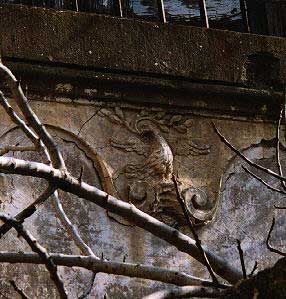
South of Rome lies an area of volcanic hills, the Colli Albani. In the main town Albano, where the Pope still retains a large Villa, the Pamphilj had one of their palaces. Today it's abandoned and does not have any impressive looks, so it is not mentioned in the guides. The little garden has gone wild, but when the eye meets the dove, one suddenly realizes that history and art were here. For a dove which managed to survive see the coats of arms spared by the Revolution. 
VISIT THESE OTHER EXHIBITIONS (for a full list see my Detailed Index)   
|