  What's New! Detailed Sitemap All images © by Roberto Piperno, owner of the domain. Write to romapip@quipo.it. Text edited by Rosamie Moore. |
 AVIGNON AVIGNON
The Palace of the Popes
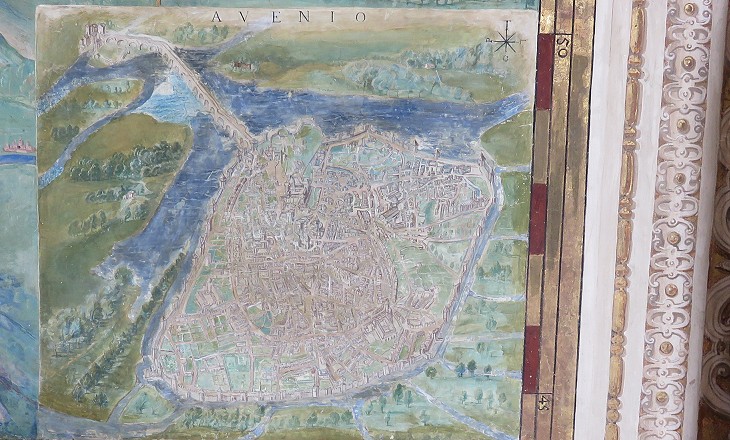
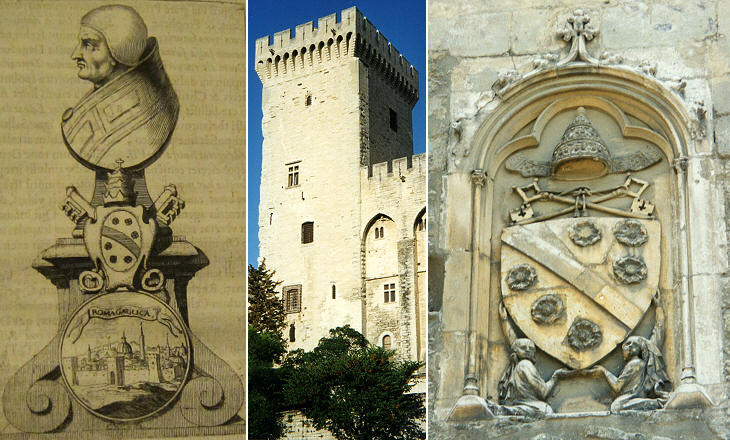
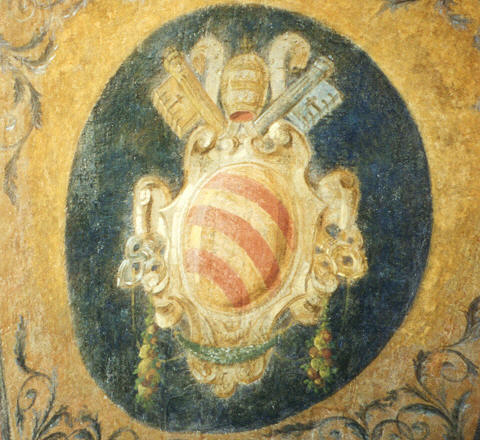
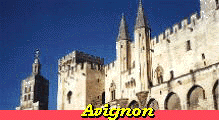
For more than 450 years Avignon was under the rule of the Church. It was "Roma Gallica" that is the Rome of France as it was written in the medallion under the portrait of Clement VI the most important Pope who lived in Avignon. It was reunited to France in 1791, but in just a few years all signs of the previous rule were destroyed. For ten years Religion was banned and the Revolutionary Government systematically fought every symbol of faith. After this period the knowledge of having destroyed masterpieces of art and memories of the past prevailed, but very little was left. So when wandering in delightful Avignon you have to bear in mind you are generally seeing heavily restored or even rebuilt monuments and palaces. The Palais des Papes, was built originally as a fortress as the tower shows and later on under Clement VI (coats of arms on the façade) gained a more graceful aspect. The Palace lost all its furniture and statues and served as a barracks. Only a few frescos have survived under repainting and now testify to the glory of the landlords, for example this coat of arms of Pope Pius V.
The Palais de la Monnaie
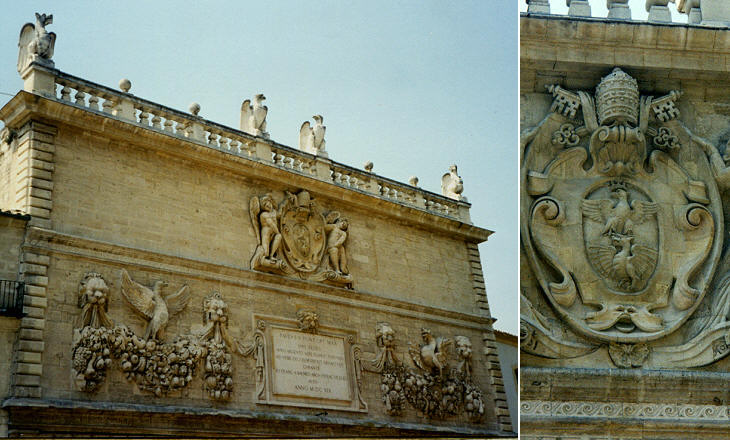
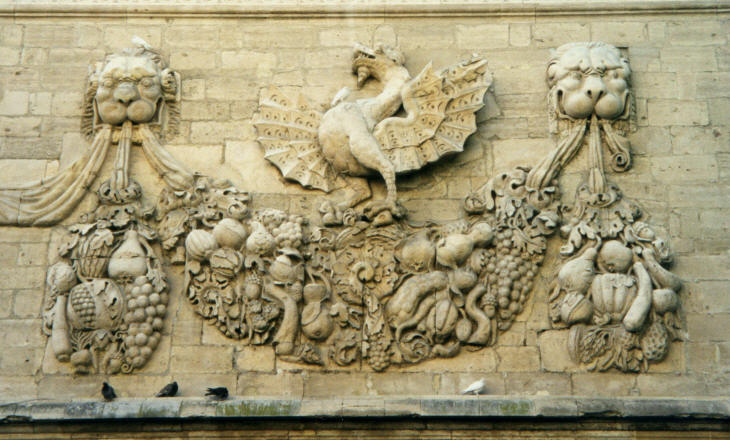
The Palais de la Monnaie (the Mint Palace) was originally built in honour of Pope Paul V and its façade is dedicated to his coat of arms. Although heavily restored, it is a masterpiece of Italian Baroque, quite unique in France. One can imagine that the eagle of the Borghese family managed to survive as a symbol of Napoleon. The decoration is quite sophisticated as you can see from the details of the dragon. Searching around
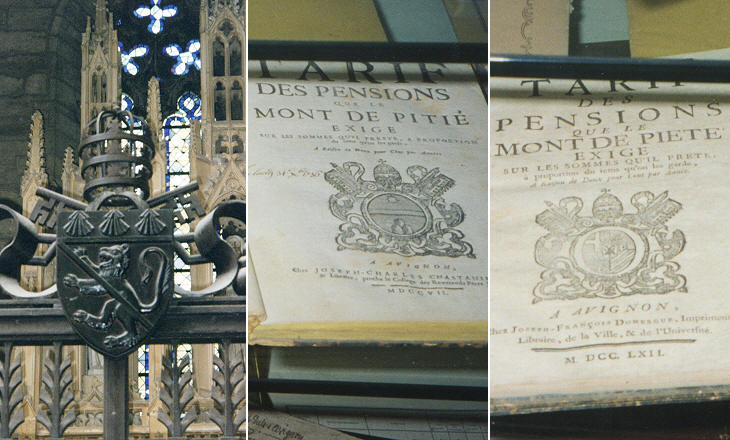
A few miles away, on the other side of the river Rhone, Innocent VI built a large Carthusian charterhouse (Chartreuse du Val de Bénédiction), where he was buried . Confiscated and sold, in a few years it was destroyed and abandoned. Today it houses an interesting centre on old scripts and it is a moving experience to visit, because restoration has been kept to a minimum. The tomb of the Pope has been returned to the chapel of the chartreuse and a brand new coat of arms protects it. To find signs of the past which are not fakes you should go to the Mont-de-Piété where the old registers will tell you which rates of interest the Popes (here Clement XI and Clement XIII) requested for lending. Comtat Venaissin
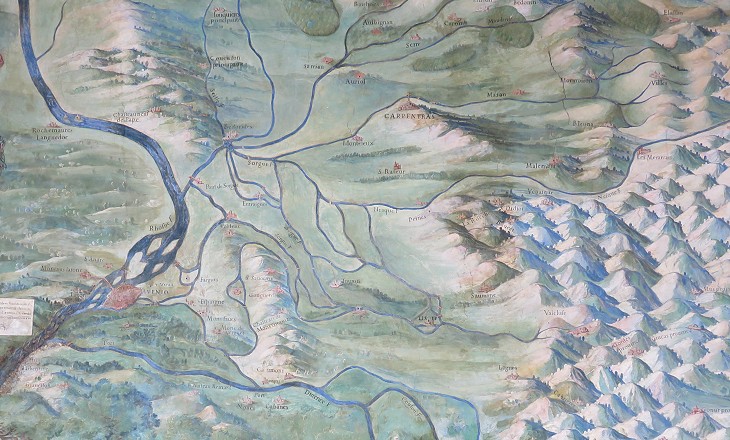
The rule of the Popes did not cover Avignon only, but also the nearby countryside (and this before Avignon was bought from the Dukes of Provence), which has always been a distinct entity, known as the "Comtat Venaissin".
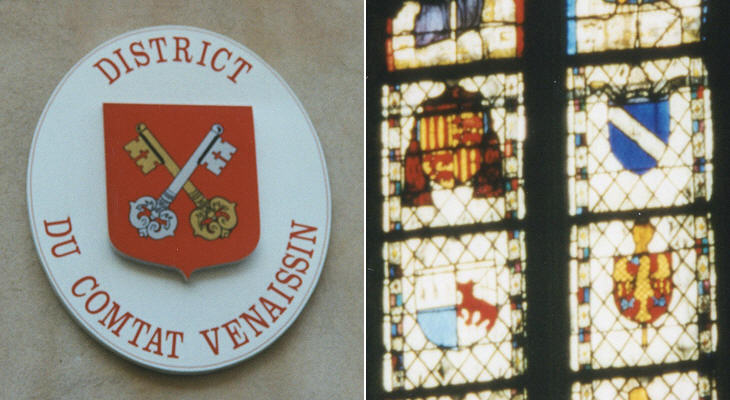
The symbol of the District reminds us of the old rulers (here you can clearly see that the keys are made of silver and of gold), but a part from this I could not find anything else until in the Cathedral of St. Siffron in Carpentras I detected the coat of arms of Pope Eugenius IV on the stained glass windows. 
VISIT THESE OTHER EXHIBITIONS (for a full list see my Detailed Index)
|