  What's New! Detailed Sitemap All images © by Roberto Piperno, owner of the domain. Write to romapip@quipo.it. Text edited by Rosamie Moore. Page added in July 2006. |
  - Afrodisias - Afrodisias
Aphrodite is usually associated with a painting by Botticelli (click here to see it in an external link) where the goddess is portrayed rising from the sea of Citera in a scallop shell. She was regarded as the goddess of beauty and desire, but her figure involved also other aspects. While the classic Greek myth was mainly based on male figures, in the Anatolian peninsula and in the islands next to it (such as Lemno), the prevailing myth was associated with female figures (Myrine/Cybele). When this region was Hellenized the ancient goddesses were replaced by the female members of the Greek pantheon, chiefly by Artemis, who was worshipped in large sanctuaries at Ephesus and Sardi.
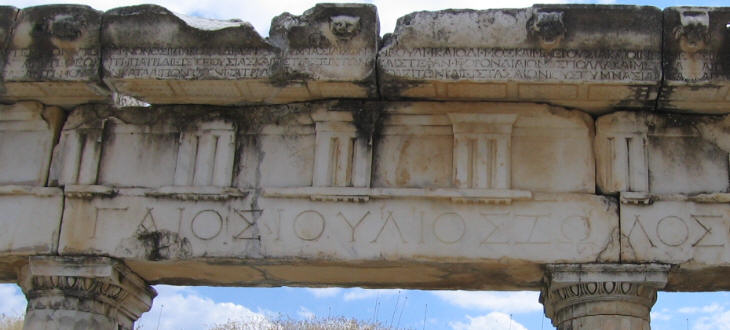
In Afrodisias, a town of Caria, a region in the south-western corner of the Anatolian peninsula, the worship of the ancient goddesses was associated with that of Aphrodite (Venus to the Romans). The cult of Aphrodite had also some political aspects: the town flourished during the reign of Augustus at the initiative of Zoylos, a slave freed by the emperor, who added to his name those of his former master (Gaius Julius, names of Caesar, which in turn Augustus had added to his name when he had been adopted by Caesar). Both Caesar and Augustus claimed to descend from Aeneas, son of Anchises and Venus, so in a way the cult of Aphrodite was a sort of tribute paid to the Roman rulers. It is unclear who Zoylos was and how he achieved the wealth and the political role which allowed him to build theatres, temples and markets and to erect a magnificently decorated monument dedicated to himself: maybe he was an important citizen of Afrodisias from the very beginning; he might have been captured by Cilician pirates and subsequently freed by Augustus: from the reliefs of his monument we know that he visited Rome.
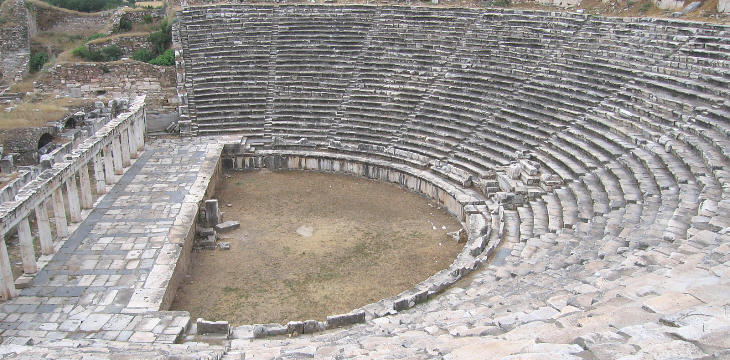
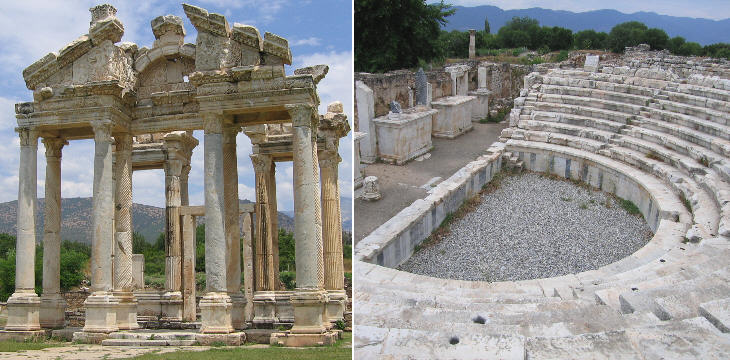
The theatre built by Zoylos was later on modified during the reign of Marcus Aurelius. Greek theatres had a circular orchestra where the chorus danced and sang; in the Roman theatres the orchestra was reduced to a semicircle. The seats reserved for the town's key officers are clearly visible. The theatre seems to have been built on a natural slope, but excavations have shown that the mound behind it is the result of earlier human settlements.
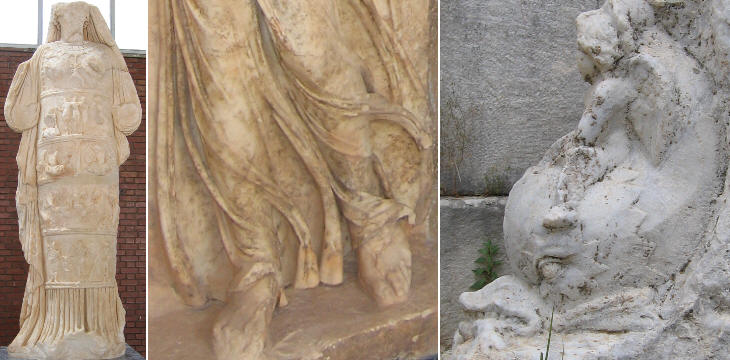
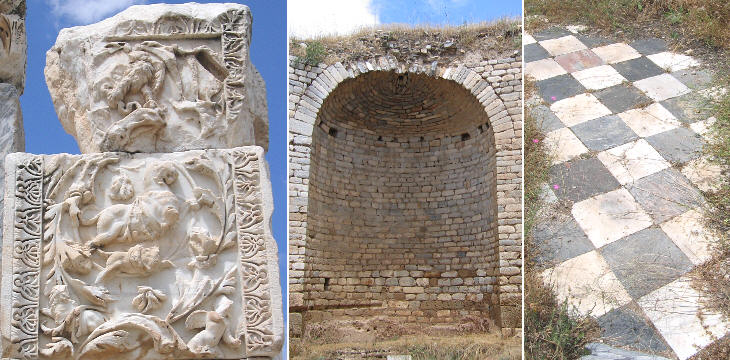
The statue of Aphrodite which was worshipped in the sanctuary is far from meeting the expectations of those who visit Afrodisia having in mind a rather lascivious goddess; the existence of marble quarries near Afrodisias led to the development of a school of sculptors whose works of art show excellent craftsmanship either in the virtuoso representation of legs beneath a dress or in the expressionistic portrayal of a dolphin.
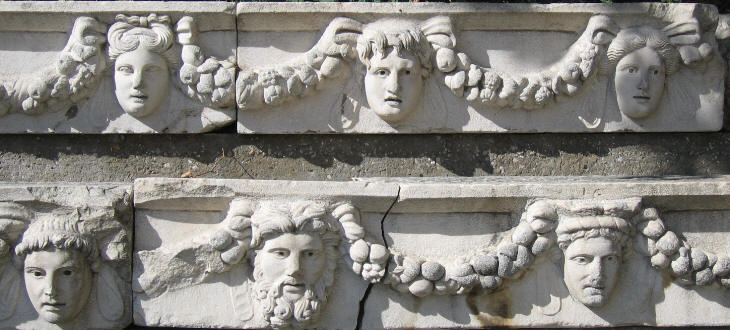
The masterpiece of the sculptors of Afrodisias is a long frieze (now in the gardens of the Archaeological Museum of Izmir - Smyrna) portraying all the Greek gods. The frieze decorated a portico dedicated to Emperor Tiberius.
Afrodisias had large baths, both near the theatre and near the market square. They were huge buildings with large halls decorated with marbles and reliefs.
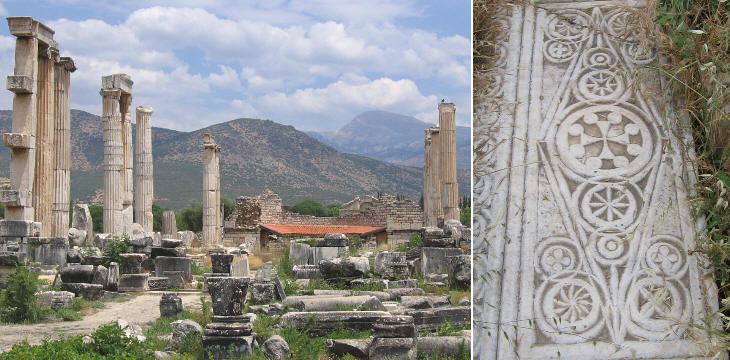
Afrodisias, as well as other towns with important sanctuaries, opposed the diffusion of the Christian faith. For this reason during the reign of Emperor Justinian, who was determined to eradicate the pagan cults, the Temple to Aphrodite was converted into a church. In order to physically show that the building was no longer a temple, its shape was modified by relocating the columns of the temple's portico along the existing side columns with the final result of obtaining a very long building having little resemblance to the old one.
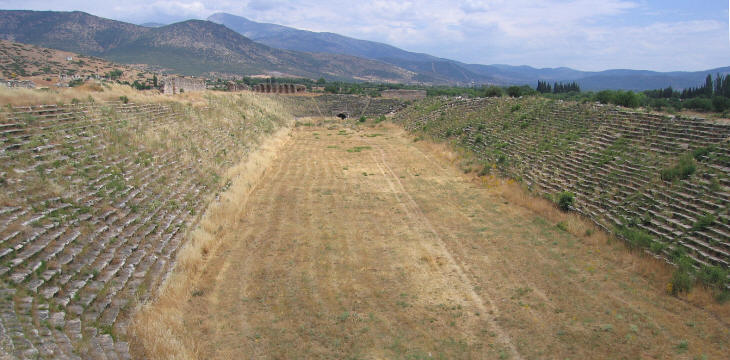
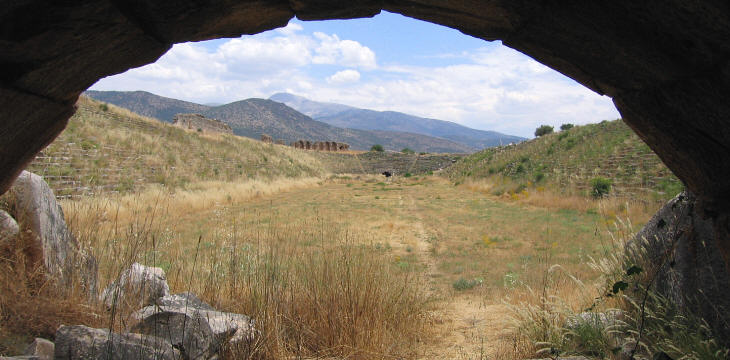
The most impressive building of Afrodisias is undoubtedly its stadium. Unlike other similar buildings which made use of natural slopes, this stadium was built on flat land and its steps are entirely supported by a complex masonry structure.
Over the centuries the strong winds which characterize the entire region pushed so much earth against the barrier constituted by the stadium structures that the building almost disappeared under it. While its interior has been excavated, the external structures are still almost entirely underground.
In addition to the theatre Afrodisias had also an odeon, a small covered theatre which could be used all year round and was particularly apt for musical performances. This building too shows advanced masonry techniques. 
One of the advantages of travelling with old guidebooks is that of noticing modern buildings having an ancient appearance: Afrodisias, as well as many other Roman cities, had a grand entrance (propylaea); of this entrance a few columns withstood the ravages of time, but not those of some archaeologists. In the early 1990s, rather than excavating the stadium, they preferred to pull down what was left of the old entrance, to remove the old foundation, to lay a base of concrete and to erect with steel and concrete a new structure covered with the stones and reliefs found on the site. This process is called anastylosis (same stones), but the use of Greek words does not hide the fact that a memory of the past has been tampered with. Archaeologists should limit themselves to conserving for the future generations the treasures we have inherited from the past. Map of Turkey with all the locations covered in this website     |