  What's New! Detailed Sitemap All images © by Roberto Piperno, owner of the domain. Write to romapip@quipo.it. Text edited by Rosamie Moore. Page revised in May 2015. |
 The Silent Streets of Rome The Silent Streets of Rome
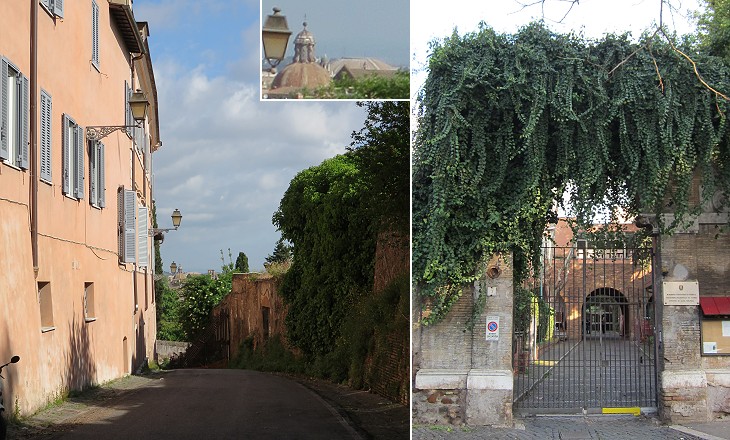
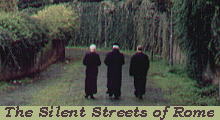
Oxymoron n. Figure of speech with pointed conjunction of seemingly contradictory expressions (The Concise Oxford Dictionary). The statement silent streets of Rome may seem an oxymoron, but in the XXth century the opening of new streets required by modern life led to the isolation of some streets which still retain some flavour of the past, including the lack of noise. Clivo dei Publici and Clivo di Rocca Savella These two streets are called Clivo (slope) because they both ascend the Aventine hill. Clivo dei Publici links S. Prisca with S. Sabina and Clivo di Rocca Savella links S. Sabina with S. Maria in Cosmedin.
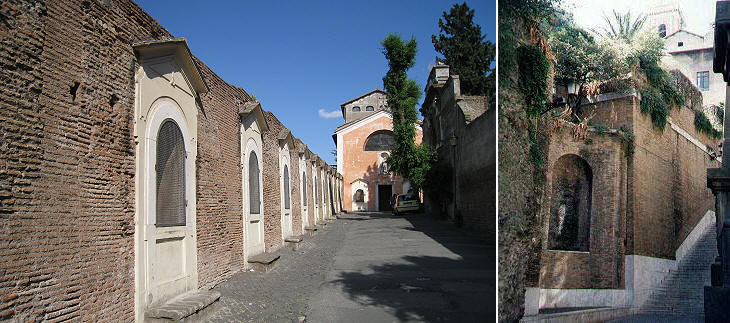
Clivo dei Publici is named after ager publicus a part of the Aventine the Roman Senate opened to all citizens. In the XVIIIth century the area belonged to monasteries or rich families and the narrow street was flanked by low walls interrupted by fine gates.
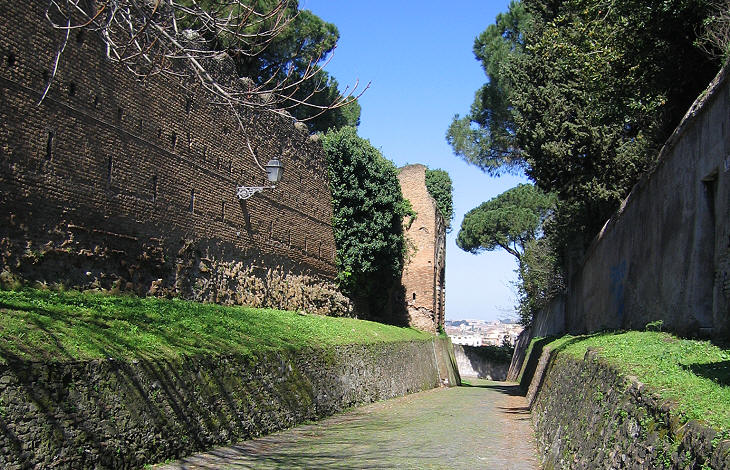
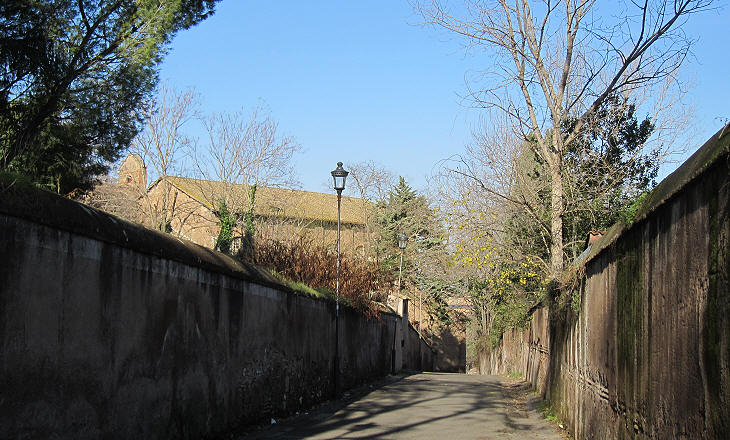
Clivo di Rocca Savella was for centuries the main access to the Aventine and in 1285 with the election of Pope Honorius IV it became one of the most important streets of Rome, because the pope, a member of the Savelli family, preferred to hold the papal court in the family fortress (Rocca Savella) at the top of the street. Today the street is open only in day time and a few steps protect it from becoming a parking lot. The first stretch of the street has on the left side the walls of the fortress covered by a rich spontaneous vegetation.
Only a few locals know that the street leads to S. Maria in Cosmedin and to the river and that it has a very fine view over Rome (Clivo di Rocca Savella is also shown in the image used as background for this page). Via di Villa Pepoli and Via di S. Balbina These two streets are located on the lower peak of the Aventine, which is today known as S. Saba, after the church dedicated to this saint.
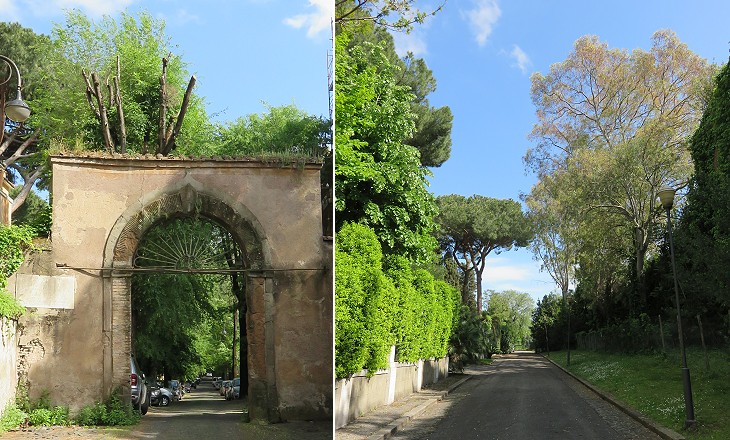
At the beginning of the XIXth century Cardinal Fabrizio Ruffo turned a farm between the Baths of Caracalla and the walls into a summer retreat. The Cardinal was a very powerful man, who had personally led the resistance to the French in southern Italy, by organizing the so called Army of the Holy Faith, which eventually defeated, with the help of Horatio Nelson, the Partenopean (of Naples) Republic.
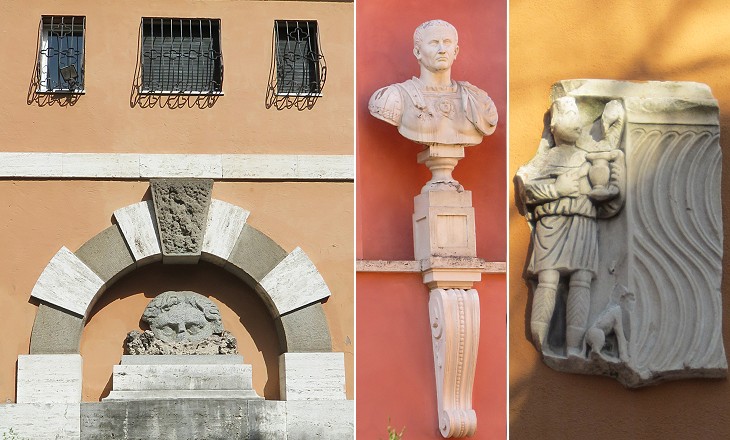
In the XXth century the area was split into several little estates in each of which there is now a building (of a limited size), some of which are worth looking at.
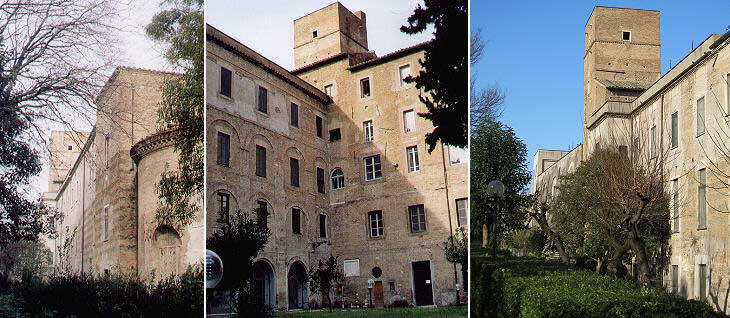
Via di S. Balbina is named after a medieval church. It was one of the very few streets in this part of the Aventine and it still retains the appearance of a country lane.
At the end of the street there is the entrance to the large medieval buildings adjoining the church, which once were used as a monastery and a hostel for the poor. They still show the medieval technique used for building them with alternate layers of bricks and stones. The tower is a sign of the poor security of this part of Rome during the Middle Ages. Rampa di S. Sebastianello and Rampa Mignanelli The Spanish Steps are one the most celebrated sites of Rome, but they are not the only steps linking Piazza di Spagna with the Church of SS. Trinità dei Monti. To the left and to the right of the main steps there are two other steps, where one can avoid the crowds usually sitting on the Spanish Steps.
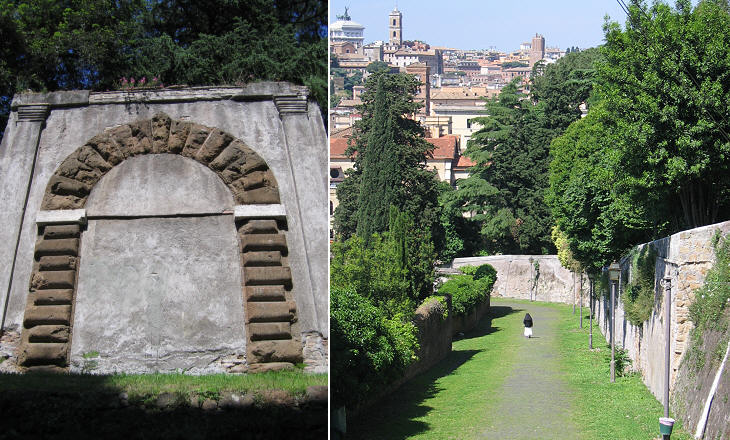
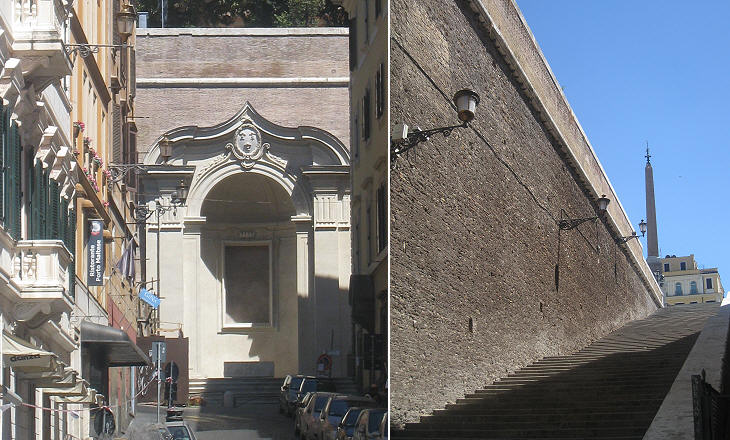
Rampa (flight of steps) di S. Sebastianello was built at the same time as the main steps (1720s) and it was decorated with a large niche designed by Filippo Raguzzini. The coat of arms on its top celebrates the French Royal Family (the Bourbons).
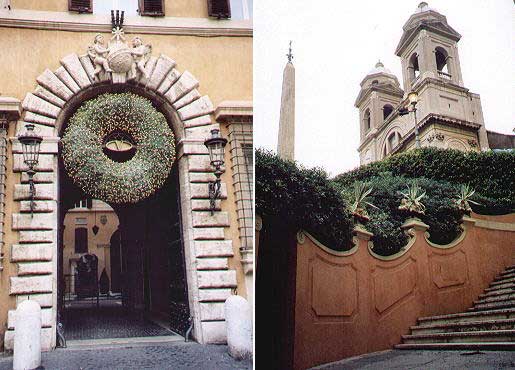
Rampa Mignanelli is named after Palazzo Mignanelli a late Renaissance palace, currently rented by stylist Valentino. The steps offer an interesting view of the church and of the obelisk. Other Silent Streets Via di S. Bonaventura on the Palatine hill is another fine example of the old rural streets of Rome. Via dell'Arce Capitolina is a modern flight of steps leading from Piazza Venezia to the Capitol Hill and few notice it because it is hidden by the large Monument to Victor Emmanuel II.
Via dei Giardini, near the Gardens of Palazzo del Quirinale, Salita di S. Onofrio, Via delle Sette Sale, behind S. Pietro in Vincoli, Via dei SS. Giovanni e Paolo, near the church of SS. Giovanni e Paolo and Via del Montonaccio, can also be included among the silent streets of Rome.  SEE THESE OTHER EXHIBITIONS (for a full list see my detailed list).    |