  What's New! Detailed Sitemap All images © by Roberto Piperno, owner of the domain. Write to romapip@quipo.it. Text edited by Rosamie Moore. Page added in June 2005. |
 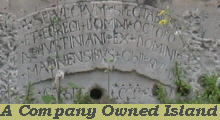 Scio (Chios) Scio (Chios)(an inscription making reference to Maona Giustiniani) Kampos The wealth of Scio was (and in part still is) linked to the lentisk, a small tree exuding a gum. The tree Lentiscus Pistacia grows in most of the Mediterranean countries, but only in Scio its gum solidifies: this evergreen is called a mastic tree and it was known to the ancient Greeks and Romans: in a way it was the chewing-gum of antiquity. It grows in the southern part of Scio.
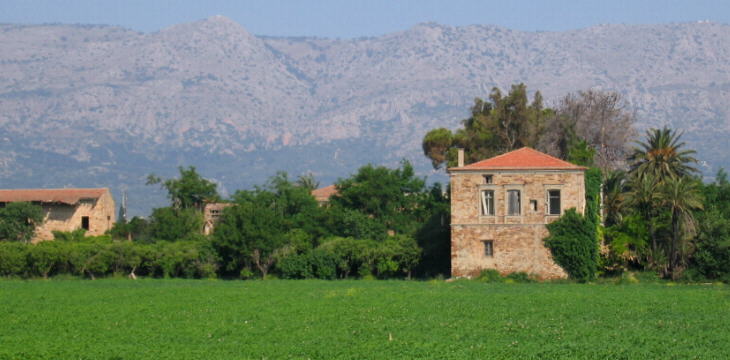
Maona Giustiniani promoted farming on Scio and in particular on Kampos, a plain to the south of the town. There is a striking contrast between the bald grey mountains and the green plain.
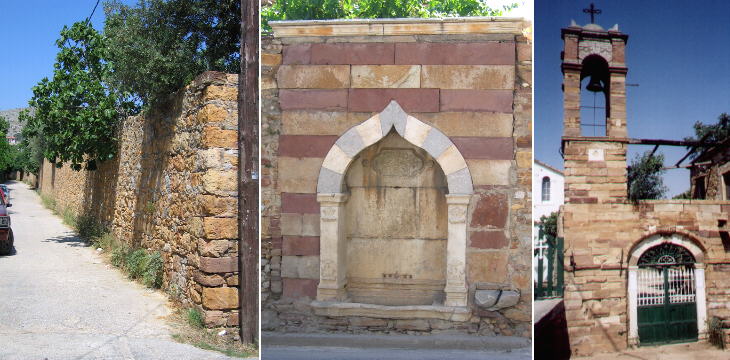
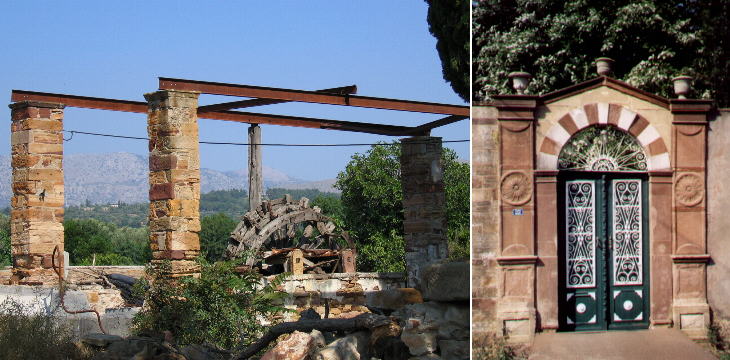
Each farm was surrounded by walls, often rather high, having the objective to minimize the erosion of the soil due to the meltemi the strong wind which blows on the Aegean. The walls and the buildings were erected making use of Thymiana, a local stone with warm yellow and red tones.
Each farm had a deep well to intercept the flow of abundant underground water. Overall the texture of buildings, gates, boundary walls, etc. is still very consistent and the majority of the modern additions respect the old architectural patterns. Mesta and Pirgi The farms of the Kampos plains could be easily protected from corsar raids by the Genoese ships in the harbour of Scio, but the southern tip of the island was exposed to this risk. For this reason the peasants lived in fortified villages, which have retained their peculiar layout.
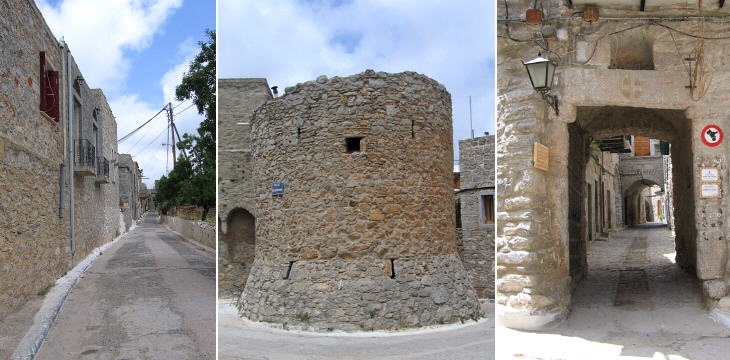
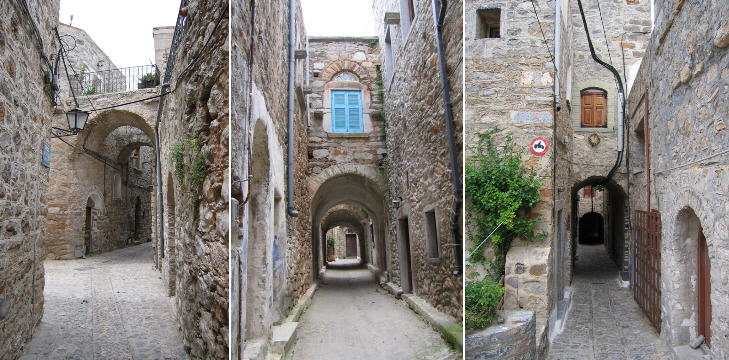
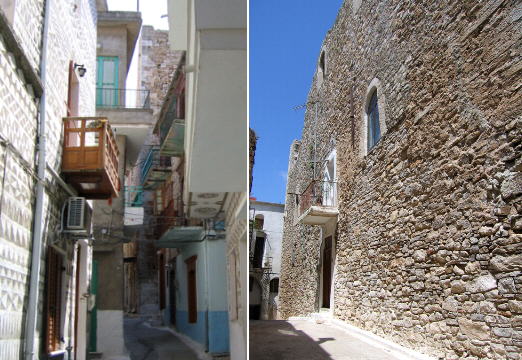
The villages did not have walls, but the external houses were lined up to form a barrier. They did not have doors or windows on this side (now they have been opened). At each corner of the village there was a tower and there was only one gate giving access to the village. This structure is still very well preserved in Mesta.
The defence of Mesta was entrusted to the villagers themselves. The corsairs who had managed to penetrate inside the village found themselves in a maze of very narrow alleys covered by archways through which the villagers could easily move and repel the assailants. This layout is impressively similar, although the buildings of Mesta are not so high, to the carrugi, the very narrow streets of the medieval quarter of Genoa.
The fortifications of the villages were completed by a large tower at the centre of the village. It could be reached only through very narrow streets and it did not have openings at the ground floor level. The tower of Mesta has been pulled down to provide the village with at least one open space, but that of nearby Pirgi still exists.
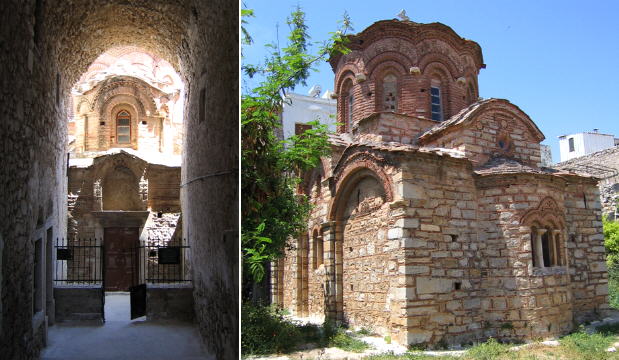
Even the fine church of Pirgi was accessible only through an archway (today some buildings have been pulled down and its rear part is visible).
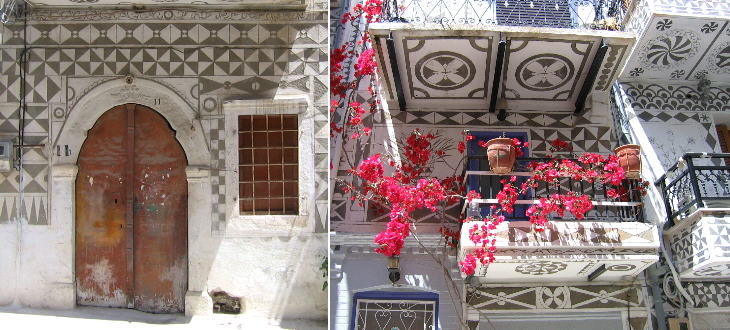
Another link to the Genoese period is made by the decoration of the houses of Pirgi, a kind of graffito, a technique developed in Italy during the Renaissance. Today the decoration, which once was based on very simple geometrical shapes, and which can still be seen on a few buildings, includes too many varieties of patterns. The technique too, is no longer the original one.
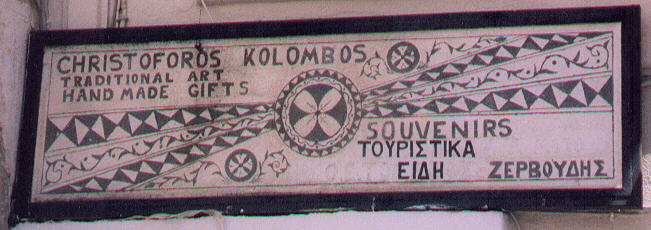
Finally the funniest link to Genoa is the fact that some inhabitants of Pirgi pretend to be the descendants of Columbus, as they believe that the great navigator was born in Scio. Return to page one or move on to Fochies or Cismes. Clickable Map of the Ionian and Aegean Seas with links to other locations covered in this website (opens in a separate window)     |