  What's New! Detailed Sitemap All images © by Roberto Piperno, owner of the domain. Write to romapip@quipo.it. Text edited by Rosamie Moore. |
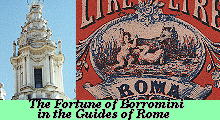 The Fortune of Borromini in the tourist guides of Rome The Fortune of Borromini in the tourist guides of Rome
Initial Fortune The Tourist, as a member of the middle class with some cultural background but needing help in understanding the artistic values of the location he/she is visiting appears at the end of the first half of the XIXth century. The advent of the railroad allows fast and secure mass transportation and industrialization is giving some wealth to merchants and manufacturers. Before the tourists, Rome was visited by pilgrims, especially during the Holy Years: to help them get around in Rome, books with information about the seven basilicas to visit were printed, but they were basically religion oriented suggesting which saint to pray for in a church and which relics to look for in another. The first attempt to provide visitors with a comprehensive review of the churches of Rome from an artistic viewpoint appeared in 1674 by Filippo Titi with his "Studio di Pittura, Scoltura et Architettura nelle Chiese di Roma": this book was reprinted until 1763. His review of Borromini's St Yves' says: "Pope Alexander VII completed ... the church con bizzarra e vaga architettura del Cavalier Borromino"; vaga at that time meant beautiful. For the few who could afford the Grand Tour of Italy in the mid XVIIIth century a book with the prints of ancient and new Rome was a must. Two artists are known for these prints: Giovanni Battista Piranesi and Giuseppe Vasi. Their very comprehensive selection of views of Rome were printed around 1750. Piranesi was already headed towards neoclassicism and he ignored Borromini's works while Vasi was still fascinated by the ingenuity of Borromini. Here you can see a detail of one of his prints entitled to S. Eustachio but having the objective of showing the spire of St Yves'.
The etchings were accompanied by a description and arranged in a sequence similar to a tourist itinerary. Oblivion Vasi because of the success of his books printed a guide of Rome in 8 days and this guide influenced the first XIXth century books printed in Rome for foreigners. In 1834 A. Nibby a French professor in Rome follows Vasi's steps, but his mention of Borromini in his "Itineraire de Rome" is limited to a short note in the description of the University: "Dans la quatrième coté est l'eglise, dont l'architecture, non moins singulière que bizarre est du Borromin". But this was still a traditional book for people visiting Rome. The first tourist guides appear a few years later. In 1855 Hachette publishes a Guide of Italy, the author is mentioned in small characters. The book provides all practical information for traveling in Italy (roads, hotels, currency, etc.) together with history and art summaries. Borromini is quoted as the lowest point of art in Rome: "Avec le XVIIe siècle s'ouvre l'époque de dècadence de l'art italien. L'architecture se jette dans la recherche de l'effet pittoresque et tend à n'etre plus qu'une vaine décoration....Borromini dans sa rivalité avec le Bernin et son désir de nouveauté ne mit plus de frein au dévergondage de son immagination." The guide describes the University of Rome but does not even mention the church of Borromini. A cheap guide in Italian of 1877 just says the church was designed by Borromini.
Karl Baedeker Karl Baedeker was both the author and the printer of a series of tourist guides which had such a success that "baedeker" stands for tourist guide. His 1883 Guide of Central Italy hosts a short essay on medieval and modern art. "Maderna with Borromini and Carlo Fontana were the leaders of that band of Artists who conspired to rob architecture of its fitting repose and ... substituted a turbulent unrest". Nevertheless the author admits: "Not that the style was without striking and artistic effect". When mentioning the University the guide just says:"The church, with its grotesque spiral tower was designed by Borromini in the form of a bee, in honour of Urban VIII." The very detailed view of Rome attached to the guide pays little attention to the spiral of St.Yves', which, although very neatly visible from S. Pietro in Montorio, is not carefully shown.
Resurrection The guides recommended not spending time on the baroque churches and palaces of Rome, but nevertheless tourists liked their theatrical appeal and in the end the guides had to reflect this fact. 1909 Baedeker's French Guide says of Borromini, Fontana and Maderno: "C'est eux qui ont crée ces églises et ces palais grandioses, dont les espaces imposants et les effets pittoresques ont donné a la ville éternelle sa physionomie décisive." and the description of St Yves' spiral is no longer despising. In 1911 for the 50th anniversary of the Kingdom of Italy several guides of Rome were published and with them the ban on Francesco Borromini and his feverish art is lifted. A list of works by Francesco Borromini
SEE THESE OTHER EXHIBITIONS (for a full list go to my detailed index)    |


