  What's New! Detailed Sitemap All images © by Roberto Piperno, owner of the domain. Write to romapip@quipo.it. Text edited by Rosamie Moore. Page added in July 2006. |
  Seddulbahir Seddulbahir(detail of an Ottoman miniature showing Rumeli Kavagi, a lost fortress on the Bosporus) During the fifth Ottoman-Venetian war (War of Candia 1645-69), the Venetians blocked the Dardanelles, which were protected by two fortresses (Kale Sultanieh and Kilitbahir) built by Sultan Mehmet II. In 1648 the impact of the Venetian success threw the people of Constantinople into such a panic that Sultan Ibrahim was deposed and replaced with his six years old son Mehmet IV. The change of sultan did not bring to a halt the Venetian raids in the Dardanelles which lasted until 1657.
In 1656 the Ottoman fleet made an attempt to dislodge the Venetians, but this resulted in a naval defeat comparable to that suffered by the Ottomans at Lepanto in 1571. This time it was the turn of the Grand Vizier to be replaced. The new man, Mehmet Koprulu, was determined to solve once and for all the Venetian blockade of the Dardanelles. He reorganized the Ottoman fleet and in 1657 the Venetians were engaged again. The battle soon turned into a new disaster for the Ottomans and the Grand Vizier was so enraged that he put to death the grand admiral of his own fleet. The Venetians thought the time had finally arrived to move through the Dardanelles and attack Constantinople, but an Ottoman cannoneer (today regarded as a Turkish national hero) hit the mast of the galeazza of the Venetian commander; this in turn led to the explosion of the magazine and the ship sank. The Venetians lost impetus and eventually retreated.
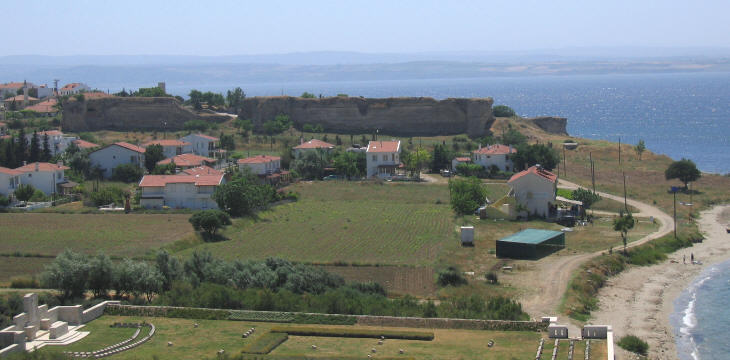
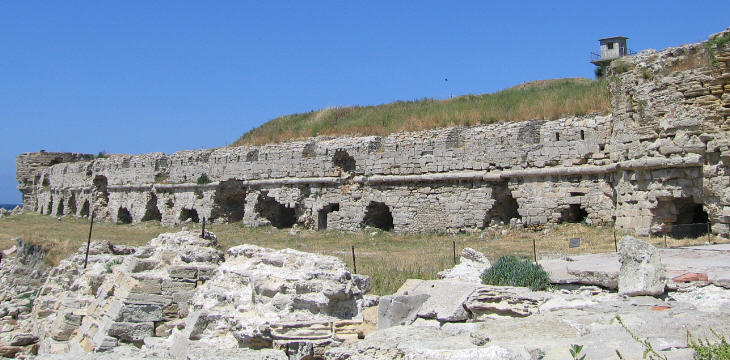
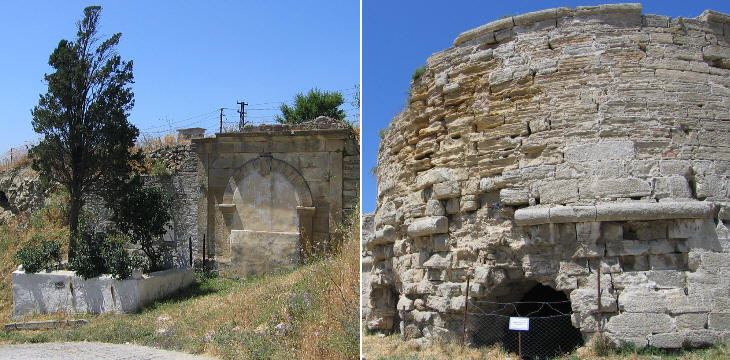
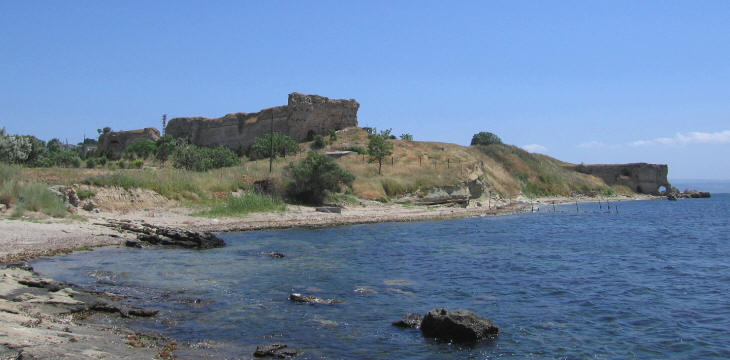
The Grand Vezier understood that, in order to prevent a reoccurrence of the blockade, the Ottomans needed additional fortresses at the point of entry into the Dardanelles and therefore he built that same year Seddulbahir (Wall of the Sea) on the European side and Kumkale (Castle on the Sand) on the Asian one.
These two fortresses bore the brunt of the 1915 Anglo-French attack: the sea front of Seddulbahir was almost entirely razed to the ground by British shelling, but the defenders did not give up and the site saw some very fierce fighting. The French attacked and destroyed Kumkale, but their aim was just to create a diversion as the chief commanders had chosen to land on the Gallipoli peninsula, the European side of the strait.
The scarce ruins of Kumkale are today inside a naval base of the Turkish Navy. The village near the castle was so totally destroyed that it was rebuilt after the war at a certain distance from its original site and it is therefore called Yeni (new) Kumkale.
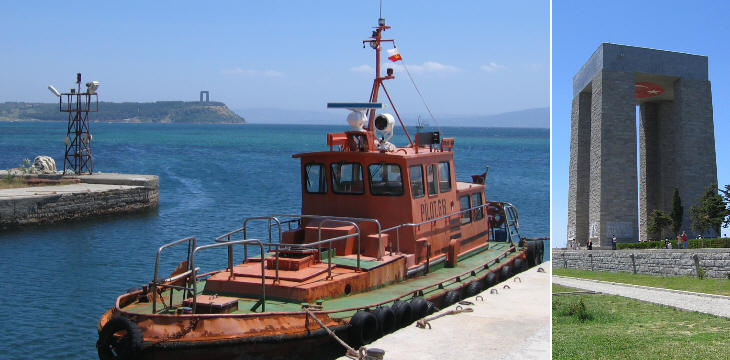
Cape Abydos, at the end of the Gallipoli peninsula, has many memorials both Turkish and of the various countries which took part in the Anglo-French expedition. Lord Byron set his Turkish tale The Bride of Abydos at this location, a poem narrating the love of a young man living on the Asian side of the Dardanelles for a woman living on the European one: every night he swam across the strait to meet his sweetheart; one night the torch which she lit to help him find his way, was extinguished by the wind and the young man drowned. By personally swimming across the strait Lord Byron proved that the account was plausible. The winds are high on Helle's wave, As on that night of stormy water, When Love, who sent, forgot to save The young, the beautiful, the brave, The lonely hope of Sestos' daughter. Lord Byron - The Bride of Abydos - Canto the Second - 1 to 5
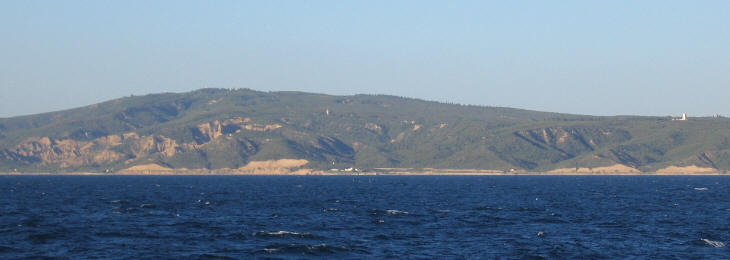
In April 1915 a major landing of ANZAC (Australian and New Zealand Army Corps) forces took place on the western coast of the Gallipoli peninsula. It was a military operation which had not been carefully planned for, but which was decided when the Turkish minefields in the Dardanelles proved to be a barrier to naval progress. The actual landing took place two miles north of the intended site on a terrain which was most unfavourable for the attackers. It is a paradox that an operation which was meant to be an alternative to the bloody trench warfare which characterized WWI from its onset, turned into yet another trench warfare which claimed a similar toll of lives.
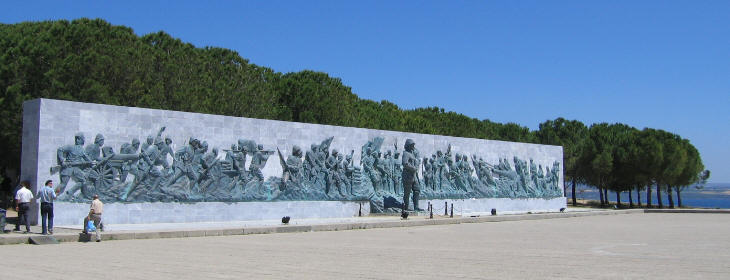
Every year on ANZAC day (April 25) many Australians and New Zealanders visit the war cemeteries where their John, Mark and Steven lie in the grass. In adjoining war cemeteries the Turks visit their Mehmet, Adnan and Orhan. Notwithstanding the gigantic reliefs and statues which celebrate the heroism of the dead, one cannot avoid thinking that if the fallen could speak they would say with Wilfred Owen: ..My friend, you would not tell with such high zest To children ardent for some desperate glory, The old Lie; Dulce et Decorum est Pro patria mori. Note: Dulce et decorum est pro patria mori Horace - Odes - III, 2, 13. It is sweet and right to die for your country. Fortresses of the Sultans - Introduction Fortresses built before 1453: 1 - Anadolu Hisar 2 - Rumeli Hisar Fortresses built after 1453 and before 1657: 3 - Kale Sultanieh 4 - Kilitbahir Fortresses built after 1657: 5 - Seddulbahir 6 - Imbro 7 - Tenedo Clickable Map of the Ionian and Aegean Seas with links to other locations covered in this website (opens in a separate window) |