  What's New! Detailed Sitemap All images © by Roberto Piperno, owner of the domain. Write to romapip@quipo.it. Text edited by Rosamie Moore. Page revised in February 2010. | Ponte Adriano (Book 5) (Map C2) (Day 8) (View C4) (Rione Borgo) and (Rione Ponte) In this page: The plate by Giuseppe Vasi Today's view Ponte Adriano Mausoleo di Adriano Castel Sant'Angelo The View La Girandola The Plate (No. 86)
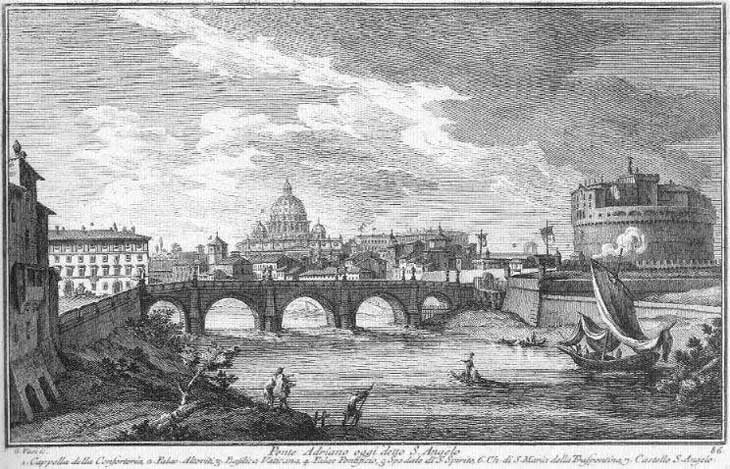
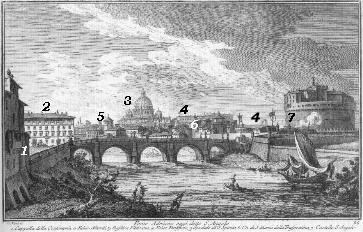
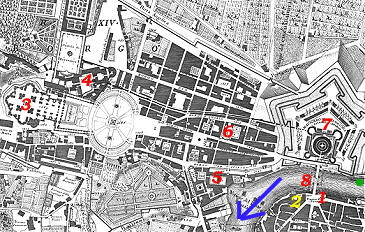
This is one of the best known views of Rome, but Giuseppe Vasi was not the first one to depict it; Gaspar Van Wittel (1653-1736), a Dutch landscape painter who spent most of his life in Rome painted this view of the Tiber in the 1690s (you may wish to see it in an external link). Vasi chose a point of observation closer to Ponte S. Angelo than Van Wittel and his etching provides a more detailed view of Piazza di Ponte, the square which was located at the beginning of the bridge; Vasi shows to the far left Cappella della Conforteria where (up to the XIXth century) those sentenced to death were comforted prior to the execution which took place in a corner of Piazza di Ponte; the chapel was dedicated to S. Giovanni Decollato and it belonged to Arciconfraternita della Misericordia, a brotherhood of the Florentine Community in Rome (which also had a church in Velabro). The view is taken from the green dot in the small 1748 map here below. In the description below the plate Vasi made reference to: 1) Cappella della Conforteria; 2) Palazzo Altoviti; 3) Basilica Vaticana; 4) Palazzo Pontificio (left) and Palazzo del Belvedere (right); 5) Spedale di S. Spirito; 6) S. Maria della Traspontina; 7) Castel Sant'Angelo. 3), 4), 5), and 6) are shown in other pages. The small map shows also 8) Ponte Adriano or S. Angelo. Vasi showed Castel Sant'Angelo also in plate 20 and in the related page you can find more information on its fortifications.
Today
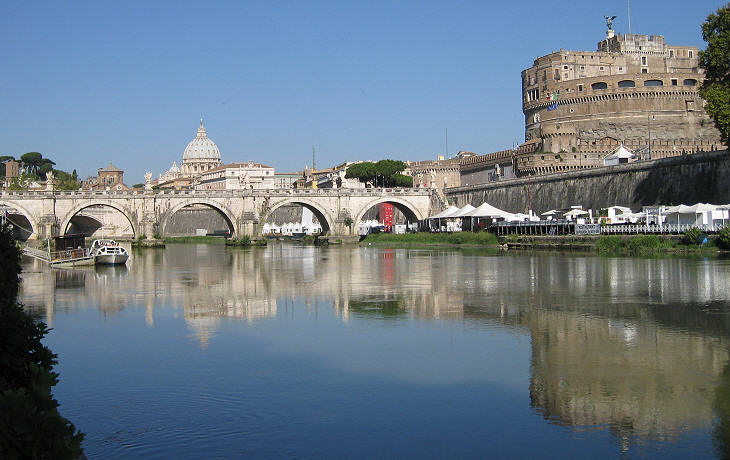
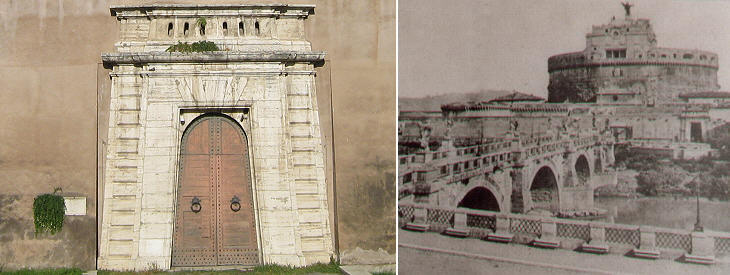
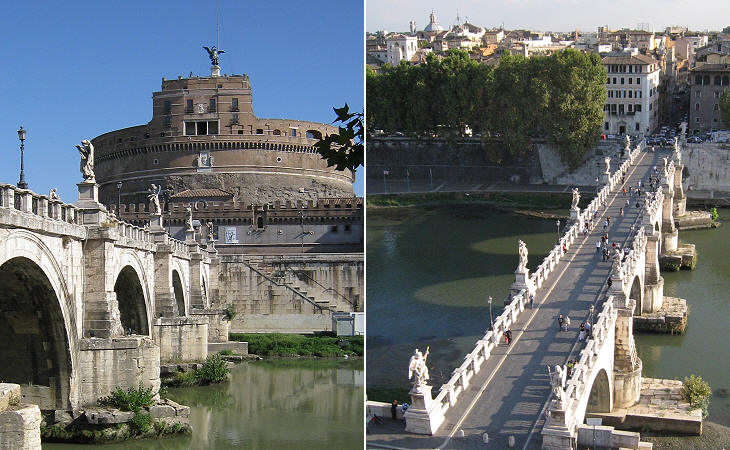
In the late XIXth century the river bed was enlarged and high walls were built on its banks in order to prevent floods; the small arches at both ends of Ponte S. Angelo were replaced by two arches of the same size as the central ones. These changes impacted on Piazza di Ponte which was significantly reduced with the loss of Palazzo Altoviti and Cappella della Conforteria.
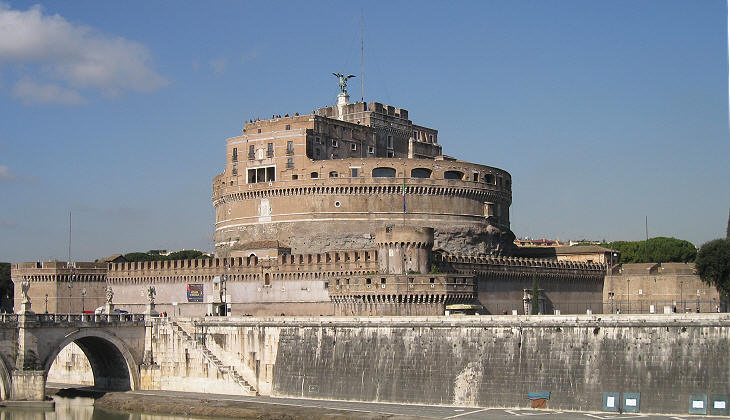
The front of Castel Sant'Angelo was modified by relocating its XVIIth century entrance to a side wall of the building and by pulling down a XVIth century bastion to show a tower built at the time of Pope Nicholas V. Ponte Adriano
The ancient name of the bridge was Pons Aelius; it was built almost exclusively to allow access to the mausoleum of Emperor Hadrian and to facilitate its construction; as a matter of fact it became the most important bridge of medieval Rome because the majority of the other bridges collapsed. In a page dealing with another plate by Giuseppe Vasi showing this bridge you can find a more detailed description of Ponte S. Angelo and its statues. Mausoleo di Adriano
The behaviour of Emperor Hadrian was a subject of controversy during his lifetime and after his death; the imposing mausoleum he built on the right bank of the river was at risk of not being completed because of the opposition of the Senate, but Emperor Antoninus Pius, his successor, insisted on its completion and wanted to be buried there, thus turning the building into the funerary monuments of the emperors (Caracalla was the last emperor whose ashes were placed inside the mausoleum).
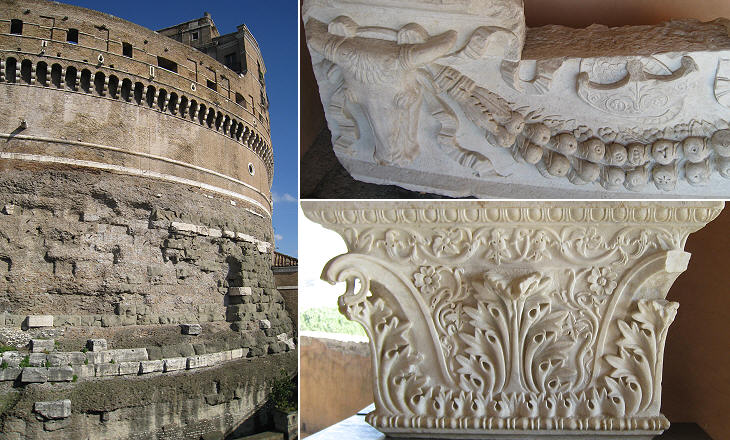
The mausoleum consisted or a circular tower on a square base; on the roof of the tower there was a mound having at its top a circular temple; a statue of the emperor driving a quadriga, a chariot drawn by four horses, was placed at the top of the temple; there is a possibility that the horses which today are in Venice were in origin part of Hadrian's quadriga; the emperor was portrayed as Helios, the Greek god of the sun; Hadrian belonged to gens Aelia and his second name was Aelius which sounds very similar to Helios. The structure of the building was made up of opus caementicium (see a page dealing with Construction Techniques in Ancient Rome) and it was faced with travertine and tufa. It had an elaborate marble decoration and many statues were placed on the balustrade of the roof. The top of the building was accessed through an internal circular ramp which allowed the passage of carriages. The mausoleum was perhaps sketched by the emperor himself and it was built by the architect Demetrianus. Read Lord Byron's verses dedicated to this site.
On a day of winter 590 St Gregory the Great was leading Litania Septiformis, seven processions which started from different churches; they all went towards S. Maria Maggiore and from there to S. Pietro; the objective of the procession was to pray for the cessation of a plague; when the pope was about to cross the bridge in front of the mausoleum he saw Saint Michael the Archangel on top of the building in the act of sheathing his sword: this was interpreted as a sign of the end of the pestilence, which actually ended soon afterwards; the miraculous event changed the name of the mausoleum and of the bridge.
The utilization of the former mausoleum as a fortified site began during the VIth century Greek-Gothic War; in the IXth century Pope Leo IV linked Castel Sant'Angelo with walls to S. Pietro; later on these walls became known as il Passetto (the small passage) because they allowed the popes to seek refuge in the castle.
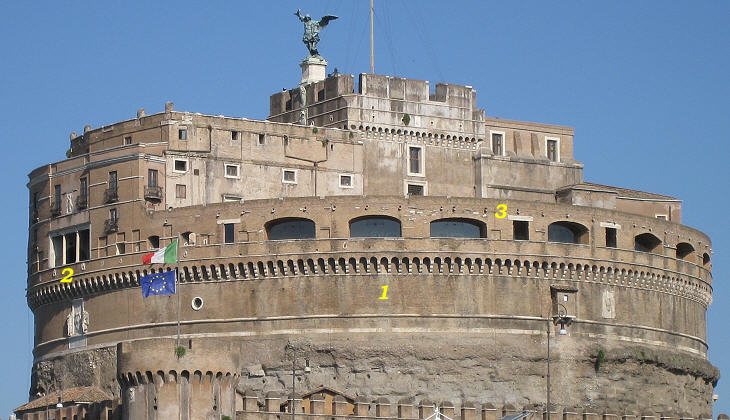
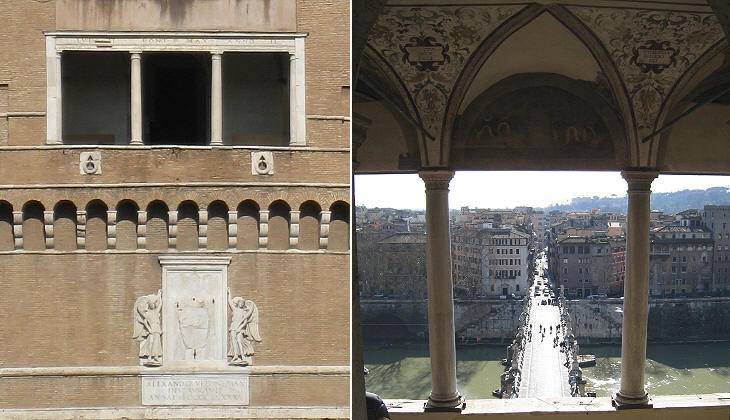
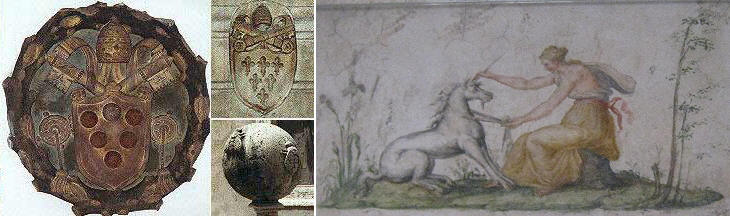
The popes regained control over Castel Sant'Angelo after their return from Avignon and Pope Boniface IX cleared the central tower from the rubble it was surrounded by and fortified the square base; he also built a new internal ramp which was more easily defensible, owing to its traps. Pope Nicholas V built small towers on the walls along the river. Pope Alexander VI promoted a major restructuring of Castel Sant'Angelo by building bastions at each corner of the base, by providing the central tower with battlements, by building warehouses to store supplies and by initiating the development of a papal apartment.
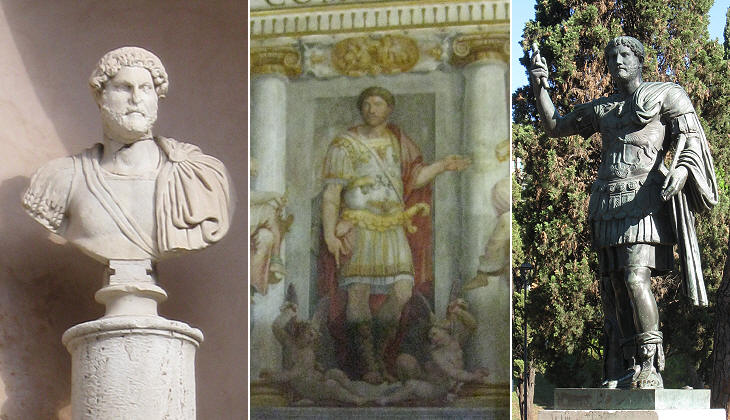
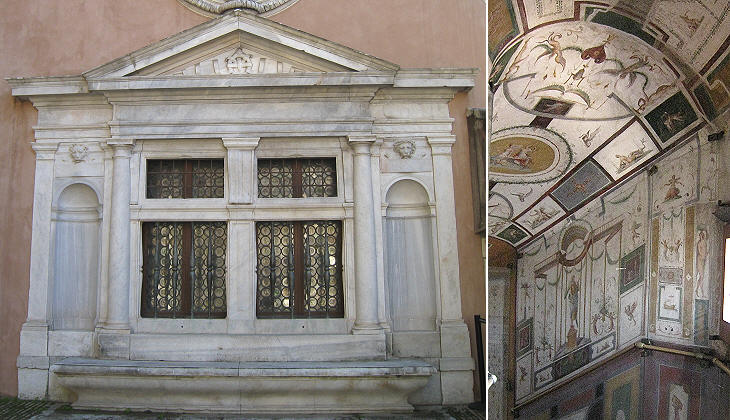
Pope Julius II, Pope Leo X and Pope Clement VII were mainly involved in enlarging the papal apartment; during the 1527 Sack of Rome, Pope Clement VII lived for a month in that apartment; his successor Pope Paul III greatly strengthened the fortifications of Rome, but not those of Castel Sant'Angelo where he focused on the decoration of the papal apartment; Perin Del Vaga, a scholar of Raphael, painted a large hall (Sala Paolina) with events of the life of Alexander the Great (the pope's name was Alessandro Farnese) and with a portrait of Emperor Hadrian.
Today Castel Sant'Angelo is a National Museum, where one can admire its extraordinary artistic and historic heritage.
Dan Brown set an episode of his novel Angels and Demons in Castel Sant'Angelo; read some remarks on it. The View
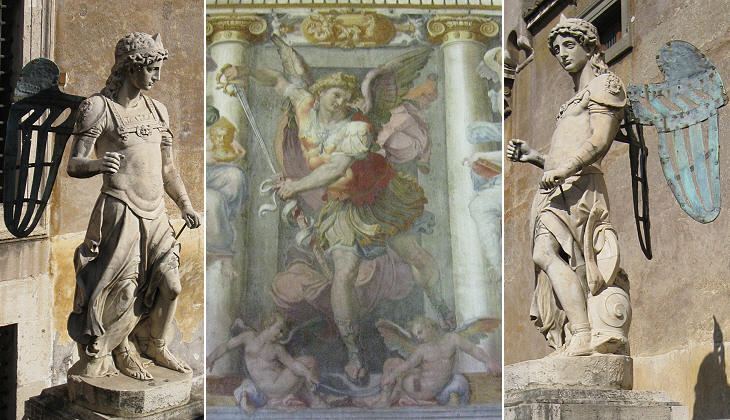
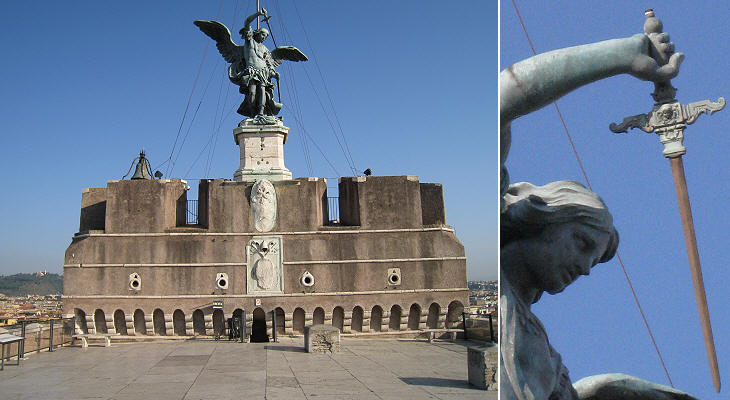
In 1752 a bronze angel by the Flemish sculptor Peter van Verschaffelt replaced a marble statue by Raffaello da Montelupo at the top of Castel Sant'Angelo. The statue by Verschaffelt was composed of 35 bronze pieces and its structure was strengthened by three iron bars inside the bronze shell. The two angels could not have been portrayed in a more different way; the design of the bronze statue was influenced by a famous painting by Guido Reni, while the angel by Raffaello da Montelupo has the composure of an ancient warrior in a moment of rest. 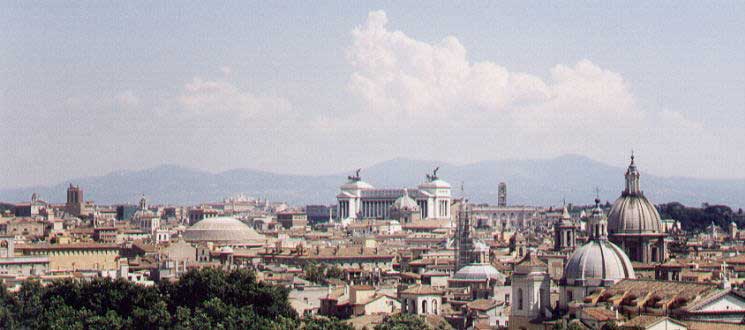
La Girandola
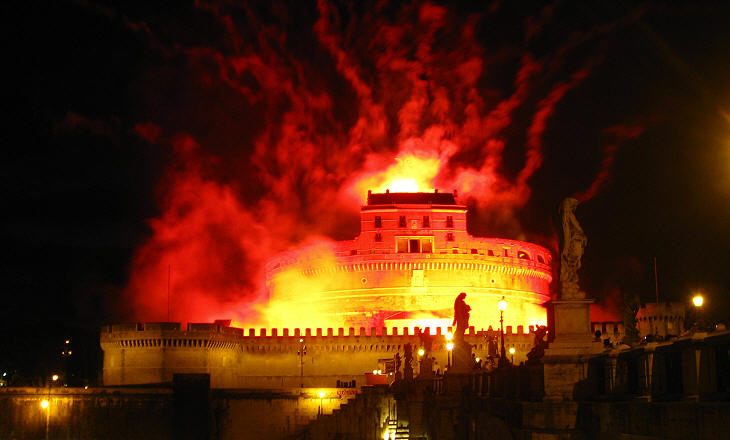
According to tradition in 1481 Pope Sixtus IV celebrated the tenth anniversary of his election with a firework display from Castel Sant'Angelo; until 1851 the fireworks at Castel Sant'Angelo were one of the main attractions of Rome; Michelangelo and Bernini designed temporary structures for enhancing their effect; the display ended with la Girandola, a major launching of rockets from the top terrace. Read Charles Dickens's account of the fireworks at Castel Sant'Angelo in 1845 or see an entire page on the re-enactement of the fireworks. Excerpts from Giuseppe Vasi 1761 Itinerary related to this page:
Next plate in Book 5: Vestigie dell'antico Ponte Trionfale Next step in Day 8 itinerary: Spedale di S. Spirito in Sassia |