What's New!
Detailed Sitemap
All images © by Roberto Piperno, owner of the domain. Write to romapip@quipo.it. Text edited by Rosamie Moore.
Page revised in February 2010.
|
Palazzo Augustale detto Maggiore (Book
4)
(Map B3)
(Day 5) (View C9) (Rione Campitelli)
and (Rione Ripa)
In this page:
The plate by Giuseppe Vasi
Today's view
Circus Maximus
Torre della Moletta and la Vignola
The Plate (No. 60 ii)
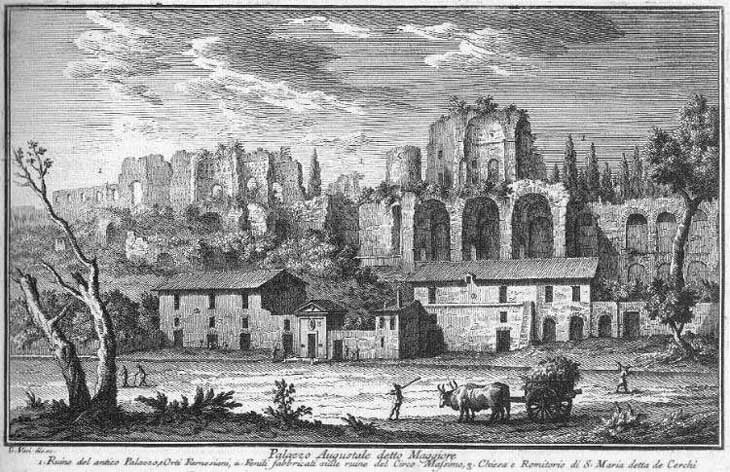
Giuseppe Vasi opened his Book on the Palaces of Rome with a special, not numbered plate
dedicated to the "Palace" par excellence. In his introduction to the plate Vasi wrote: "(Readers) you should not think it a strange idea,
if in showing you the magnificent Palaces of Rome I will
start by showing first the ruins on the Palatine hill,
because from these ruins the word Palace originated."
Actually Italian palazzo comes from Latin palatius a corruption of
Palatinus with reference to the Palaces built by Augustus,
Tiberius and other Emperors on that hill. At the time of Vasi most of the hill was part of Orti Farnesiani.
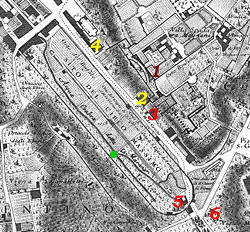
The view is taken from the green dot in the small 1748 map here below.
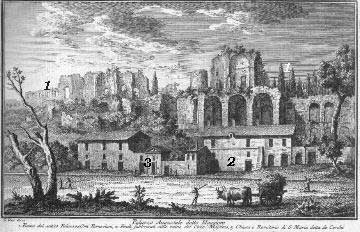
In the description below the plate Vasi made reference to: 1) Ruins of the old Palace and Orti Farnesiani;
2) Haylofts built on the ruins of Circo Massimo;
3) S. Maria de' Cerchi.
The small map shows also 4) Baroque building behind S. Anastasia; 5) Torre della Moletta; 6) La Vignola.
The dotted line in the small map delineates the border between Rione Ripa (left) and Rione Campitelli (right).
Today
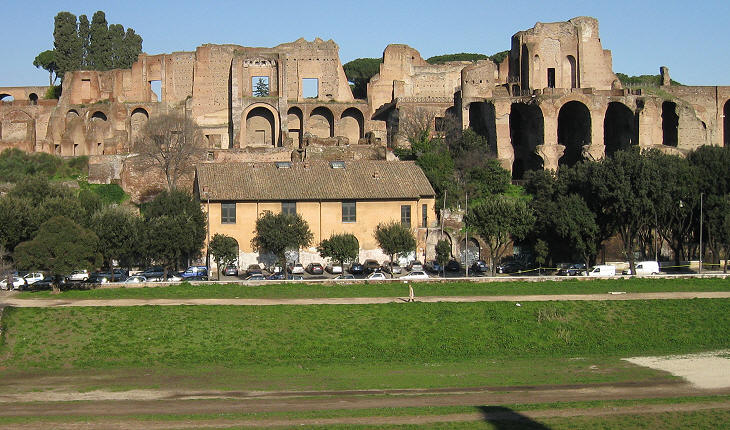
The view in January 2009
The photo was taken from the north side of the Aventine hill (near Roseto di Roma): the view is almost the same as far as the ruins are concerned, whilst the shape of Circus Maximus, the ancient course for chariot races, is more clearly visible, owing to a wide redesign of the area which occurred in 1932-35. The small chapel of S. Maria de' Cerchi was pulled down at the end of the XIXth century.
You may wish to see a 4430X630 image of the Palatine or see it in the moonlight.
Circus Maximus
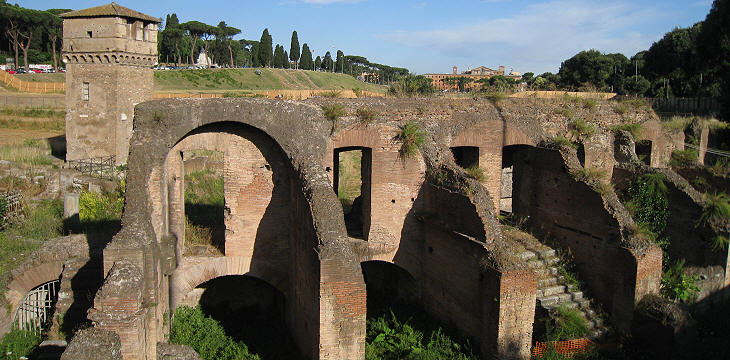
Ruins of the eastern section of Circus Maximus
The long and narrow valley between the Palatine and the Aventine provided a
natural setting for races. According to Titus Livius the first races date
from the time of King Tarquin the Elder, while the last race occurred in 549 when Rome was occupied by the Goths of Totila.
Circus Maximus was built and destroyed several times. The two Egyptian obelisks which decorated the spina, the central low wall around which the chariots raced,
were restored and relocated to
Piazza del Popolo and
Piazza S. Giovanni by Pope Sixtus V in 1587.
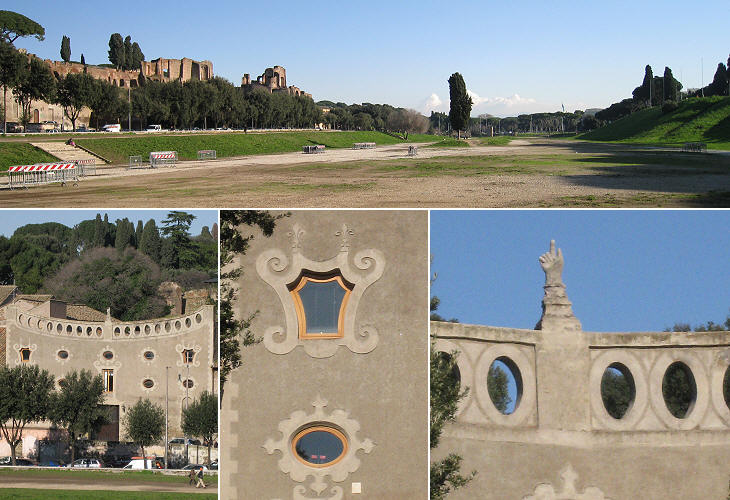
(above) View from the western end; (below) a baroque building which was part of Orti Farnesiani near S. Anastasia
In 1932-35 the area was cleared of all buildings
(including the gas-works of Rome) and the ancient shape of the circus was made more clearly visible, but the actual racing course is some thirty feet below the current ground level.
The hand of a gigantic ancient statue stood for some time near S. Maria dei Cerchi which for this reason was also known as S. Maria de Manu (hand). Its memory is retained by a smaller copy of the hand which was placed at the top of a building belonging to the Farnese (the windows are decorated with fleurs-de-lys, the heraldic symbol of the Farnese).
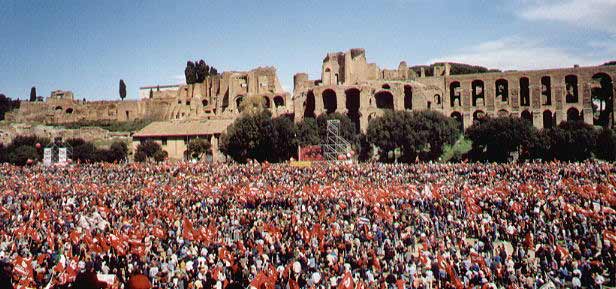
A rally against Mr. Berlusconi's labour laws in March 2002
The large and empty space is usually a preferred spot for joggers, but in recent years
it turned out to be perfect for very large mass gatherings such as a rally against new labour policies or the celebrations for the winning of the 2006 FIFA World Cup by the Italian soccer team. More on how the Romans voice their views.
Torre della Moletta and la Vignola
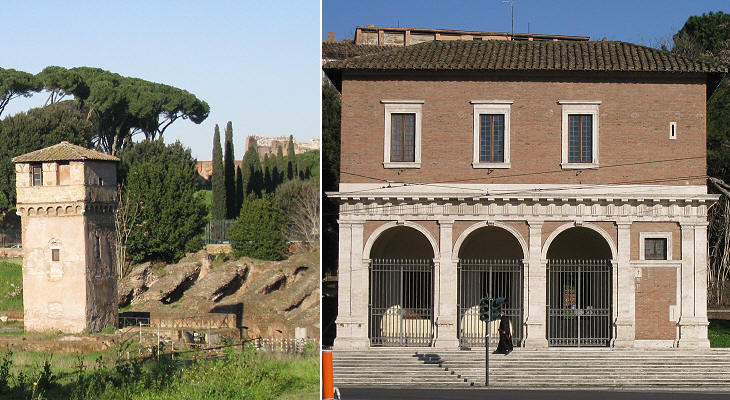
(left) Torre della Moletta; (right) Casino della Vignola
With the decline of Rome during the Middle Ages, Cloaca Massima, the sewer discharging excess water into the
Tiber, was no longer maintained and small streams (marrana) found their way
through the abandoned parts of the city. A relatively large stream coming from the hills near Albano
crossed the ruins of Circus Maximus (it is visible in the small 1748 map) and a bridge was built on it. In the XIIth century
the area belonged to the Frangipane family who had their
fortress in Colosseo. The stream was utilized by a small
mill (moletta) and the Frangipane built a tower to protect it.
Ancient Porta Capena, the starting point of Via Appia, was located near the eastern end of Circus Maximus; in 1911 the area where the gate stood was redesigned in order to provide an appropriate entrance to the restored archaeological sites along the ancient road and chiefly to Terme di Caracalla. This led to enlarging Valle delle Camene, the valley between
the Aventine and the Caelian hills. A small but elegant Renaissance building at the foot of the Aventine was
pulled down and rebuilt in the new square. It is called la Vignola with a reference to the XVIth century architect
Jacopo Barozzi, called il Vignola, but the name is due to the fact that the building
was located in a small vineyard (It. vignola) belonging to the Boccapaduli family.
Excerpts from Giuseppe Vasi 1761 Itinerary related to this page:
Circo Massimo, come era
anticamente
Tutta la valle, che poi vediamo tra il monte Palatino, e l'Aventino ora occupata da orti, e rozzi edifizj,
era il sito del famoso Circo Massimo, in cui si facevano li spettacoli, e feste di Romani. Furono queste
istituite da Romolo, allora quando li suoi cittadini cercavano moglie, e però, come dicemmo,
concorrendovi fra gli altri i Sabini colle loro donne, in un tratto lasciato il giuoco, ognuno de' Romani
si provvide di moglie, perciò restando celebre il ratto delle Sabine appresso di loro, seguitarono in ogni
anno a celebrarne con pubblici giuochi la memoria nel medesimo luogo.
Tarquinio Prisco fu il primo, che ivi eresse il Circo ornato di portici, che prima facevasi ogni volta informa
di semplici palchi di legno. Giulio Cesare lo ampliò, ed Ottaviano Augusto lo adornò maravigliosamente;
ma poi in tempo di Trajano, essendo caduto, lo ristaurò, e fecelo maggiore, ed Eliogabalo lo arricchì di
colonne, e d'indorature grandissime, facendovi ancora il pavimento di una certa sorte di arena di color
d'oro, chiamata crisocolla; vi erano nel mezzo due obelischi egizj; uno è quello, che vedemmo drizzato
sulla piazza del Popolo, l'altro sulla piazza di s. Gio. Laterano; ed insieme eranvi varie statue, e tempj; da
capo, e da piede eranvi le mete, affinchè i cavalli e carri potessero correre con metodo; d'intorno era
circondato di sedili, sopra de' quali era un portico di tre ordini con colonne, e nel difuori vi erano tutte
botteghe, e scale da salire, non essendovi altro, che un solo ingresso nobile, e magnifico.
Era lungo passi 375., e largo 125. e vi capivano duecento sessantamila persone, senza, che uno impedisse
l'altro, e però il popolo vi andava con più desiderio di vedere la bellezza, e magnificenza del luogo, che
per osservare i giuochi, che vi si facevano, tal volta con orti, leoni, e simili fiere, ed è rimarchevole, come
scrive Aulo Gellio, che essendovi condannato a combattere contro un leone, un certo Androdo servo,
questo in vece di essere sbranato, fu dalla fiera accolto, ed accarezzato, del che maravigliatisi gli
spettatori, seppero, che Androdo in una spelonca dell'Affrica l'aveva guarito da una ferita, e per tre
anni continui erano convivuti insieme; onde quì riconosciutisi rinnovarono l'amicizia: per lo che Augusto
non solamente donò a Androdo la vita, e la libertà, ma ancora il leone, che egli poi conduceva per la
Città legato con una piccola funicella a guisa di un ciucciarello, ed il popolo con risa diceva, questo
è il leone albergatore dell' uomo, e quello è il medico del leone. Or di tanta magnificenza non rimane
altro, che alcuni voltoni dalla parte del monte Palatino, ed il nome alla contrada, che corrottamente dicesi
Santa Maria a Cerchi
Questa piccola cappelletta fu eretta dalla famiglia Cenci in orrore della ss. Vergine, e sta in custodia
di un Eremita. Quindi lasciando per il ritorno l'osservare i santuarj, che da questo luogo si vedono sul
monte Aventino, passeremo a mirare le grandi macerie, che si vedono intorno a questa cappelletta.
Rovine del palazzo Imperiale
detto Maggiore
Da quei laceri avanzi, che si vedono sulla schiena del monte Palatino, si può facilmente comprendere
quanto grande sia stati la mole del palazzo de' Cesari, e a quanto sia giunto il lusso degl'imperatori Romani,
specialmente di Nerone, il quale per la troppa estensione, e vastità lo rendè quasi non meno difficile ad
abitarsi, che a credersi da noi le sue magnificenze. Nel vestibolo, o vogliamo dire primo ingresso vi era il
colosso di metallo alto 120. piedi, i portici erano a tre ordini di logge sostenute da colonne, e si
distendevano per un miglio di cammino; la sala principale, dove si cenava, era rotonda, ed il soffitto era
ornato di stelle, e notte e giorno si rivolgeva, e sopra a' commensali spargeva fiori, ed acque odorifere; le
tavole erano di avorio, i palchi delle stanze intarsiati di oro con lavori, e scompartimenti di gemme, e di
madreperle; i marmi, i metalli, le statue, e le ricchezze delle tapezzerie di questo furono tali, che prese il
nome di palazzo Aureo: nondimeno quando Nerone andò ad abitarlo, disse: io ho pure cominciato ad
abitare come uomo. Eravi in particolare un tempio della Fortuna tutto costruito di alabastro di tanta
chiarezza, che eziandio colle porte chiuse, riluceva come di mezzo dì.
Nell'an 1720. fu scoperta una sala lunga palmi dugento, e larga cento trentadue, ed era di si superba
magnificenza, e struttura, e sì ornata di statue, di colonne, di marmi,. e di tal grandezza con due altre
parimente nobili, e sorprendenti, che le sole statue, che stavano nelle nicchie erano alte palmi 22., e
lavorate in basalto egizio, dal che possiamo comprendere di qual pregio, e valore sia stato il resto.
Ora tutte quelle superbe magnificenze sono ricoperte di orti, e giardini, come dicemmo nella prima
giornata, eretti dal Pontefice Paolo III.
Settizonio di Settimio
Severo
Nel fine della valle de' Cerchi sono delle mole da macinare il grano, voltate coll'acqua della marrana,
la quale si crede comunemente essere l'antica calabra. Ivi presso fu il settizonio di Severo, cioè un
edifizio con sette piani ornato di colonne, alcune delle quali erano di porfido, ed altre di marmo striate.
Sino al tempo di Sisto V. ne stette in piedi tre ordini; ma perchè minacciavano rovina il medesimo
Pontefice feceli buttare a terra, servendosi di quei marmi per altre fabbriche.
|
Next plate in Book 4:
Palazzo Pontificio sul Quirinale
Next step in Day 5 itinerary:
S. Gregorio Magno
Next step in your tour of Rione Campitelli: Chiesa di S. Anastasia
Next step in your tour of Rione Ripa: Chiesa di S. Prisca
|