  What's New! Detailed Sitemap All images © by Roberto Piperno, owner of the domain. Write to romapip@quipo.it. Text edited by Rosamie Moore. Page added in June 2009. |
 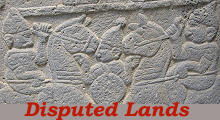 - Adana - Adana(relief at Karatepe) Today Adana is one of the largest cities of Turkey; its growth and wealth is in part due to the entrepreneurial skills of Haci Homer Sabanci; he started his career in 1921 as a cotton picker, but with his savings he managed to become a broker for cotton harvesters and eventually a cotton trader. He then entered cotton manufacturing and he extended his interests to other sectors including banking. The holding controlling all these activities is based in Adana where it has established a major charity institution.
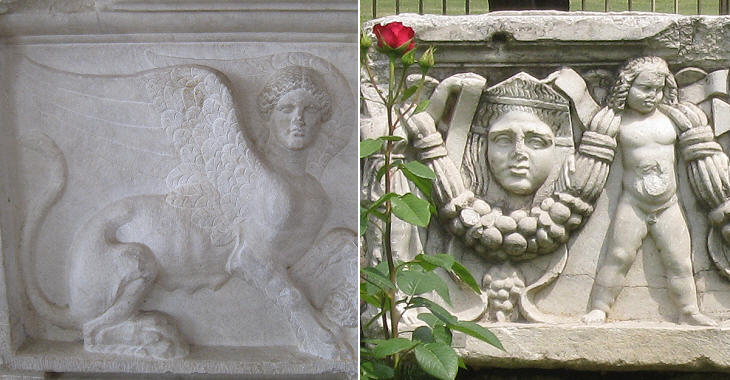
Adana has limited memories of its ancient past, but its museum has many interesting exhibits of the Hellenistic/Roman periods which were found in the whole region. For a time it was called Antiochia ad Sarus to distinguish it from Antiochia ad Orontes.
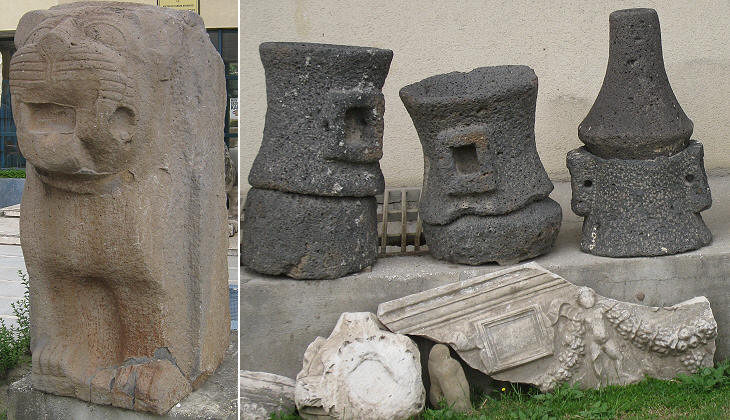
Hattusa was the capital of the Hittites and it retains several interesting monuments of their civilization. However there are very interesting Hittite reliefs at Ivriz in the Taurus Mountains and at Karatepe in Cilicia. They used to place guarding lions at the sides of their gates. Today Cukurova (Cilicia) is a very rich farming district, owing to a major system of dams and canals. The region knew another period of great agricultural development during the Roman rule; Roman engineers were very good at controlling the flow of rivers and the many grinding stones found near Adana testify that the region was a granary for the whole empire (these types of grinding stones can be seen also at Ostia).
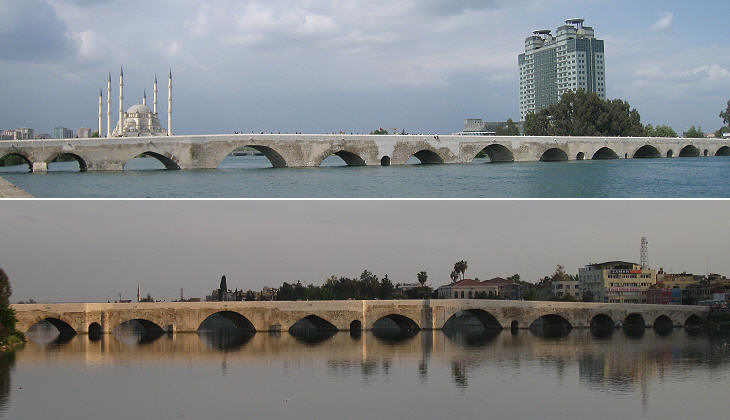
In August 117 AD Emperor Trajan died at Selinus, near Alanya, which was part of the Roman province of Cilicia. He had brought the Roman Empire to its maximum expansion by adding the new province of Mesopotamia. Emperor Hadrian, his successor chose to devote himself to consolidating the Empire, rather than to expanding it further; he promoted the construction of many facilities, including a very long bridge over the Sarus (although there is not absolute certainty about the year of construction). The bridge was restored by the Byzantines and by the Arabs; it is now reserved to pedestrians (and motorcyclists), but until a few years ago it was used also by cars and trucks.
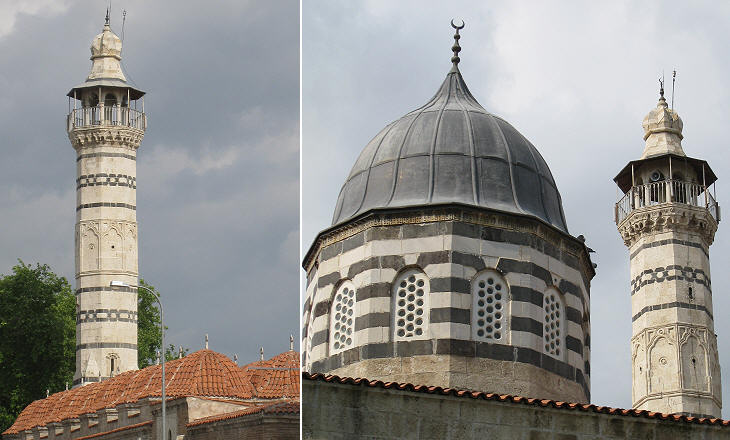
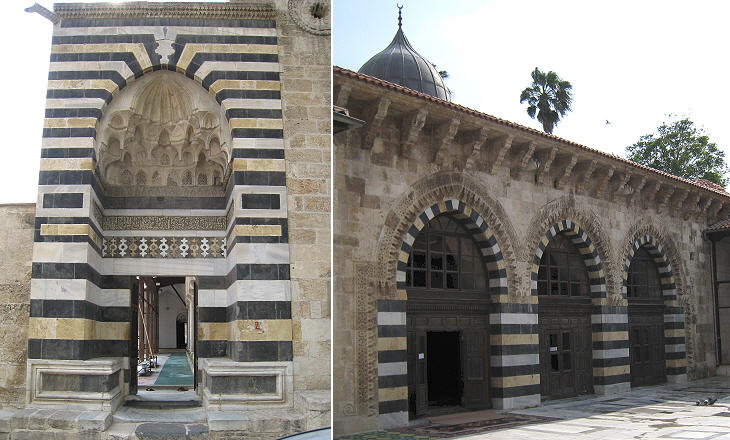
In the early XVIth century Adana and most of Cilicia were ruled by the Ramazanoglu; they were of Turkish descent, but they acknowledged the sovereignty of the Mamelukes who controlled Egypt and Syria. The construction of Ulu Camii (great mosque) was started in 1513 and it was completed in 1541, when the region was part of the Ottoman Empire; the Ramazanoglu managed to retain their influence also with their new masters.
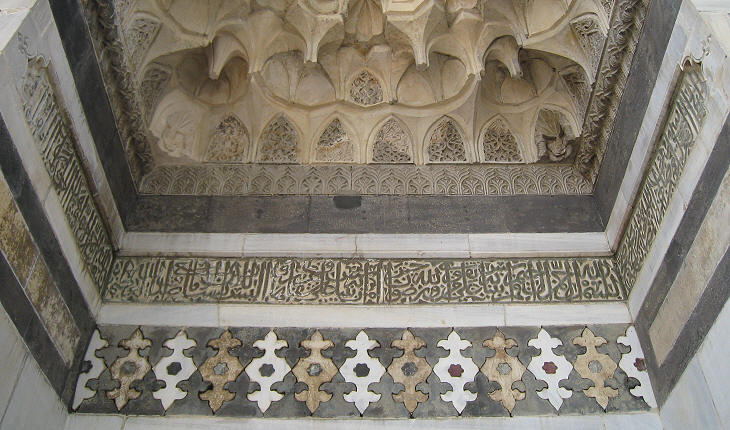
The style of Ulu Camii shows the influence of Syrian and Egyptian buildings; the decoration is based on the strong contrast between white and black stones; the Ottomans too used to adopt this type of decoration, but the contrast was between white (stone) and red (bricks).
The Ottomans did not promote the development of Adana; it was only in the 1830s during the occupation by Ibrahim Pacha, son of Muhammad Ali, the very autonomous governor of Egypt, that the introduction of cotton growing laid the foundation for the agricultural and industrial development of Adana and Cilicia.
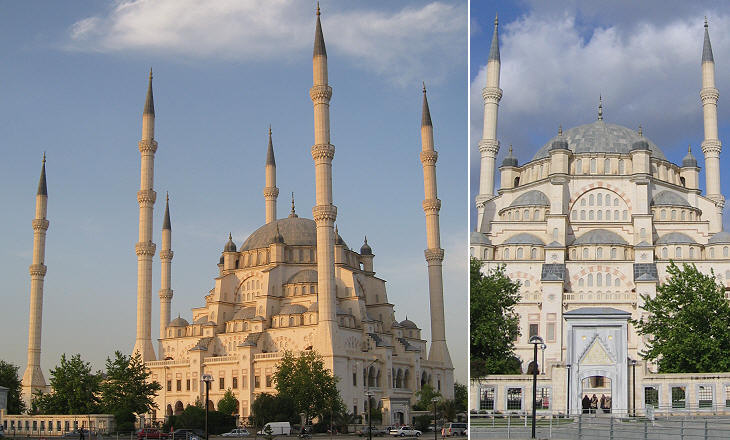
The imbalance between the wealth of modern Adana and the relevance of its monuments led the Sabanci foundation to build the largest mosque of Turkey; it is very similar to Sultan Ahmet Camii in Istanbul; its very Ottoman design was meant to give Adana a very Turkish skyline and atmosphere. The image used as background for this page shows a Hittite relief in the Museum of Adana. Move to Introductory page Tarsus Lampron Castle Sis (Kozan) Laiazzo (Yumurtalik) Karatepe Yilanli Kale Kahramanmaras Gaziantep Kilis Birecik Aleppo Cyrrhus Ain Dara Sanliurfa Harran Nemrut Dagi Harput Diyarbakir Mardin Silvan and Malabadi Koprusu Map of Turkey with all the locations covered in this website     |