  What's New! Detailed Sitemap All images © by Roberto Piperno, owner of the domain. Write to romapip@quipo.it. Text edited by Rosamie Moore. Page revised in January 2011. |
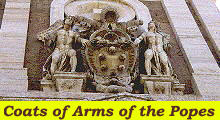 - A Clue to Rome's History and Art - A Clue to Rome's History and Art(coat of arms of Pope Pius IV at Porta Pia) For more than a thousand years the popes were not only leaders of the Catholic Church, but also monarchs of a country and for this reason their coats of arms can be found on gates, hospitals, tribunals, fountains and many other monuments which are not related to their religious role; the popes were very keen on marking with their coats of arms or their heraldic symbols everything that was built, modified or restored during their pontificate; they asked the greatest artists of their time to design new frames for their coats of arms, which in some cases are a work of art by themselves.  The Heraldic Symbols of the Popes
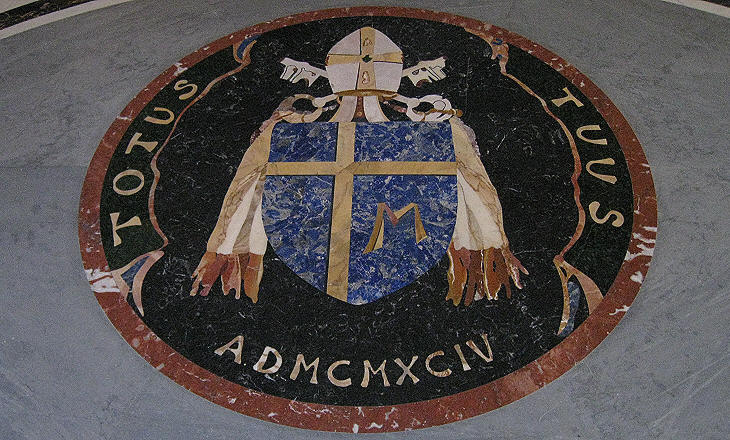
Towards the end of the XIVth century the final form of the papal coat of arms was established; the pope's family heraldic symbol was placed below:  two keys
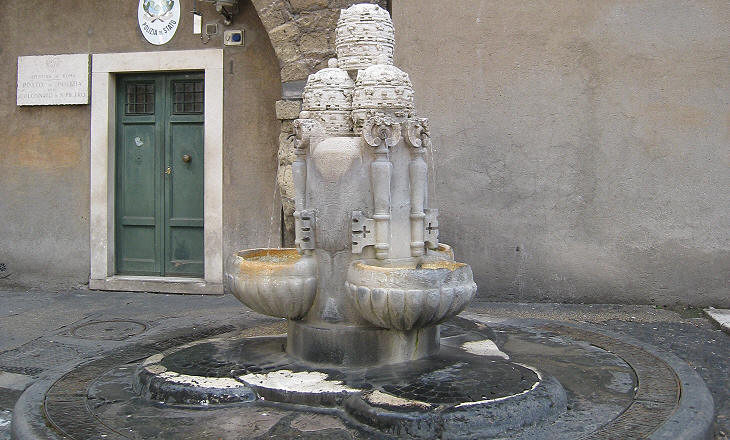
a tiara, a high diadem encircled with three crowns (aka "Triregnum", three kingdoms). two keys
a tiara, a high diadem encircled with three crowns (aka "Triregnum", three kingdoms).
"I will give unto thee the keys of the kingdom of heaven: and whatsoever thou shalt bind on earth shall be bound in heaven: and whatsoever thou shalt loose on earth shall be loosed in heaven." (Matthew 16:19 - King James Bible). This sentence led to strongly associate St. Peter with the keys; unlike the other martyrs who are portrayed holding the weapon by which they were executed (see a page on their iconography) St. Peter was portrayed holding two keys, which became a symbol of his authority to open and close, to bind and loose. The metaphor of Matthew's words was portrayed as an actual event, a sort of coronation of St. Peter by Jesus with all the Apostles attending the ceremony (see a famous painting by il Perugino - external link).
The popes regarded themselves as St. Peter's heirs and in some cases they wanted to be portrayed while receiving the symbol of their authority directly from him. Usually the keys are gold and silver, but there are cases of two gold keys; they cross each other with the handles in a lower position; in many coats of arms, especially from the Renaissance onwards, the size of the keys is enormous and they may seem cannon rather than keys; this excessive size was done on purpose to stress the power of the popes, at a time when they were often involved in wars.
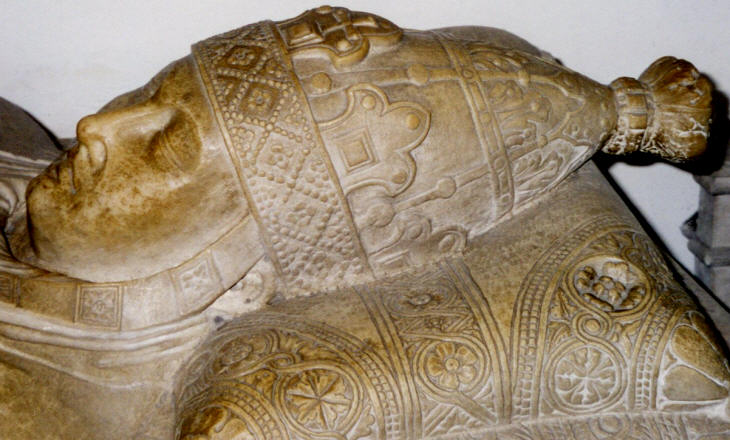
According to Donatio Constantini, a medieval fake document, Emperor Constantine donated the Empire to Pope Sylvester I; chronicles report that during the coronation in S. Giovanni in Laterano the popes wore a crown in memory of the authority they received from Constantine; the crown encircled mitra papalis, a tall conical hat which was the religious headdress; Pope Innocent III added to the titles given to the pope during the coronation ceremony that of pater regum (father of the kings) and during his pontificate a tiara (with one crown) became the official headdress of the pope (see a famous portrait of the pope at Subiaco). At the time of Pope Boniface VIII the tiara was made of a large crown which was linked by metal stripes to a smaller crown which in turn was linked to a small ring.
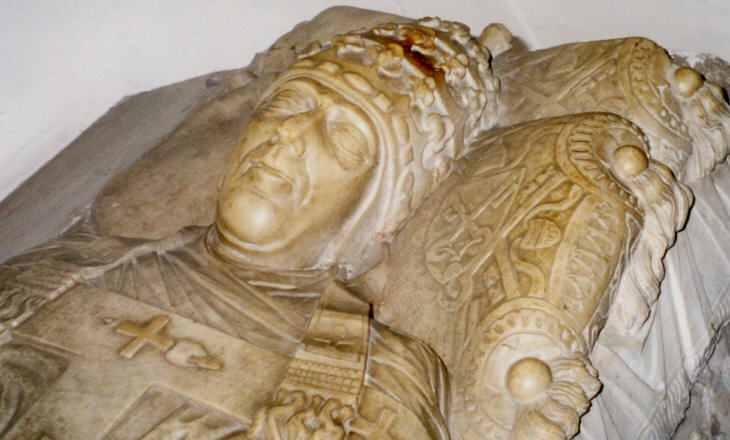
The very tall headdress of Pope Boniface VIII was difficult to wear and probably its upper section broke after the popes moved to Avignon; it was repaired by replacing the high conical top with a third crown; the tiara worn by Pope Nicholas V in his funerary monument was already very similar to the headdress of the papal coats of arms.
The tiara continued to be part of the pomp associated with all papal appearances until Pope John XXIII and Pope Paul VI limited its use; eventually it was replaced by a mitre also at the coronation ceremony; some coats of arms of Pope John Paul II were designed with a mitre rather than a tiara and the official coat of arms of Pope Benedict XVI is also with a mitre. The Papal State
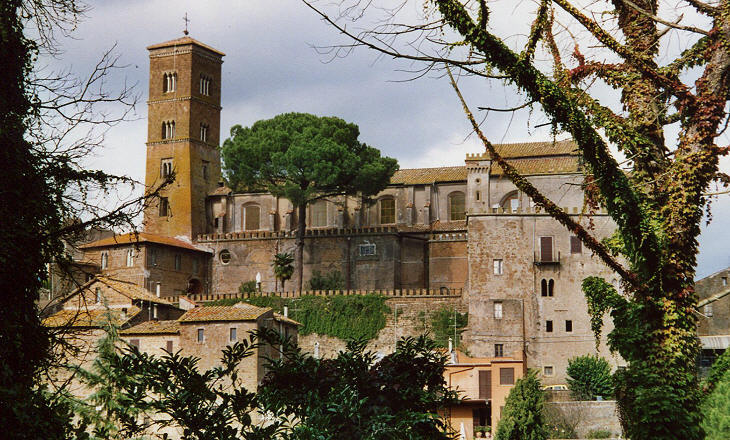
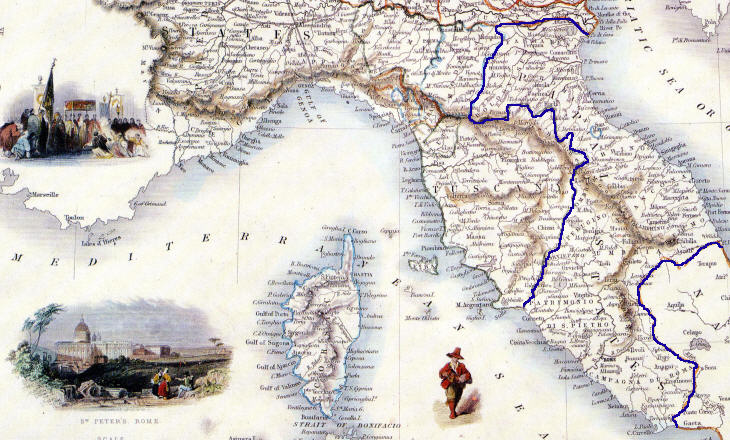
The Papal State began in 728 with the "Donation of Sutri" when Liutprand, King of the Lombards, donated the town of Sutri to Pope Gregory II. Sutri is located 40 miles north of Rome; gradually the papal possessions were enlarged and they included the region around Viterbo; they were known as "Patrimonio di S. Pietro".
In the XIIIth century Pope Innocent III expanded the direct papal rule over most of central Italy, with the exception of Tuscany. In 1598, by the acquisition of Ferrara, the border of the Papal State reached the Po River; Avignon and the Comtat Venaissin in southern France belonged to the popes until the French Revolution; Pontecorvo and Benevento in the Kingdom of Naples were papal fiefdoms until 1860. The Papal State was dissolved during the 1860-70 period and in 1870 Rome was annexed to the Kingdom of Italy. In 1929 an agreement between the Italian Government and Pope Pius XI led to the creation of Vatican City, a tiny state ruled by the pope. You may wish to look at An Abridged History of Rome for more information on the Papal State.      
|