What's New!
Detailed Sitemap
All images © by Roberto Piperno, owner of the domain. Write to romapip@quipo.it. Text edited by Rosamie Moore.
Page added in July 2011.
|

 - Shaqqa (Maximianopolis) - Shaqqa (Maximianopolis)
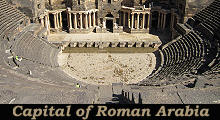
(Theatre of Bosra)
Shaqqa is a small town east of Philippopolis (Shahba) in southern Syria; because of some imposing Roman ruins it has been associated with Maximianopolis in Arabia, a town mentioned as a dioceses in a list of bishops attending the 451 Council of Chalcedon. The Maximian referred to by the name of the town is most likely Diocletian's co-emperor.
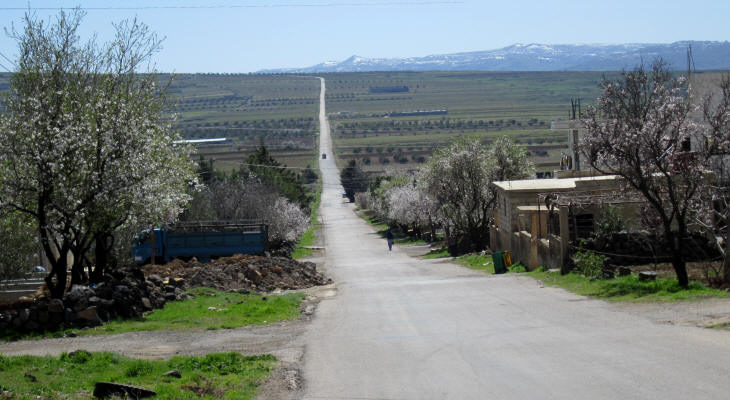
View of the countryside from ed-Deir (early March 2011); Jebel al-Druze on the horizon line
Shaqqa is located in Hauran, a region of Syria which enjoyed a period of great prosperity after being
annexed to the Roman Empire by Emperor Trajan in 106 AD.
Hauran is a low tableland which is limited to the west by the Golan Heights and to the east by Jebel al-Druze, a range of low mountains which today are named after the Druzes who migrated to this region from Lebanon and repopulated it in the XIXth century; these mountains separate Hauran from the Syro-Arabian desert, a combination of steppe and true desert which from Syria and Iraq reaches Jordan, Saudi Arabia and Yemen.
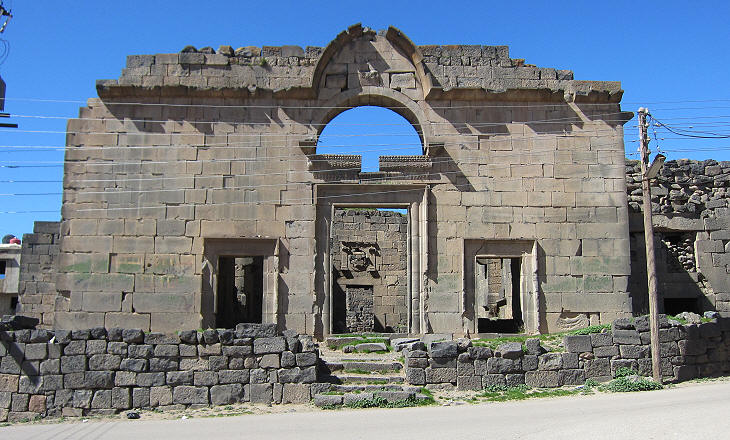
Kaisariye: façade
The locals call Kaisariye (imperial palace) the imposing ruins of a palace which perhaps was the residence of
the governor of the town; the façade is extremely well preserved and it is a rare example of this type of civilian buildings.
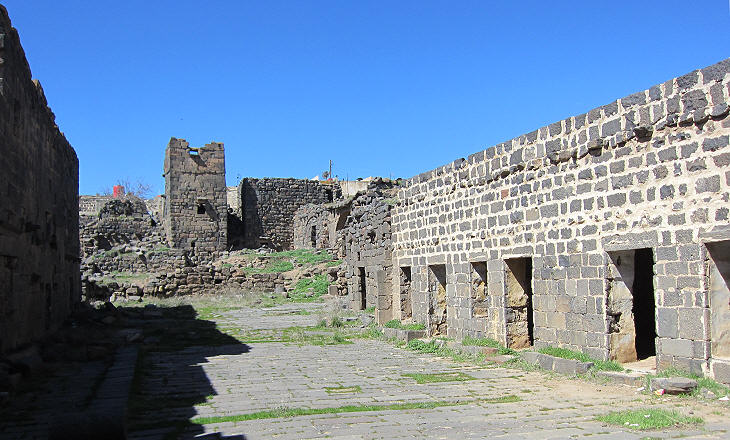
Main courtyard
The residence was built around a large central paved courtyard which was not surrounded by a portico, but gave direct access to halls and rooms.
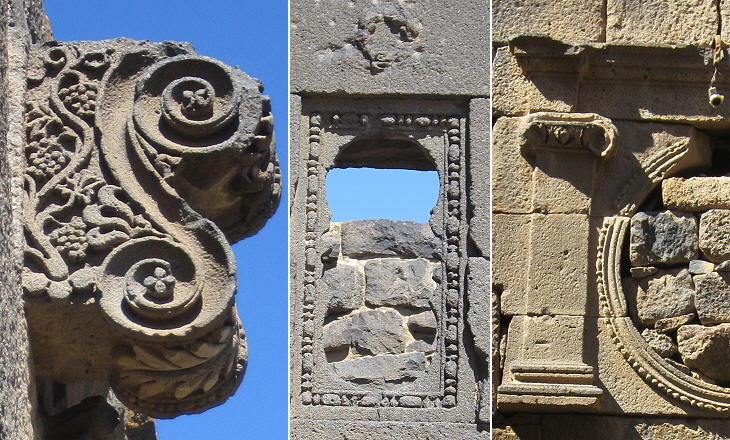
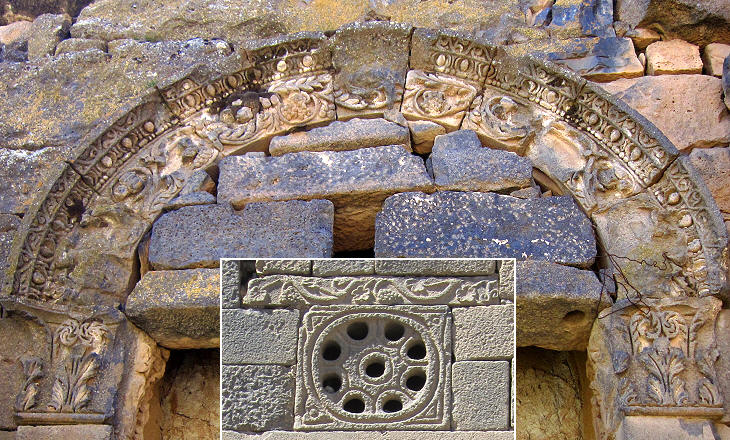
Details of the decoration of windows
An unusual aspect of Kaisariye is the relatively large number of windows opened in the external walls; traditional Roman houses did not have such windows and all rooms received light from doors and more rarely windows in the courtyard.
The shape and decoration of the windows varies; in some cases the elaborate decoration is based on grapes, a reference to the rich agriculture of the region.
Internal portal; (inset) another detail of the decoration
Kaisariye is generally thought to have been built at the middle of the IIIrd century; this timing would make its construction to coincide with the monuments of Philippopolis, which however show a very poor decoration, so maybe Kaisariye was built at a slightly earlier time when craftsmanship was at a higher level.
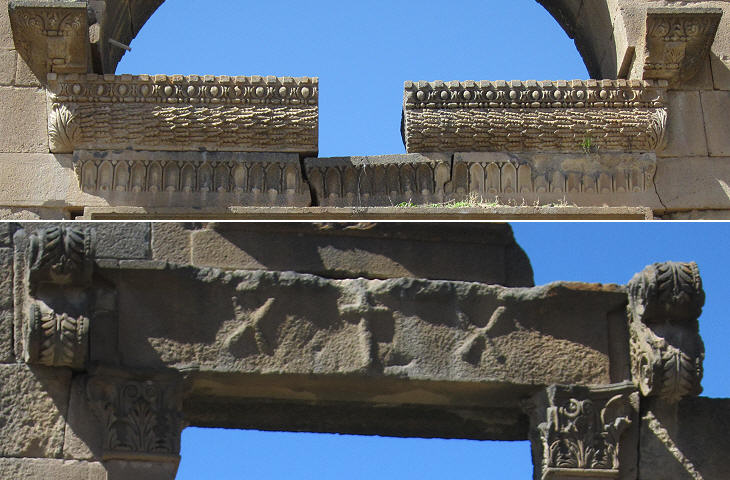
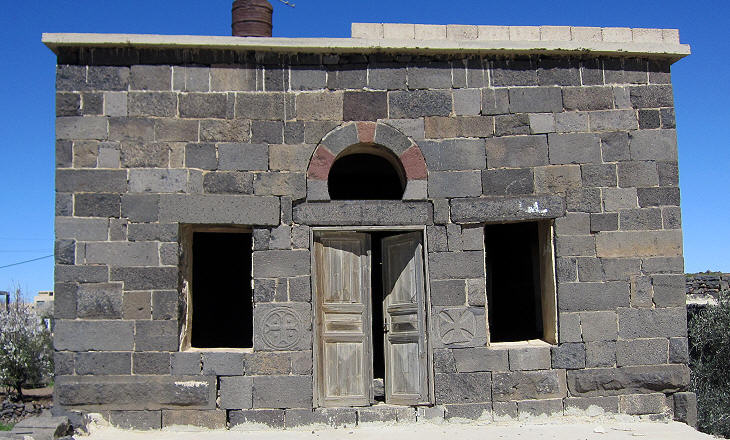
(above) Lintel of the main entrance; (below) a modified lintel with Christian symbols
The palace continued to be inhabited during the Byzantine era and a building near the palace was turned into a church; Christian references were added by erasing the previous decoration of some lintels.
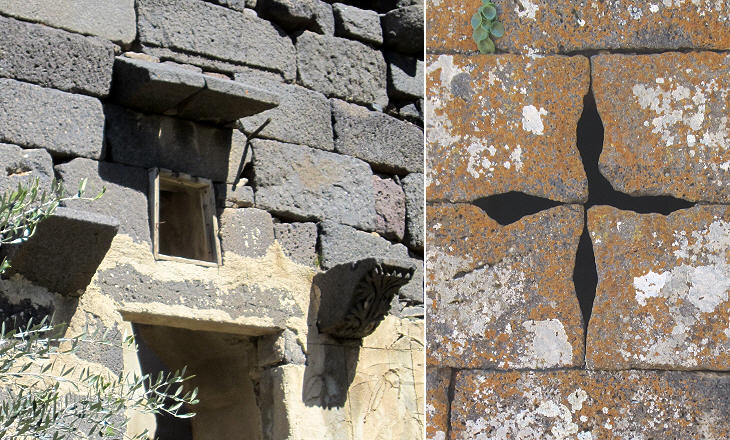
(left) Entrance of a former Roman tomb which now serves as meeting hall for the Druze community (see also the image in the background of this page); (right) a cross-shaped opening in the rear wall of the tomb
When exactly Maximianopolis was abandoned is difficult to say, although it is likely this occurred in the XIIIth century when the region was invaded
by the Mongols from the north and a few years later by the Mamelukes from the south.
In the XVIIth century Druzes from Lebanon relocated to Hauran because of rifts among clans of their community; they were followed by more Druzes in the XIXth century; the newcomers repopulated some of the Roman towns and villages and nested their homes in the ancient buildings; although today the majority of the population has modern accommodation, some ancient buildings are still utilized.
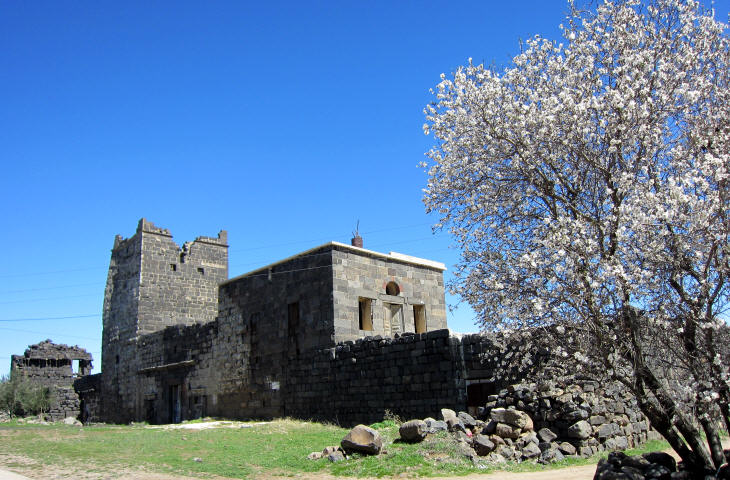
Ed-Deir, the monastery, a complex of ancient buildings
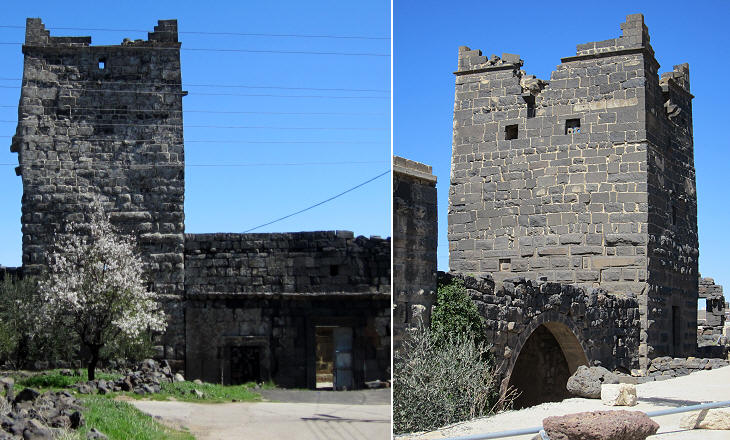
This complex of buildings is now a farm; it is located to the east of Shaqqa; it was probably a civilian building which was turned into a fortified monastery by the Byzantines when the security of the region started to decline.
Views of the tower
The massive tower allowed the early detection of Bedouin tribes approaching the town from the desert behind the mountains; at Shahba, similar to the other Roman towns of the regions, buildings have the black colour of the basalt stone which was employed in their construction.
A hall on the upper floor which housed the church of the monastery, with crosses at the sides of the entrance
Zabadani
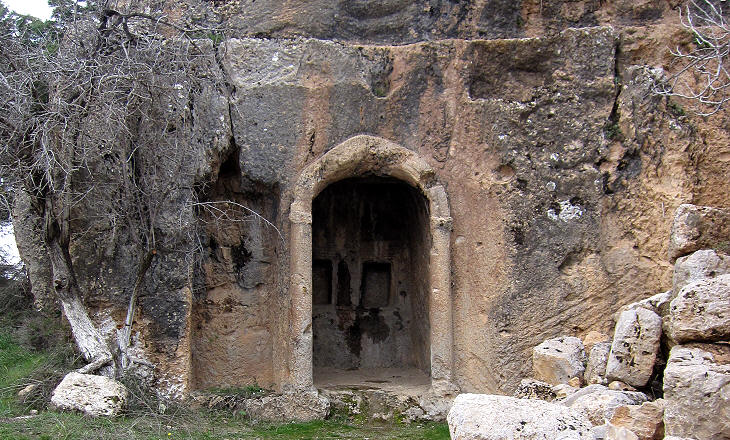
Rock cut tomb at Zabadani
The Roman presence in southern Syria, in addition to the concentration of monuments in some towns, is documented by a large number of tombs, bridges and other buildings disseminated in the whole region around Damascus and not only in Hauran.
Zabadani is a modern ski resort in the Anti-Lebanon Mountains, very near the border between Syria and Lebanon and just a few miles away from Heliopolis (or Baalbek), the most important Roman town of Lebanon.
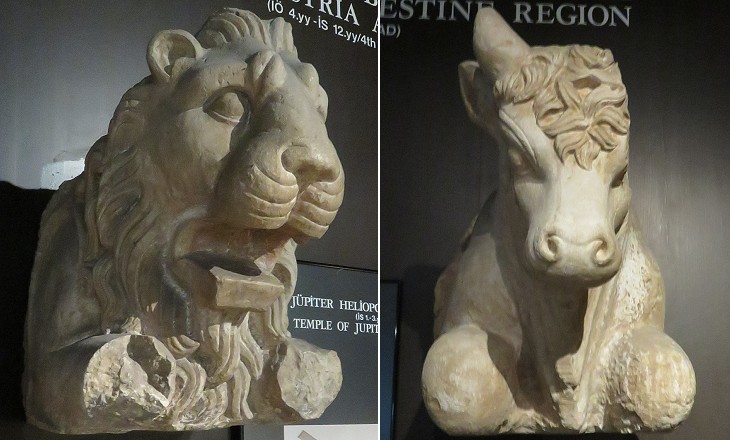
Archaeological Museum of Istanbul: heads of animals which decorated the Temple to Jupiter at Baalbek
Go to:
Philippopolis
Qanawat
Bosra
Map of Syria with all the locations covered in this website

SEE THESE OTHER EXHIBITIONS (for a full list see my detailed index).
|