  What's New! Detailed Sitemap All images © by Roberto Piperno, owner of the domain. Write to romapip@quipo.it. Text edited by Rosamie Moore. |
 Fountains in the Courtyards of Rome Fountains in the Courtyards of Rome
Pope Sixtus V in 1587 and Pope Paul V in 1612 built new aqueducts (Acqua Felice) or reactivated old Roman aqueducts (Acqua Paola). In addition to the large fountains at the Rome end of the aqueducts several other fountains were built between 1587 and 1620 to make the water easily available to the inhabitants of Rome. Most of the richest families asked the pope for a private supply of water. The conduits very often fed a little fountain in the courtyard of their palaces.
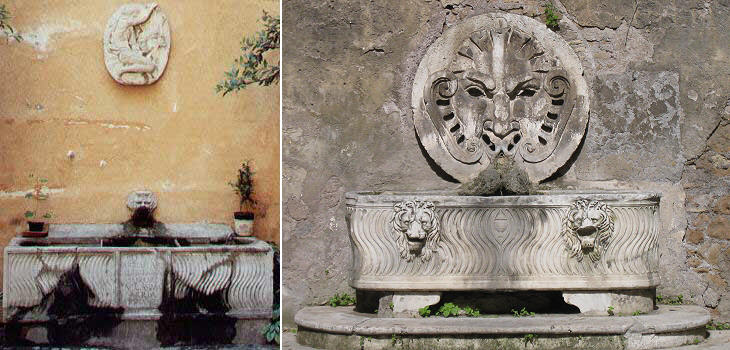
The Roman sarcophagi were found to be very useful as water containers and with the addition of a Roman relief they became the most common kind of private fountain.
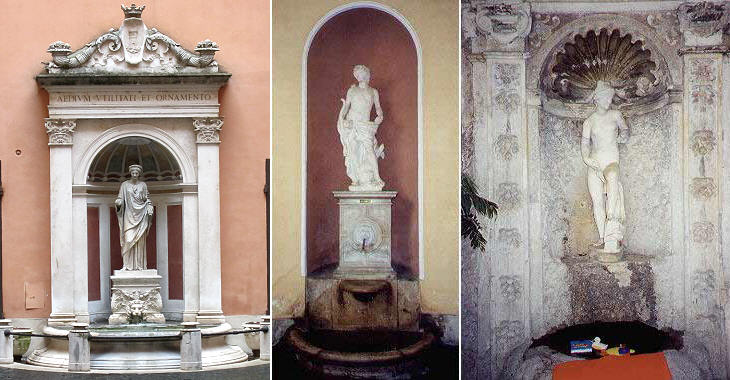
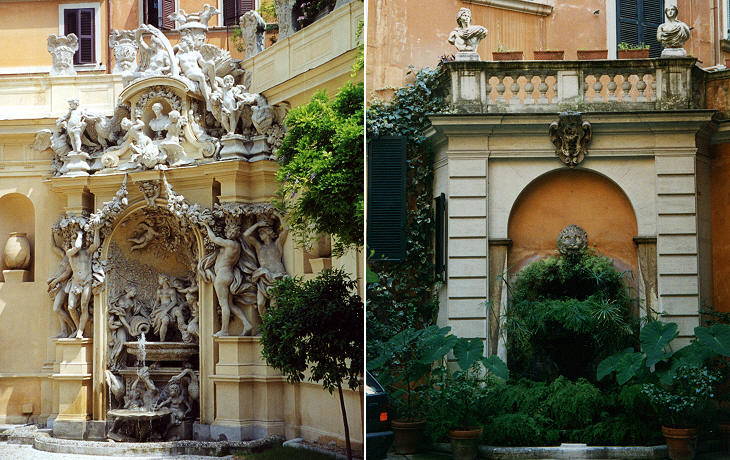
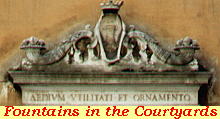
In other palaces the fountains were located in the courtyard in a way that they could be seen from the street through the main door. In these cases a statue in a niche was used to emphasize the perspective from outside. The inscription above the fountain in Palazzo Ferrajoli is very clear about the purpose of the fountain: AEDIUM UTILITATI ET ORNAMENTO means: (built) for the usefulness and the embellishment of the house. Palazzo Sterbini is a Renaissance palace opposite to Banco di S. Spirito. In the case of Palazzo Massimi the fountain is not visible from outside, but it is the focal point of the courtyard.
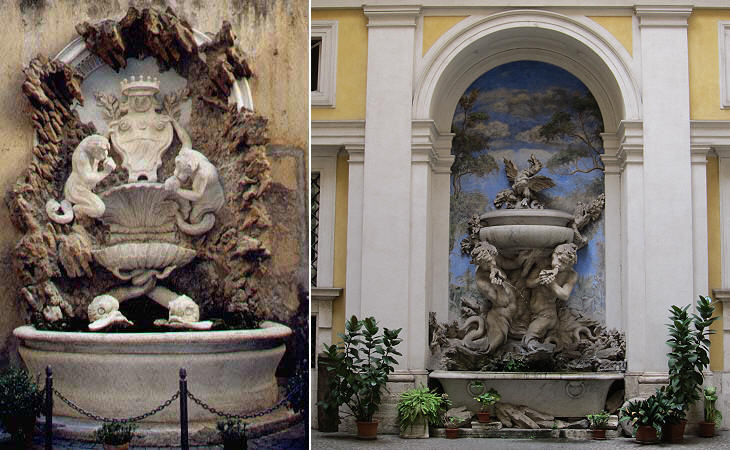
In 1667 Paolo Strada, an officer of the Papal Court, was presented by Pope Clement IX with a supply of water and he decided to celebrate the pope by dedicating to him a fountain in the courtyard of his palace. The fountain was designed by Gian Lorenzo Bernini. The two tritons held the coat of arms of the Pope, but when the palace was acquired in the XVIIIth century by the family Antamoro, the fountain was modified and the coat of arms of the pope was replaced. Palazzo Antamoro is located in Via della Panetteria, near Fontana di Trevi. A very similar fountain, although not designed by Bernini, can be seen in Palazzo del Collegio Germanico. The fountain shows a dragon, the heraldic symbol of Gregory XIII, the founder of Collegio Germanico.
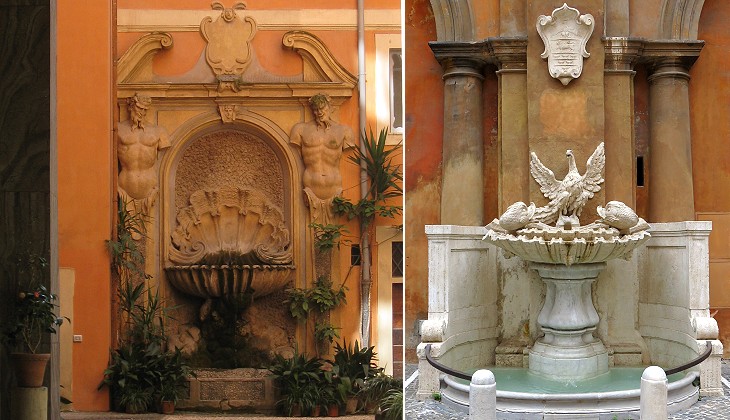
The fountains shown in the image have basins at two levels. The higher basin has the shape of a shell and most likely it was used for drinking water while the lower basin was used for filling buckets. Palazzo Falletti di Villafalletto is near S. Lorenzo a Panisperna.
Some palaces were large enough to have a little garden rather than a courtyard. The garden of Palazzo Borghese and its supply of water were so large that in 1673 Prince Giovanni Battista Borghese commissioned Carlo Rainaldi the redesign of the garden which was embellished with three large fountains (in the picture Bagno di Venere by Leonardo Retti). The little garden in Palazzo Maccarani Odescalchi, near S. Maria in Campitelli has just a small fountain with on top the family's coat of arms.
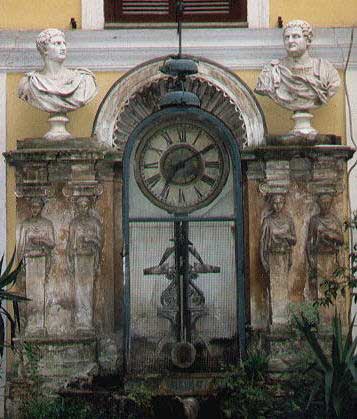
The last image of this page shows a fountain in Palazzo Berardi Muti which is located near Chiesa del Gesł. The fountain has at the center a hydrochronograph, (a clock based on the movement of water) which in 1870 replaced a statue. |